


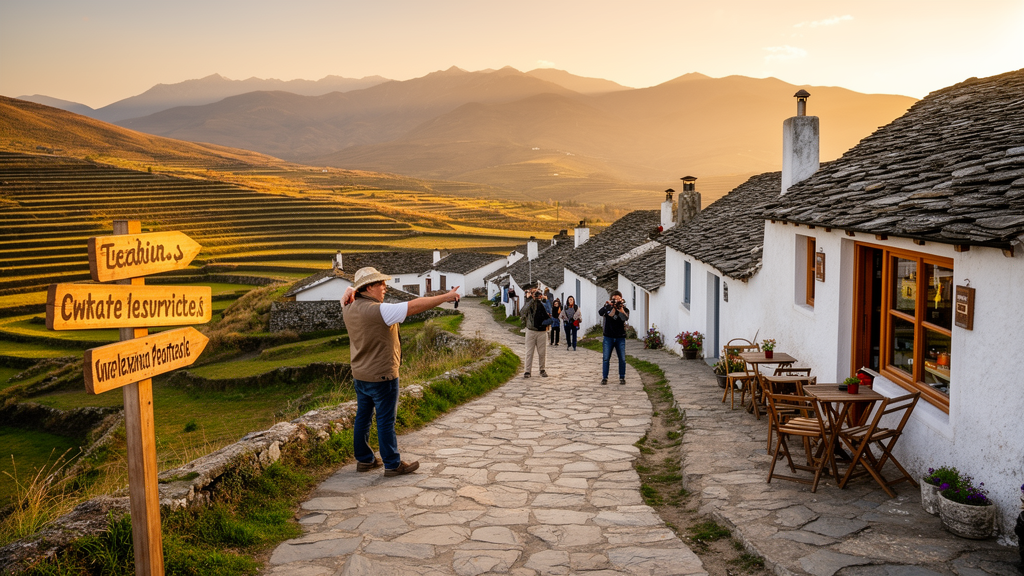
Rural communities across South Africa have long been told that tourism can rescue struggling agrarian economies, but a new study argues that nobody has clearly explained how that transformation is actually supposed to happen. A literature review published in SN Social Sciences by Penitence Ndebele of Walter Sisulu University proposes a conceptual framework that breaks rural tourism development into three distinct stages: planning, implementation, and management. The framework, built from an analysis of 31 peer-reviewed articles published between 2021 and 2025, aims to replace a fragmented research landscape with a single, coherent model that policymakers, developers, and community leaders can actually follow.
The intellectual foundation of the framework is the tourism area life cycle model developed by R. W. Butler in 1980, which tracks how destinations evolve through six stages based on visitor numbers, from exploration to rejuvenation. Butler’s model cemented the idea that tourism development is a process rather than a single event. Yet the review identifies critical limitations: the life cycle model begins only when tourists start arriving, measures progress along a single dimension, and offers no context-specific detail about what happens before or during development. Ndebele’s framework deliberately starts earlier, before any tourist has set foot in a village, and considers the different factors and role players at every stage.
The methodology followed the PRISMA framework for systematic reviews, ensuring that the search and analysis process was transparent and reproducible. An initial keyword search of the Web of Science database yielded more than 11,000 articles, which were filtered by publication year, article type, and country down to 156 candidates. After manual abstract review and the exclusion of four studies focused on urban tourism, 31 articles remained for document analysis. Each was read and summarised, then grouped according to the three stages of the development process, producing a model grounded in community-based tourism principles and stakeholder theory.
The planning stage, which the framework labels pre-development, emerges as the foundation on which everything else rests. Before development begins, destinations must undergo feasibility analysis to assess whether their natural and cultural resources can realistically attract visitors, and whether supporting infrastructure such as accommodation and basic services like water and electricity can sustain tourism over time. The reviewed literature stresses that this analysis must extend beyond the core attraction to the entire supporting ecosystem, and that seasonality must be considered so that rural economies can diversify into activities that remain viable year-round.
Community consultation during planning is not presented as a courtesy but as a determinant of success. The review cites the case of Xau! Lodge in the Kgalagadi, where initial community exclusion produced poor results, and a subsequent co-ownership agreement with the surrounding Khomani San and Mier communities gave local people a genuine seat in decision-making on their own land. Researchers also highlight that rural resources often carry cultural and spiritual significance, as with certain water bodies, and that developers must understand local beliefs and myths before repurposing these assets. Communities may harbour fears about rising crime or eroding moral values, yet studies show they are generally positive about heritage tourism when they understand their role as custodians and see government and public-private partnerships facilitating skills development.
The implementation stage is where plans meet reality, and where the framework demands collaboration among communities, government, and the private sector. Because many rural economies remain anchored in farming and fishing, the review argues that tourism should supplement rather than replace traditional livelihoods. In the coastal town of Paternoster, for example, the local fishing community can supply restaurants with seafood, embedding residents directly in the tourism value chain. The review also calls for regulations such as fishing permits and quotas to be revisited during diversification so they favour local entrepreneurship rather than hindering it. Skills shortages are rife in rural areas, and initiatives like the Airbnb Entrepreneurship Academy demonstrate how private organisations can equip locals to launch their own tourism businesses.
Infrastructure and funding dominate the implementation discussion. Poor roads and deteriorating sites make attractions unattractive to potential tourists, and constant maintenance of both basic and tourism-specific infrastructure is deemed essential for long-term community livelihoods. Formal tourism institutions play a significant role by providing funding, information, and skills development, acting as a bridge between community-based tourism businesses and the wider economy. The review warns that strategies and policies without proper implementation are futile, and that each stakeholder must play a clearly defined role to ensure mutual benefit.
The management stage addresses longevity and sustainability, and here the framework’s most striking finding emerges: communities must be involved beyond mere employment. Part ownership, participation in real decision-making, and inclusion in the value chain as suppliers translate into genuine economic power, while engagement with government and private businesses secures the skills and funding needed for long-term survival. The review points to co-management programmes elsewhere in southern Africa, such as Zimbabwe’s CAMPFIRE, Zambia’s ADMADE, and Namibia’s Communal Conservancy Program, as models for shared governance. It also cautions that long-term leases with private stakeholders can delay community benefits for years, as private entities recoup their investments before transferring ownership, making transparency in agreements paramount.
Environmental sustainability threads through the entire framework. Research from Limpopo province documents damage caused by debarking and burning trees for fuel, tourist waste dumping, and vandalism at heritage sites such as the Big Tree, where visitors continue to scribble on the ancient specimen despite warnings. The review recommends regulatory compliance, registration of establishments with relevant authorities, and educational materials for tourists, alongside community-led conservation using traditional methods reinforced by expert knowledge. Uneven distribution of tourism benefits is flagged as a source of social tension, misaligned with stakeholder theory’s insistence that development should serve all parties fairly.
Perhaps the framework’s most distinctive feature is its integration of feedback loops, which carry lessons, performance outcomes, and stakeholder experiences from the implementation and management stages back into planning. This reframes rural tourism development as a dynamic, adaptive system rather than a linear checklist, allowing strategies to shift in real time as environmental, social, governance, and economic conditions change. The review acknowledges its own limitations, including the absence of empirical data to test the model and its focus on the development process rather than administrative background work such as policy formulation. Still, its central message is unambiguous: communities are the custodians of the natural and cultural resources on which rural tourism depends, and when they are sidelined from decision-making, underfunded, and denied tangible benefits, the entire enterprise risks failure. Treating development as a flowing, feedback-driven process, the study concludes, offers the best chance of building rural tourism initiatives that endure.
Subject of Research: A conceptual framework for the rural tourism development process in South Africa based on a systematic literature review
Article Title: Towards a conceptual framework for the rural tourism development process in South Africa: a literature review
Article References: Ndebele, P. (2026). Towards a conceptual framework for the rural tourism development process in South Africa: a literature review. SN Social Sciences, 6(9), Article 396. https://doi.org/10.1007/s43545-026-01656-6
Image Credits: AI Generated
DOI: 10.1007/s43545-026-01656-6
Keywords: rural tourism, South Africa, community-based tourism, stakeholder theory, tourism area life cycle, planning, implementation, management, PRISMA, sustainable development, community participation, tourism policy
Cite Scienmag News
Courtney Benton. (October 19, 2026). New Framework Maps How Rural Tourism Should Grow, Stage by Stage. Scienmag. https://scienmag.com/new-framework-maps-how-rural-tourism-should-grow-stage-by-stage/
Courtney Benton. "New Framework Maps How Rural Tourism Should Grow, Stage by Stage." Scienmag, 19 October 2026, https://scienmag.com/new-framework-maps-how-rural-tourism-should-grow-stage-by-stage/. Accessed 19 October 2026.
Courtney Benton. "New Framework Maps How Rural Tourism Should Grow, Stage by Stage." Scienmag. October 19, 2026. https://scienmag.com/new-framework-maps-how-rural-tourism-should-grow-stage-by-stage/


