


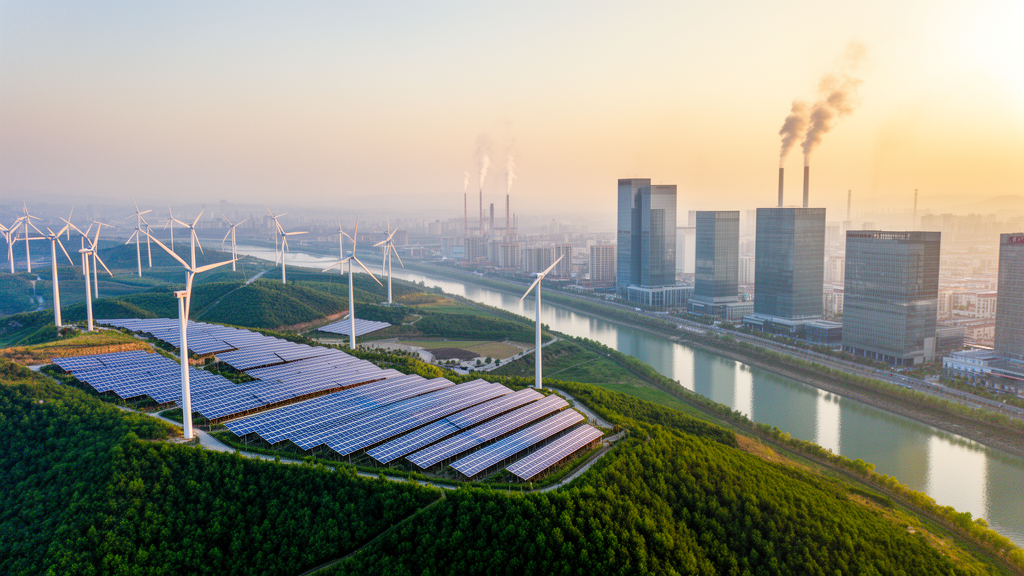
China’s pursuit of sustainable development has become one of the defining policy experiments of the decade: can the world’s largest emitter reconcile rapid economic expansion with meaningful environmental protection? A new study published in Humanities and Social Sciences Communications by Kashif Javed and Jianxin Li of Zhengzhou University’s School of Law offers a quantitatively rigorous answer, examining how artificial intelligence adoption and environmental regulation jointly drive green growth across 30 Chinese provinces from 2011 to 2020. The findings arrive at a moment when AI investment is surging globally, and they suggest that the technology’s environmental payoff is neither automatic nor evenly distributed.
The research team constructed a composite green growth index using the entropy method, a weighting technique that assigns importance to indicators based on the variability of the data rather than subjective judgment. Green growth, in this framework, captures economic development that decouples output from resource depletion and pollution. The index was built for each province-year combination, allowing the researchers to track how the distribution of green growth performance shifted across China’s regional landscape over the decade.
To estimate the effects of AI and environmental regulation, the study employed the Method of Moments Quantile Regression, or MMQR, a panel econometric technique that estimates relationships at different points in the conditional distribution of the outcome variable. This matters because green growth in China is highly heterogeneous: some provinces lead with sophisticated digital economies and strict enforcement, while others lag. Ordinary mean-based regressions would average these differences away. MMQR instead reveals whether AI’s effect differs for provinces at the bottom, middle, and top of the green growth distribution.
The results are striking. AI adoption raises green growth at the lower, middle, and upper quantiles, and the effect grows stronger as one moves up the distribution. Environmental regulation also promotes green growth across all quantiles, but its effect is small and declines slightly at higher quantiles. Fiscal policy, human capital, and urbanization all contribute positively as well. Linear panel estimates confirmed these findings, suggesting the results are robust to alternative econometric specifications.
Perhaps the most consequential finding concerns adoption thresholds. The AI effect on green growth is positive in provinces with high AI adoption but negative in provinces with low adoption. This asymmetry suggests that AI’s environmental benefits depend on a critical mass of deployment: in provinces where the technology has not yet reached sufficient scale, its effect on green growth may actually be counterproductive, perhaps because early-stage AI infrastructure consumes energy and resources without yet delivering efficiency gains that offset those costs.
The researchers complemented their regression analysis with a panel quantile Granger causality test, which examines whether changes in one variable predict changes in another across the distribution. The test indicated that all five variables—AI, environmental regulation, fiscal policy, human capital, and urbanization—Granger-cause green growth across most quantiles. This bidirectional predictive structure reinforces the conclusion that these factors are not merely correlated with green growth but actively shape its trajectory.
The study’s implications for policy are direct. Combining AI adoption with environmental regulation appears to be the most effective strategy for promoting green growth, but the adoption-threshold finding suggests that targeted support for low-adoption provinces is essential. Without such support, the digital divide in AI deployment could translate into a widening green growth gap across China’s regions, undermining national sustainability goals.
The research was supported by a major project of the National Social Science Fund focused on constructing a big data sovereignty security guarantee system. The authors declare no competing interests, and the study involved no human participants or animals, so no ethical approval was required. The article is published open access under a Creative Commons license, and the data and code are available as supplementary materials, enabling replication and extension by other researchers.
As China continues to invest heavily in AI infrastructure and tighten environmental enforcement, this study provides a quantitative foundation for understanding how these forces interact. The message is clear: AI can be a powerful engine for green growth, but only when it reaches sufficient scale, and only when paired with effective environmental regulation. For policymakers worldwide watching China’s experiment, the lesson is that technology alone is not enough—adoption thresholds, regional disparities, and regulatory frameworks all determine whether the digital revolution delivers environmental dividends or deepens existing divides.
The methodological choices in this study reflect a broader shift in environmental economics toward distributional analysis. Traditional panel techniques such as fixed effects or system GMM estimate average effects across all observations, which can obscure meaningful variation in how policy-relevant variables behave at different points of an outcome distribution. By applying the Method of Moments Quantile Regression, the authors were able to distinguish between provinces that are struggling to establish green growth trajectories and those that have already achieved them, an important distinction because the levers that help laggards may differ substantially from those that accelerate leaders.
The entropy weighting approach used to build the composite green growth index deserves particular attention. Unlike subjective weighting schemes, where researchers assign importance to indicators based on judgment, the entropy method derives weights from the information content of the data itself. Indicators that vary widely across provinces and years receive greater weight, while those that are relatively uniform contribute less. This reduces one source of researcher discretion, though the choice of which indicators to include in the index remains a substantive decision that shapes the resulting measure.
The decade covered by the analysis, 2011 to 2020, spans a formative period in China’s environmental governance. During these years, the central government introduced increasingly stringent pollution controls, expanded its emissions trading pilots, and elevated ecological considerations within official evaluations of local officials. At the same time, AI investment accelerated dramatically, with provinces competing to attract data centers, research institutes, and technology firms. The panel structure of the study captures the interplay of these two trends, offering a window into a period when digital and environmental policy agendas began to converge.
The finding that environmental regulation’s effect is small and slightly declining at higher quantiles invites careful interpretation. One possibility is that provinces already performing well on green growth face diminishing returns from additional regulatory stringency, having exhausted the easier gains from pollution control. Another is that regulation operates primarily by pushing laggards toward compliance, a mechanism that matters less where firms have already internalized environmental performance. Either interpretation underscores that regulation and technology are complements rather than substitutes: regulation sets the floor, while AI adoption extends the ceiling.
The negative AI effect in low-adoption provinces aligns with a growing body of literature on the energy costs of digital infrastructure. Training large models, operating data centers, and manufacturing the hardware that underpins AI all carry substantial resource footprints. In provinces where AI deployment remains sparse, these costs may not yet be offset by the efficiency improvements that mature adoption can deliver, such as optimized energy grids, smarter logistics, and precision agriculture. The threshold dynamic suggests that the environmental payoff of AI follows a J-curve, with initial investments temporarily worsening green growth before benefits materialize.
Human capital’s positive contribution across quantiles is consistent with the mechanism through which AI translates into environmental gains. Skilled workers are needed not only to develop AI systems but to integrate them into industrial processes, energy management, and environmental monitoring. Provinces with stronger educational endowments can absorb and deploy new technologies more effectively, which may partly explain why the AI effect differs so sharply between high- and low-adoption regions. Fiscal policy’s positive role similarly reflects the capacity of provincial governments to fund the infrastructure and incentives that support both technological diffusion and environmental compliance.
Urbanization’s positive effect on green growth may seem counterintuitive given the environmental pressures associated with urban expansion, but dense cities can deliver economies of scale in public transport, waste management, and energy distribution that reduce per-capita footprints. The result suggests that, in the Chinese context during this period, the agglomeration benefits of urban concentration outweighed the pollution burdens it generated, at least as reflected in the composite green growth measure.
The panel quantile Granger causality results add a temporal dimension that pure regression estimates cannot provide. Establishing that AI, regulation, fiscal policy, human capital, and urbanization each predict future green growth across most quantiles strengthens the case that these relationships are not artifacts of simultaneous correlation. For policymakers, this predictive structure implies that interventions in any of these five domains can plausibly shift green growth trajectories, though the magnitude and distribution of those shifts will vary across the provincial landscape.
Several caveats merit consideration when generalizing these findings. The study period ends in 2020, before the most recent wave of generative AI development, which has dramatically expanded the energy demands associated with computing. Whether the adoption-threshold pattern documented here persists as AI applications proliferate remains an open empirical question. Additionally, provincial-level analysis masks variation within provinces, and the composite index, however carefully constructed, necessarily simplifies the multidimensional character of green growth. Replication with alternative indicator sets or finer geographic units would help establish the robustness of the threshold finding.
For other large economies confronting similar tensions between digital ambition and environmental responsibility, the Chinese experience offers a template for empirical evaluation. The combination of distributional econometrics, composite sustainability indices, and causality testing provides a framework that can be adapted to other federal systems where regional heterogeneity is pronounced. The central lesson—that technology policy and environmental policy must be designed jointly, with attention to where adoption capacity is weakest—is likely to travel well beyond China’s borders as governments worldwide grapple with the dual challenge of digital transformation and decarbonization.
Subject of Research: The effects of artificial intelligence and environmental pollution on green growth in China
Article Title: The effects of artificial intelligence and environmental pollution on green growth in China
Article References: Javed, K., & Li, J. (2026). The effects of artificial intelligence and environmental pollution on green growth in China. Humanities and Social Sciences Communications. https://doi.org/10.1057/s41599-026-09352-9
Image Credits: AI Generated
DOI: 10.1057/s41599-026-09352-9
Keywords: effects, artificial, intelligence, environmental, pollution, green, growth, China, scientific research
Cite Scienmag News
Courtney Benton. (October 19, 2026). AI and pollution regulation shape green growth across China’s provinces. Scienmag. https://scienmag.com/ai-and-pollution-regulation-shape-green-growth-across-chinas-provinces/
Courtney Benton. "AI and pollution regulation shape green growth across China’s provinces." Scienmag, 19 October 2026, https://scienmag.com/ai-and-pollution-regulation-shape-green-growth-across-chinas-provinces/. Accessed 19 October 2026.
Courtney Benton. "AI and pollution regulation shape green growth across China’s provinces." Scienmag. October 19, 2026. https://scienmag.com/ai-and-pollution-regulation-shape-green-growth-across-chinas-provinces/


