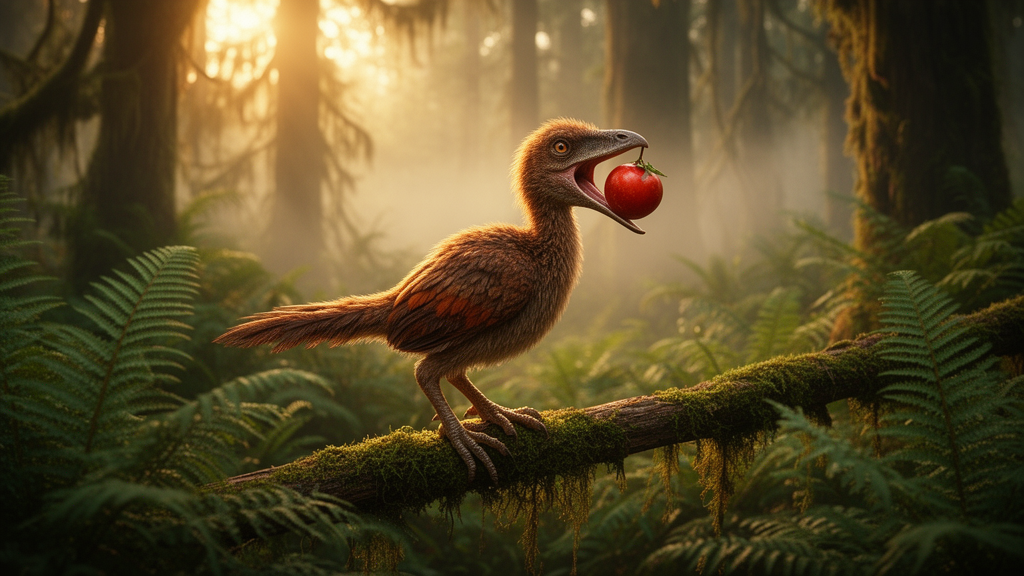
Paleontologists have identified a new species of small oviraptorosaur dinosaur that appears to be the first known dinosaur specialized for eating fruit. The species, named Infernogallus jamesi, is described in a study published in Nature Communications by researchers from Stony Brook University, the Royal Ontario Museum, and the North Dakota Geological Survey. Detailed analysis of its chewing muscles shows a unique arrangement otherwise seen only in fruit-eating parrots today, suggesting the animal was adapted for mashing soft food such as fruit.
The fossils, which include a nearly complete, articulated skull and a partial skeleton now on display at the Royal Ontario Museum, were recovered from the Hell Creek Formation, which stretches across Montana, North Dakota, South Dakota, and Wyoming. The name Infernogallus, meaning “hell chicken,” references this locality, where the animal would have lived alongside T. rex and Triceratops roughly at the end of the Cretaceous period.
Infernogallus belonged to the caenagnathids, a group of toothless, feathered dinosaurs. It was about the size of a turkey and would have weighed roughly 12 kilograms (25 pounds), making it one of the smallest members of its group even as a fully grown adult. Curiously, the researchers note, caenagnathids evolved from the meat-eating side of the dinosaur family tree, making the shift toward fruit processing especially unexpected.
The key evidence comes from the animal’s palatal bones, the parts of the skull that form the roof of the mouth. Using CT scans to reconstruct the skull, the team found that these bones arched downward into the mouth, which oriented certain chewing muscles front-to-back rather than up and down. This configuration would have enabled a chewing motion in which the beak slid back and forth, similar to chewing in humans, instead of the rigid vertical bite seen in T. rex and many other dinosaurs.
Such forward-facing chewing muscles are rare in the animal kingdom. They occur in mammals like humans that exhibit complex chewing, and in some birds that specialize in eating fruit, such as the Vulturine Parrot (Psittrichas). The researchers concluded that this unusual muscle organization likely evolved for the same reason in Infernogallus: processing soft foods, such as fruit, in the mouth rather than the gut.
Detailed analysis of the animal’s chewing mechanics indicates that its skull was specialized for mashing stone fruits to remove the flesh from the central seed. This finding came as a surprise because paleontologists had previously struggled to demonstrate any clear link between dinosaur diversity and the evolution of flowering plants. The study instead points to parallels between the evolutionary radiations of caenagnathids and of fruit, with caenagnathids developing their specialized chewing capabilities as fruits became larger and more common during the Cretaceous.
The discovery may also carry broader ecological implications. Because specialized fruit-eating is rare among animals, the identification of a fruit-processing dinosaur suggests that dinosaurs may have played an unrecognized role in the evolution of flowering plants as seed-dispersers, a function filled today by birds, reptiles, and small mammals. During the Cretaceous, flowering plants replaced cone-bearing plants as the dominant land vegetation, a transition recorded in the fossil record, which includes fossilized fruits.
Complete remains of small dinosaurs like Infernogallus are very rare in the fossil record, which has long obscured what the skulls of these animals looked like. According to the researchers, the strange skull reveals surprising insights into dinosaur evolution and feeding specialization, and shows that much remains to be learned about the world of T. rex and about dinosaurs more generally.
The authors also suggest that recognizing this species as occupying a new ecological role indicates that the full diversity of dinosaur species and behaviors at the end of the Cretaceous may not yet be appreciated. They note that the finding adds to the ongoing scientific debate about whether dinosaurs were already in decline before their extinction.
Lead author Dr. Gregory Funston, Assistant Professor in the Department of Anatomical Sciences at Stony Brook University, said the team never expected to discover fruit-eating dinosaurs, noting that for more than a hundred years the skulls of these animals were unknown and that they turned out to be stranger than predicted. Co-author Dr. Thomas Dudgeon, Rebanks Postdoctoral Research Fellow at the Royal Ontario Museum, observed that it is rare for animals to become specialized for a fruit diet and that when it happens it comes with remarkable adaptations, describing the anatomy of Infernogallus as bizarre among dinosaurs. Senior author Dr. David Evans, Chief Curator of Natural History at the Royal Ontario Museum, emphasized that the strange skull is an exciting find because complete remains of small dinosaurs are so rare.
Subject of Research: Feeding adaptations and fruit-eating specialization in a new Late Cretaceous oviraptorosaur dinosaur
Article Title: Rare fossil discovery reveals new dinosaur species that were specialized fruit-eaters
Article References: Rare fossil discovery reveals new dinosaur species that were specialized fruit-eaters. Original publication (Bibliographic details unavailable.)
Image Credits: AI Generated
DOI: Not provided
Keywords: dinosaurs, oviraptorosaur, Infernogallus, Hell Creek Formation, fruit-eating, Cretaceous, paleontology, chewing mechanics, caenagnathids, flowering plants, Royal Ontario Museum, Nature Communications
Cite Scienmag News
Gavin Prescott. (October 27, 2026). New dinosaur species Infernogallus jamesi identified as first known fruit-eater. Scienmag. https://scienmag.com/new-dinosaur-species-infernogallus-jamesi-identified-as-first-known-fruit-eater/
Gavin Prescott. "New dinosaur species Infernogallus jamesi identified as first known fruit-eater." Scienmag, 27 October 2026, https://scienmag.com/new-dinosaur-species-infernogallus-jamesi-identified-as-first-known-fruit-eater/. Accessed 28 October 2026.
Gavin Prescott. "New dinosaur species Infernogallus jamesi identified as first known fruit-eater." Scienmag. October 27, 2026. https://scienmag.com/new-dinosaur-species-infernogallus-jamesi-identified-as-first-known-fruit-eater/