


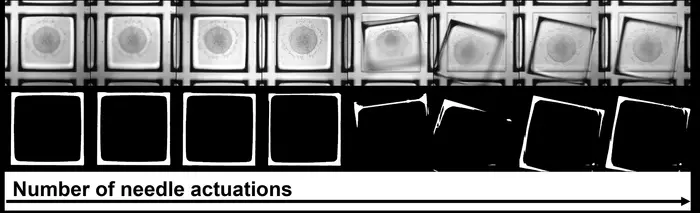
In the realm of developmental biology, understanding human embryogenesis has always posed significant challenges due to ethical restrictions and technical limitations. However, a groundbreaking advancement from scientists at the University of Washington and the Brotman Baty Institute for Precision Medicine is set to revolutionize this field. Their work, recently published in APL Bioengineering, unveils a novel automated sorting system designed specifically for two-dimensional “gastruloids”—miniature, lab-grown models that faithfully replicate the critical third week of human embryonic development when the three foundational germ layers emerge.
Gastruloids are engineered from human pluripotent stem cells carefully cultured into circular microcolonies on specialized substrates. By adding small signaling molecules, these colonies undergo cellular differentiation mimicking gastrulation, a pivotal process in which the embryo begins organizing distinct cell lineages destined to form the body’s tissues and organs. Despite their promise as ethical alternatives to studying early embryos, extensive research has been hampered by inefficient manual methods that struggle to isolate and analyze these microscopic structures individually.
The team’s innovation addresses this bottleneck with an integrated sorting platform that combines high-resolution microscopy, imaging technology, and robotic micromanipulation. Central to this system are the “microrafts” — tiny, detachable supports on which gastruloids grow. Using a custom-built stage controlled by bespoke software, the system autonomously scans vast arrays of microrafts, identifies gastruloid characteristics, and physically sorts them based on preset criteria. This mechanized precision accelerates experiments that would otherwise be tedious and prone to human error.
Ian Jan, the lead author, likens the sorting mechanism to the claw machine games popular in arcade settings but designed to delicately “grab” microrafts harboring these miniature embryos. By automating this process, researchers can now harvest virtually hundreds of consistently sized gastruloids simultaneously and subject them to individualized analyses, thereby facilitating a high-throughput approach to developmental studies unprecedented in this domain.
What makes gastruloid models particularly valuable is their capacity to reveal early developmental abnormalities that mirror human diseases. Prior studies utilizing these models have illuminated how conditions like Huntington’s disease manifest genetically during the very earliest embryonic stages, even before traditional clinical symptoms emerge. Moreover, these platforms enable scientists to explore the phenomenon of aneuploidy—where cells contain abnormal numbers of chromosomes—and to observe the embryo’s inherent mechanisms for self-correction, shedding light on the remarkable resilience of early development.
The newly developed sorting system is poised to deepen these insights by making it feasible to isolate unique gastruloids that exhibit subtle phenotypic differences. This capability is essential given that heterogeneity among gastruloids reflects the complexity of authentic human embryogenesis, where individual cells and clusters follow diverse developmental trajectories. Recognizing and probing this diversity offers the potential to untangle how various genetic and epigenetic factors influence embryonic outcomes.
From a technical perspective, the sorting apparatus integrates a high-sensitivity camera with angular precision optics, coordinated by an advanced software pipeline that employs image processing algorithms to rapidly identify target gastruloids. Once selected, microrafts are released and collected in specific chambers, enabling downstream molecular or functional assays. This efficient, non-destructive method preserves sample integrity and opens doors to subsequent live-cell imaging or genetic sequencing examinations.
Looking ahead, the research team is ambitiously working to incorporate neural networks and machine learning models into the image analysis process. This artificial intelligence integration promises to enhance sorting accuracy and recognize complex patterns that elude conventional algorithms. Ultimately, such computational augmentation will enable real-time, adaptive screening of gastruloid phenotypes across vast experimental datasets, bringing unparalleled speed and sophistication to studying human developmental biology.
The significance of this technology extends beyond fundamental research. By improving our capability to screen large gastruloid arrays, the platform holds implications for drug discovery, toxicology assessments, and personalized medicine initiatives. Pharmaceutical companies might one day use automated gastruloid sorting to investigate how candidate compounds affect early human tissue organization, substantially reducing reliance on animal models and expediting regulatory approval workflows.
This advance exemplifies the kind of interdisciplinary convergence where engineering principles meet biological complexity. The marriage of microscale robotics with stem-cell science delivers a powerful toolset to tackle long-standing challenges in embryology, empowering researchers to interrogate developmental pathways with unmatched throughput and precision. Through this lens, the intricate dance of cells during gastrulation can now be observed, manipulated, and understood in transformative new ways.
Overall, this large-scale sorting system marks a pivotal step toward decoding the mysteries of human development. By enabling extensive, automated analysis of gastruloid variations, it shines a spotlight on the intrinsic heterogeneity fundamental to growth and differentiation. As the platform continues to evolve with AI-driven enhancements, it heralds an exciting era where the earliest chapters of life can be studied systematically, ethically, and at scale, unlocking insights that may ultimately improve human health across generations.
News Publication Date: June 10, 2025
Web References: https://doi.org/10.1063/5.0269550
References: Jan, I., Cearlock, A., Yang, M., & Allbritton, N. L. (2025). Development of large-scale gastruloid array to identify aberrant developmental phenotypes. APL Bioengineering. https://doi.org/10.1063/5.0269550
Cite Scienmag News
Drew Townsend. (June 10, 2025). “New ‘Claw Machine’ Technology Enables Rapid and Efficient Sorting of Hundreds of Embryo Models”. Scienmag. https://scienmag.com/new-claw-machine-technology-enables-rapid-and-efficient-sorting-of-hundreds-of-embryo-models/
Drew Townsend. "“New ‘Claw Machine’ Technology Enables Rapid and Efficient Sorting of Hundreds of Embryo Models”." Scienmag, 10 June 2025, https://scienmag.com/new-claw-machine-technology-enables-rapid-and-efficient-sorting-of-hundreds-of-embryo-models/. Accessed 3 September 2026.
Drew Townsend. "“New ‘Claw Machine’ Technology Enables Rapid and Efficient Sorting of Hundreds of Embryo Models”." Scienmag. June 10, 2025. https://scienmag.com/new-claw-machine-technology-enables-rapid-and-efficient-sorting-of-hundreds-of-embryo-models/


