


A new study sheds light on the unexplored diversity of galeommatoidean bivalves, a little-known group of marine mollusks, from the western coast of South Africa. The research, led by Paul Valentich-Scott from the Santa Barbara Museum of Natural History, along with collaborators from the University of Cape Town, Sea Change Trust, Stellenbosch University, and the University of Colorado Boulder, offers a curious glimpse into the habitats, symbiotic relationships, and taxonomy of these interesting creatures.

Credit: Craig Foster
A new study sheds light on the unexplored diversity of galeommatoidean bivalves, a little-known group of marine mollusks, from the western coast of South Africa. The research, led by Paul Valentich-Scott from the Santa Barbara Museum of Natural History, along with collaborators from the University of Cape Town, Sea Change Trust, Stellenbosch University, and the University of Colorado Boulder, offers a curious glimpse into the habitats, symbiotic relationships, and taxonomy of these interesting creatures.
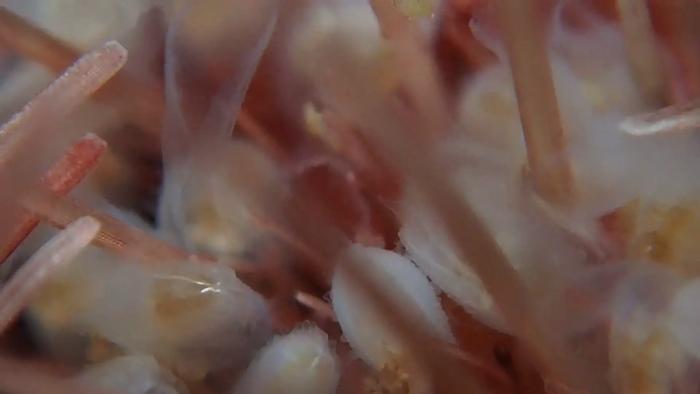
Published in the scientific journal ZooKeys, the study focuses on four species of galeommatoidean bivalves collected from the Western Cape region of South Africa. Among these is one new species, Brachiomya ducentiunus. This small clam, which is only 2 mm (less than 1/8th inch) in length, spends its life crawling between the spines of sea urchins.
The new species has so far only been found in one locality in False Bay, South Africa, where it was found attached to the burrowing sea urchin Spatagobrissus mirabilis in coarse gravel at a depth of about 3 m. It has not been observed free-living, without the host urchin.
Brachiomya ducentiunus was discovered while preparing and working on the 1001 Seaforest Species project, a research and storytelling program aimed at increasing awareness of regional kelp bed ecosystems colloquially referred to as ‘the Great African Seaforest’.
“This study marks a significant advancement in our understanding of the biodiversity and ecological interactions of galeommatoidean bivalves,” says lead author Paul Valentich-Scott. “By uncovering the hidden lives of these small but ecologically important organisms, we hope to contribute to the broader knowledge of marine biodiversity and the conservation of these unique habitats.”
Co-author Charles L. Griffiths, emeritus professor at the University of Cape Town, says, “A large proportion of smaller marine invertebrates remain undescribed in western South Africa and almost any project that samples specialized habitats turns up many new records and species.”
In a similar vein, co-author Jannes Landschoff, marine biologist at the Sea Change Trust, says “Creating foundational biodiversity knowledge is a most important step to the humbling realization of how fascinating and uniquely diverse a place is. I see this every day through our work in the rich coastal waters of Cape Town, where an extensive underwater kelp forest, the ‘Great African Seaforest,’ grows.”
Research article:
Valentich-Scott P, Griffiths C, Landschoff J, Li R, Li J (2024) Bivalves of superfamily Galeommatoidea (Mollusca, Bivalvia) from western South Africa, with observations on commensal relationships and habitats. ZooKeys 1207: 301-323.
Journal
ZooKeys
Article Title
Bivalves of superfamily Galeommatoidea (Mollusca, Bivalvia) from western South Africa, with observations on commensal relationships and habitats
Article Publication Date
22-Jul-2024
Cite Scienmag News
Drew Townsend. (July 26, 2024). New clam species discovered in South Africa’s kelp forest. Scienmag. https://scienmag.com/new-clam-species-discovered-in-south-africas-kelp-forest/
Drew Townsend. "New clam species discovered in South Africa’s kelp forest." Scienmag, 26 July 2024, https://scienmag.com/new-clam-species-discovered-in-south-africas-kelp-forest/. Accessed 3 September 2026.
Drew Townsend. "New clam species discovered in South Africa’s kelp forest." Scienmag. July 26, 2024. https://scienmag.com/new-clam-species-discovered-in-south-africas-kelp-forest/

