


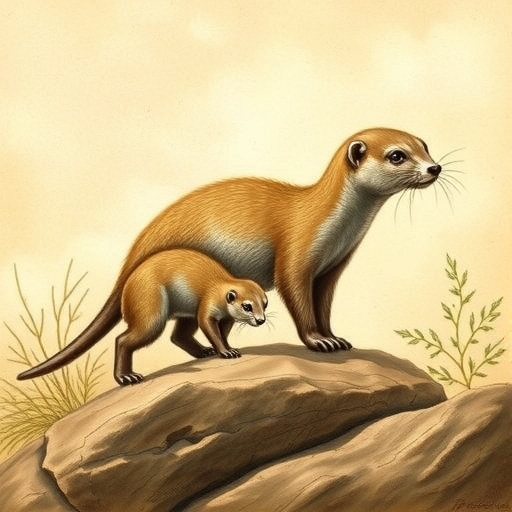
In a groundbreaking discovery that reshapes our understanding of the evolutionary timeline of weasels, researchers have uncovered the oldest known fossil belonging to the Mustelinae subfamily, pushing back the origins of these agile carnivores by nearly three million years. The team, spearheaded by scientists from the University of Washington and Complutense University of Madrid, identified a new species named Galanthis baskini from a fossil jaw fragment unearthed in Teruel, Spain, a site celebrated for its rich Miocene mammalian record.
This revelation starkly contrasts previous estimates that placed the earliest weasel fossils at around 3.5 million years ago during the Pliocene epoch, found mainly in Poland and Germany. The Spanish find, however, dates to the late Miocene, approximately 6.5 million years ago, effectively doubling the historical record and suggesting that modern weasel lineage has a deeper and more complex evolutionary past than previously thought. The implications of this pushback extend broadly across paleontology and evolutionary biology, particularly concerning the morphological and ecological adaptations of early carnivores.
Galanthis baskini was comparable in size to the least weasel (Mustela nivalis), the smallest carnivoran still existing today, weighing approximately five ounces. The fossil’s dentition provides strong evidence that this ancient creature was carnivorous, much like its modern descendants. Its slender, elongated body structure, inferred from comparative anatomy, hints at specialized hunting behaviors, possibly designed for pursuing elusive prey such as rodents in tight subterranean niches. This morphological adaptation aligns with the hypothesis that climate and environmental shifts in the mid to late Miocene, such as the rise of open grasslands and diversification of small mammals, drove unique evolutionary paths in mustelines.
Methodologically, the researchers utilized an impressive array of techniques to analyze the fossil remains. Classical comparative anatomy was combined with cutting-edge micro-computed tomography (micro-CT), allowing for three-dimensional reconstructions of the teeth and jaw internal structures. This non-destructive imaging technology revealed anatomical features invisible to the naked eye, providing nuanced insights into the species’ phylogeny and functional morphology. By leveraging micro-CT, the team accomplished a detailed visualization that firmly established Galanthis baskini within the Mustelinae lineage.
The genus name Galanthis draws from Greek mythology, referencing a figure transformed into a weasel, emblematic of the fossil’s critical role in tracing the origins of the weasel family. The choice underscores the mythological resonance with this ancient carnivore’s discovery and highlights the continuity from ancient species to modern genera. As the senior author Alberto Valenciano noted, this fossil symbolizes an evolutionary crossroads, embodying ancestral traits that gave rise to the small, elongated forms characteristic of Mustelinae today.
Excavations in the Teruel region, conducted since the 1990s, have been pivotal in illuminating the Miocene’s mammalian diversity. This research exemplifies the robust fossil heritage of Aragón, a region renowned worldwide for its fossil record. The collaborative efforts spanning decades between paleontologists at local and international institutions have yielded a treasure trove of data, enriching our understanding of the Miocene ecosystems and the evolutionary trajectories of mammals.
Notably, the study also reclassified a contemporary fossil discovered in China, assigning it to the genus Zdanskyictis. This reassignment is significant, as it reshapes taxonomic relationships within Mustelinae and clarifies the geographical and evolutionary spread of early weasel species. Such taxonomic revisions are essential in refining the phylogenetic tree, ensuring that evolutionary studies rest on accurate and consistent lineage demarcations.
The evolutionary significance of G. baskini lies not only in its age but also in addressing longstanding questions about the distinctive body plan of modern weasels. The elongation and miniaturization that typify these carnivores enable their agile predation styles, allowing them to navigate confined spaces while hunting. This fossil provides concrete proof that these adaptations were already evolving in the late Miocene, likely driven by selective pressures tied to prey availability and habitat structure. It exemplifies how environmental factors intersect with anatomical evolution to produce the unique forms observed in extant species.
Looking forward, the researchers emphasize the pursuit of more comprehensive fossil discoveries, ideally entire skeletons, to fully illuminate the morphology and evolutionary history of early mustelines. Whole skeletal finds would allow for more accurate quantifications of body elongation, limb proportions, and other morphological parameters pivotal for understanding locomotion and ecological niche specialization. Such data are anticipated to fill critical gaps in the narrative of mustelid evolution and provide a more detailed timeline of anatomical innovations.
This discovery also invites broader reflections on mammalian responses to Miocene environmental changes. The expansion of grasslands and diversification of small mammals provided new ecological opportunities, fostering adaptive radiations in carnivorous mammals including weasels. Understanding how such ancient environmental dynamics influenced morphology and behavior in mustelines contributes to a more integrative view of mammalian evolution during a period marked by significant climatic shifts.
The combination of advanced imaging techniques and meticulous fossil analysis exemplifies the modern approach to paleontological research, breaking free from limitations imposed by fragmentary remains. Innovations like micro-CT scanning have revolutionized the field, enabling unprecedented explorations into fossil morphology even when only partial bones survive. This technological synergy provides a powerful framework for ongoing discoveries and taxonomic resolutions within the Mustelinae and beyond.
Ultimately, the identification of Galanthis baskini as the oldest known weasel expands the narrative of carnivore evolution into the Miocene, reshaping timelines, taxonomies, and ecological interpretations. It stands as a testament to multidisciplinary collaboration, technological innovation, and the continued relevance of fossil discoveries in decoding the complex history of life on Earth. For mustelid enthusiasts and evolutionary biologists alike, this finding marks a thrilling new chapter in the story of one of the most adaptable and enigmatic groups of carnivores.
News Publication Date: 13-April-2026
Web References: DOI: 10.1111/pala.70055
Cite Scienmag News
Gavin Prescott. (April 14, 2026). New Carnivoran Fossil Doubles Known Evolutionary History of Weasel Family. Scienmag. https://scienmag.com/new-carnivoran-fossil-doubles-known-evolutionary-history-of-weasel-family/
Gavin Prescott. "New Carnivoran Fossil Doubles Known Evolutionary History of Weasel Family." Scienmag, 14 April 2026, https://scienmag.com/new-carnivoran-fossil-doubles-known-evolutionary-history-of-weasel-family/. Accessed 4 September 2026.
Gavin Prescott. "New Carnivoran Fossil Doubles Known Evolutionary History of Weasel Family." Scienmag. April 14, 2026. https://scienmag.com/new-carnivoran-fossil-doubles-known-evolutionary-history-of-weasel-family/


