


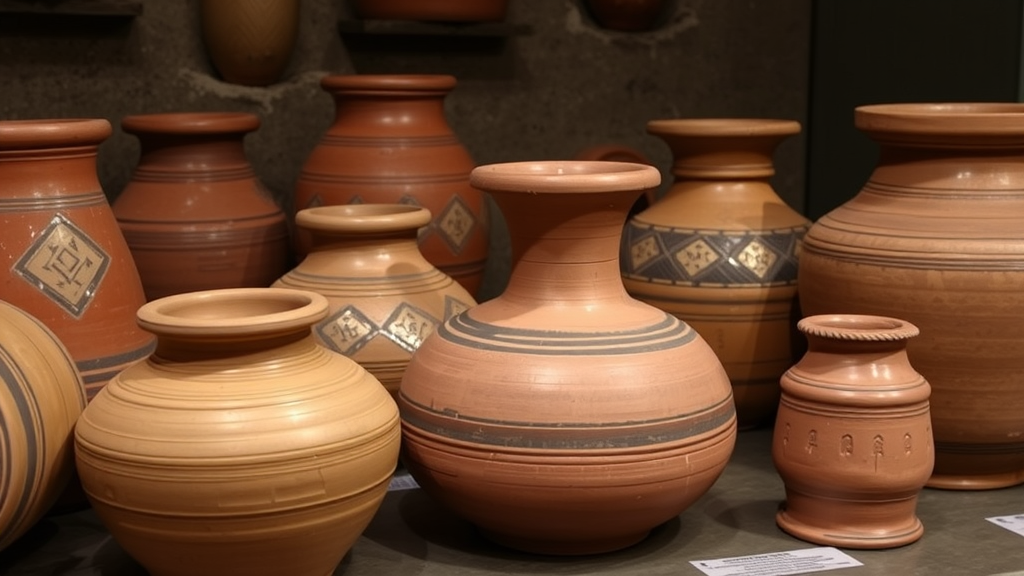
Beneath the streets of the Dutch city of Utrecht lie the remains of one of the medieval Netherlands’ earliest pottery industries, and a new study has now reconstructed, in remarkable technical detail, how its potters worked across three centuries. Researchers led by Barbara Borgers of the University of Padua, together with colleagues from the Budapest Neutron Centre, the University of Vienna, Universitat de Barcelona and Archeologisch Bureau Griffioen, analysed 59 ceramic wasters from four workshops active between the 12th and 15th centuries CE. Their findings, published in Archaeological and Anthropological Sciences, combine classical compositional analysis with an innovative neutron-based method to trace the full production sequence, or chaîne opératoire, of the town’s greyware and redware ceramics.
Utrecht occupies a special place in medieval Dutch ceramic history. The earliest evidence for pottery production there dates to the late 12th century CE, and by the 14th century the town had joined Haarlem, Leiden and Breda as a major manufacturing centre supplying both local markets and wider regional trade. Its products have been recovered as far afield as Alkmaar, Haarlem, Dordrecht and Amsterdam. The workshops themselves clustered in the suburbs of Bemuurde Weerd and Tolsteeg, north and south of the town walls, and along the banks of the Vecht river, where excavations have uncovered nine vertical updraft kilns with brick or clay floors, round or oval in plan and measuring up to five metres long.
The excavated waste heaps tell a story of technological transition. The first production phase at Zeedijk, dated 1150 to 1175 CE, yielded almost exclusively grey, round-based jars. After an apparent hiatus of roughly a century, the second phase, from 1275 to 1350 CE, saw a wider repertoire including lead-glazed reddish tripod forms, jugs, bowls and pans, though grey jars remained dominant. By the third phase, represented by the Oosterkade workshop (1350 to 1400 CE) and riverside workshops such as Anthoniedijk, Hogelanden and Lauwerecht (1375 to 1425 CE), lead-glazed redware had become far more prominent, and unglazed and lead-glazed floor tiles were also being produced.
To characterise the raw materials and firing technology, the team subjected the 59 samples, plus one clay sample from a waste pit at Bemuurde Weerd, to a battery of techniques: polarised light optical microscopy, wavelength-dispersive X-ray fluorescence spectrometry, X-ray diffraction and scanning electron microscopy with energy dispersive X-ray spectrometry. Thin-section petrography revealed two main fabric groups, a Coarse Group with large, moderately to poorly sorted quartz inclusions and a Fine Group with smaller, better-sorted inclusions. The size, rounded shape and bimodal distribution of the coarse quartz grains suggest they were deliberately added as temper, most likely derived from fluvial deposits, consistent with the Holocene river clays of the region.
The chemical data, measured on 26 major, minor and trace elements at the Fitch Laboratory of the British School at Athens, showed a strongly homogeneous, silico-aluminous dataset pointing to local clay sources. Principal component analysis identified three compositional groups, with a large, homogeneous group A accounting for more than 70 percent of the samples. All the Utrecht products were made from calcium-poor, iron-rich clay, with calcium contents below 2.5 percent, and the chemical similarity between the fired clay sample and the pottery, despite differences in calcium, may itself be evidence of quartz tempering. X-ray diffraction confirmed the mineral assemblage of quartz, illite-muscovite, K-feldspar and plagioclase, with redware bodies generally containing more hematite than greyware.
Firing temperatures emerged as consistently low. Most of the ceramics, 44 of them, were fired below 800 degrees Celsius, while a handful containing the high-temperature minerals gehlenite, diopside and mullite may have reached roughly 850 to 900 degrees or slightly above. The co-occurrence of surviving calcite and dolomite with these high-temperature phases implies short soaking times in the kiln. The glazes told their own story: single-layered, transparent coatings up to about 250 micrometres thick, of very high to high-lead type, with lead oxide contents between roughly 51 and 69 weight percent. Comparisons of corrected glaze and body compositions indicate that potters mixed lead oxide with silica before application, and that the yellowish-brown to greenish colour came from iron in the glaze over the reddish ceramic body.
The most novel element of the study was the application of small-angle neutron scattering, or SANS, to the question of how the vessels were formed. Measured non-destructively at the YS-SANS instrument of the Budapest Neutron Centre, 38 jar samples yielded data on the orientation and alignment of nanoscale domains in the ceramic fabric, which record the forces applied during forming. Thirty-two samples showed high isotropy values, indicating disorganised internal structures characteristic of percussion-building techniques such as pinching, moulding or tamper-and-concave-anvil forming. Combined with the wheel-made traces on rims and necks, this points to a two-stage strategy the authors call percussion-wheeling: the body formed by percussion, then the neck and rim refined on a rotational device.
Only six samples showed the low isotropy and significant tilting angles diagnostic of other techniques. One redware jar from the second phase at Zeedijk proved to be coil-built and wheel-shaped, while five jars, from both Zeedijk and Oudenoord, were genuinely wheel-thrown, three with clockwise and two with anticlockwise wheel rotation. Notably, all the wheel-thrown examples date to the second production phase after about 1275 CE, confirming a previously observed typo-technological shift from grey hand-formed jars to reddish tripod forms. Contrary to common expectations, the potters did not favour fine fabrics for wheel-throwing; nearly all the wheel-thrown jars were made from the coarse fabric. The persistence of percussion-wheeling across the 100-year hiatus between the first and second phases suggests a conservative, culturally embedded technological tradition, one perhaps also suited to producing the round-based jar shapes that were difficult to throw on a wheel.
The study also cautions against reading forming techniques from surface features alone. Interior depressions often interpreted as fingertip impressions from moulding appeared on wheel-thrown vessels too, and may instead reflect hands supporting the vessel wall during brushing, while interior ridges below the neck, sometimes taken as evidence of added coils, also occurred on wheel-thrown jars and may result from clay displacement during wheel work. The reasons for discarding the wasters were largely firing failures: warping and cracking from overfiring, loosened tripod legs and handles, and glazes accidentally fired in a reducing atmosphere. Taken together, the results portray a production tradition defined by both continuity and change, in which local potters favoured iron-rich, calcium-poor clay, tempered it with river sand, fired at low temperatures, and gradually adopted wheel-throwing and lead glazing, offering archaeologists a new quantitative template for reconstructing medieval craft knowledge and its transmission.
Subject of Research: The production technology and chaîne opératoire of medieval greyware and redware ceramics from 12th to 15th century Utrecht, the Netherlands
Article Title: Advancing the chaîne opératoire analysis of medieval greyware and redware ceramics: A case study from 12th to 15th centuries CE Utrecht, the Netherlands
Article References: Borgers, B., Gait, J., Bajnok, K., Allepuz, E. T., Bajnóczi, B., Len, A., & Griffioen, A. (2026). Advancing the chaîne opératoire analysis of medieval greyware and redware ceramics: A case study from 12th to 15th centuries CE Utrecht, the Netherlands. Archaeological and Anthropological Sciences, 18(9), Article 194. https://doi.org/10.1007/s12520-026-02554-x
Image Credits: AI Generated
DOI: 10.1007/s12520-026-02554-x
Keywords: medieval pottery, Utrecht, chaîne opératoire, ceramic technology, greyware, redware, small-angle neutron scattering, lead glazes, petrography, X-ray fluorescence, pottery workshops, the Netherlands
Cite Scienmag News
Katie Riggs. (September 12, 2026). Neutron Scattering Reveals How Medieval Utrecht Potters Shaped Their Wares. Scienmag. https://scienmag.com/neutron-scattering-reveals-how-medieval-utrecht-potters-shaped-their-wares/
Katie Riggs. "Neutron Scattering Reveals How Medieval Utrecht Potters Shaped Their Wares." Scienmag, 12 September 2026, https://scienmag.com/neutron-scattering-reveals-how-medieval-utrecht-potters-shaped-their-wares/. Accessed 4 October 2026.
Katie Riggs. "Neutron Scattering Reveals How Medieval Utrecht Potters Shaped Their Wares." Scienmag. September 12, 2026. https://scienmag.com/neutron-scattering-reveals-how-medieval-utrecht-potters-shaped-their-wares/


