


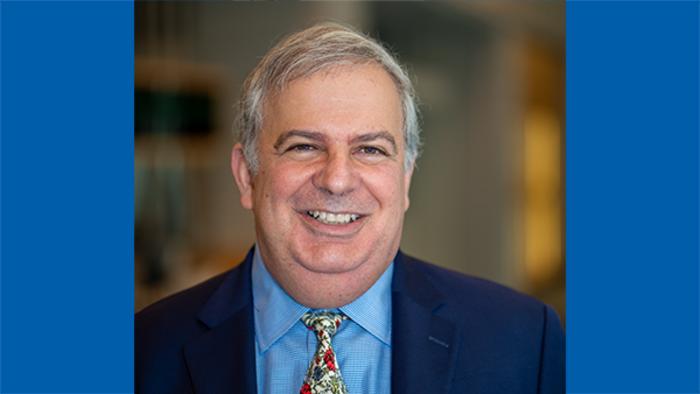
The City University of New York has appointed Joshua C. Brumberg as president of the CUNY Graduate Center, making permanent a post he has held on an interim basis since October 2023. Brumberg, a neurobiologist who has been a faculty member, dean and researcher during his 22-year career at CUNY, will lead the University’s renowned center of graduate education, scholarship and public-interest research. CUNY’s Board of Trustees approved the appointment at its meeting last night.

Credit: Alexi Irklievski
The City University of New York has appointed Joshua C. Brumberg as president of the CUNY Graduate Center, making permanent a post he has held on an interim basis since October 2023. Brumberg, a neurobiologist who has been a faculty member, dean and researcher during his 22-year career at CUNY, will lead the University’s renowned center of graduate education, scholarship and public-interest research. CUNY’s Board of Trustees approved the appointment at its meeting last night.
“Dr. Brumberg has played a key role in expanding CUNY’s research enterprise over the past several years,” said Chancellor Félix V. Matos Rodríguez. “A scientist at heart, he is widely admired for his dedication to STEM education and commitment to CUNY’s missions of advancing equity and opportunity. Dr. Brumberg is the right person at the right time to lead the Graduate Center into the future.”
The Chancellor recommended Brumberg as the permanent leader after consulting with Graduate Center faculty, students, staff, foundation board members and administrators who expressed strong and unanimous support.
Working with Graduate Center faculty and staff as interim leader, Brumberg has helped attract nearly $90 million in external funding to support research and educational programming. Notable gifts during this period have included $75 million from the Simons Foundation to establish CUNY as a hub for computational science and support CUNY’s participation in Governor Kathy Hochul’s Empire AI initiative; and $10 million from the Leon Levy Foundation to endow the Leon Levy Center for Biography.
Brumberg previously served as the Graduate Center’s dean for the sciences. In that role for seven years, he oversaw research operations, along with 11 STEM doctoral programs and five master’s programs that were created during his tenure.
He also secured external funding for diversity programs in the laboratory sciences and gender equity in mathematics. He co-chaired subcommittees for strategic plan development and Middle States accreditation, and twice served as interim executive director of the Advanced Science Research Center (ASRC), an arm of the Graduate Center that opened on the campus of The City College of New York in 2014.
“It is an honor to serve the Graduate Center and The City University of New York, and I am humbled by the confidence the Chancellor and the CUNY trustees have placed in me to lead this great public graduate school,” said Brumberg. “During my time as interim president, we have made significant strides in attracting support from donors and funders. I look forward to continuing these efforts and to working with our remarkable faculty and students to build on the Graduate Center’s record of excellence in research and teaching.”
Brumberg earned his Ph.D. in neurobiology from the University of Pittsburgh and completed postdoctoral fellowships at Yale University and Columbia University. In 2002, he joined the faculty of Queens College’s Department of Psychology and started his own laboratory there, with simultaneous appointments in the biology, psychology and cognitive neuroscience programs at the Graduate Center. In devoting his career to CUNY and the Graduate Center, he has followed in the footsteps of his father, Professor Emeritus of Education Stephan Brumberg, who served on the Graduate Center faculty and held administrative positions at Brooklyn College and in CUNY’s Central Office.
As a neurobiologist, Brumberg has used behavioral, physiological and anatomical methods to study how environmental experience impacts the development and function of cortical circuits in the brain, the site of cognitive computations. He has published more than 60 papers and has received multiple grants from the National Science Foundation and the National Institutes of Health.
Brumberg is the 18th permanent campus leader installed by Chancellor Matos Rodríguez during his five-year tenure, a highly diverse group that includes 10 women, 11 leaders of color and CUNY’s first college presidents of Asian and South Asian descent.
The CUNY Graduate Center is one of the leading Ph.D.-granting institutions in the country, educating students of diverse backgrounds from all over the world and fostering groundbreaking research. With a campus in Midtown Manhattan and a science center in upper Manhattan, the school educates over 3,200 students enrolled in more than 30 doctoral programs and a growing number of master’s programs in cutting-edge fields. It encompasses more than 30 centers, institutes and initiatives and has a faculty of 130 with Graduate Center appointments in addition to more than 1,700 faculty from throughout CUNY.
The City University of New York is the nation’s largest urban public university, a transformative engine of social mobility that is a critical component of the lifeblood of New York City. Founded in 1847 as the nation’s first free public institution of higher education, CUNY today has seven community colleges, 11 senior colleges and seven graduate or professional institutions spread across New York City’s five boroughs, serving more than 225,000 undergraduate and graduate students and awarding 50,000 degrees each year. CUNY’s mix of quality and affordability propels almost six times as many low-income students into the middle class and beyond as all the Ivy League colleges combined. More than 80 percent of the University’s graduates stay in New York, contributing to all aspects of the city’s economic, civic and cultural life and diversifying the city’s workforce in every sector. CUNY’s graduates and faculty have received many prestigious honors, including 13 Nobel Prizes and 26 MacArthur Genius Grants. The University’s historic mission continues to this day: provide a first-rate public education to all students, regardless of means or background. To learn more about CUNY, visit https://www.cuny.edu.
Cite Scienmag News
Courtney Benton. (June 26, 2024). Neurobiologist Joshua C. Brumberg named CUNY Graduate Center president. Scienmag. https://scienmag.com/neurobiologist-joshua-c-brumberg-named-cuny-graduate-center-president/
Courtney Benton. "Neurobiologist Joshua C. Brumberg named CUNY Graduate Center president." Scienmag, 26 June 2024, https://scienmag.com/neurobiologist-joshua-c-brumberg-named-cuny-graduate-center-president/. Accessed 5 September 2026.
Courtney Benton. "Neurobiologist Joshua C. Brumberg named CUNY Graduate Center president." Scienmag. June 26, 2024. https://scienmag.com/neurobiologist-joshua-c-brumberg-named-cuny-graduate-center-president/

