


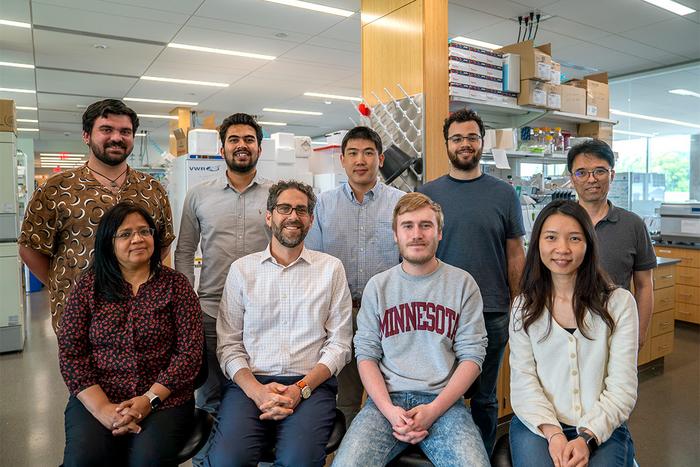
ST. LOUIS, MO, June 26, 2024 – With the goal of reducing the time and cost it takes to bring an improved crop to the marketplace, research conducted in the laboratory of Keith Slotkin, PhD, and his colleagues in the Plant Transformation Facility at the Donald Danforth Plant Science Center, was recently published in the scientific journal Nature. The publication Transposase-assisted target site integration for efficient plant genome engineering focuses on technology called TATSI (Transposase-Assisted Target Site Integration), which uses transposable elements to integrate custom DNA into specific sites in plant genomes.

Credit: Donald Danforth Plant Science Center
ST. LOUIS, MO, June 26, 2024 – With the goal of reducing the time and cost it takes to bring an improved crop to the marketplace, research conducted in the laboratory of Keith Slotkin, PhD, and his colleagues in the Plant Transformation Facility at the Donald Danforth Plant Science Center, was recently published in the scientific journal Nature. The publication Transposase-assisted target site integration for efficient plant genome engineering focuses on technology called TATSI (Transposase-Assisted Target Site Integration), which uses transposable elements to integrate custom DNA into specific sites in plant genomes.
The TATSI technology takes advantage of over two billion years of evolution of plant transposable elements, which naturally function as honed molecular machines to insert DNA into the genome. The high-frequency and high-precision target site integration of custom DNA into plant genomes enables the faster and less expensive production of gene-edited plants to address global challenges in agriculture, climate and the environment.
A critical bottleneck in modern crop improvement is the low frequency and error-prone integration of foreign DNA into the plant genome, hampering genome editing approaches for crop improvement. The CRISPR/Cas system functions like a pair of molecular ‘scissors’ to cut the genome and introduce site-specific changes to the DNA. But current methods lack robust ways to add custom DNA accurately and efficiently at those edited sites. TATSI technology takes advantage of the molecular “glue” feature of transposable elements to provide custom ‘cut-and-paste’ genome editing when combined with CRISPR/Cas. The “scissors + glue” combination enables an order-of-magnitude increase in the rate of targeted DNA integration in plant genomes, allowing for custom improvement of plants through the addition of important traits such as virus resistance, elevated nutrient levels, or better oil composition.
The research on TATSI started in 2019 following the Danforth Center’s “Conversations: Big Ideas 2.0” event, a competition in which a team from the Slotkin proposed harnessing the power of transposable elements for crop improvement. Often referred to as the “junk DNA,” transposable elements comprise over 70% of corn genome. Using the enzyme called “transposase” encoded by certain transposable elements, the big idea was a new genome editing tool that could enable development of a wide variety of new traits fast, better and cheaper. The Slotkin team won the competition and received seed money to initiate their research.
Since then, the Slotkin lab has garnered research funding from Bayer Crop Science and the U.S. National Science Foundation (NSF). Further investment from the Danforth Center’s Proof of Concept awards and NSF resulted in prototypes and pre-commercial development. “Born out of the Big Ideas 2.0 competition, this project changed the course of our research we’re doing today and into the future,” said Slotkin. “It is a real testament to the broader ‘focus-on-impact’ attitude of the Danforth Center.”
Nature is one of the oldest and most prestigious scientific journals that attempts to publish the highest impactful scientific research.
About The Donald Danforth Plant Science Center
Founded in 1998, the Donald Danforth Plant Science Center is a not-for-profit research institute with a mission to improve the human condition through plant science. Research, education, and outreach aim to have an impact at the nexus of food security and the environment and position the St. Louis region as a world center for plant science. The Center’s work is funded through competitive grants from many sources, including the National Science Foundation, National Institutes of Health, U.S. Department of Energy, U.S. Agency for International Development, and the Bill & Melinda Gates Foundation, and through the generosity of individual, corporate, and foundation donors. Follow us on Twitter at @DanforthCenter.
Media contact: Karla Roeber, VP Public and Government Affairs, kroeber@danforthcenter.org
Journal
Nature
Article Title
Transposase-assisted target-site integration for efficient plant genome engineering
Article Publication Date
26-Jun-2024
Cite Scienmag News
Alan Morgan. (June 26, 2024). New tool enables faster, more cost-effective genome editing of traits to improve agriculture sustainability. Scienmag. https://scienmag.com/new-tool-enables-faster-more-cost-effective-genome-editing-of-traits-to-improve-agriculture-sustainability/
Alan Morgan. "New tool enables faster, more cost-effective genome editing of traits to improve agriculture sustainability." Scienmag, 26 June 2024, https://scienmag.com/new-tool-enables-faster-more-cost-effective-genome-editing-of-traits-to-improve-agriculture-sustainability/. Accessed 6 September 2026.
Alan Morgan. "New tool enables faster, more cost-effective genome editing of traits to improve agriculture sustainability." Scienmag. June 26, 2024. https://scienmag.com/new-tool-enables-faster-more-cost-effective-genome-editing-of-traits-to-improve-agriculture-sustainability/

