


DNA metabarcoding has transformed the way scientists take the pulse of ocean life. Instead of sorting through jars of preserved plankton under a microscope, researchers can now extract the genetic traces left behind in a sample and match them against barcode databases to reveal which species were present. But a persistent worry has shadowed the technique: because no standardised field protocols exist, two laboratories sampling the same stretch of ocean with different nets, tow lengths or times of day might produce incomparable results. A new experimental study conducted off the coast of Durban, South Africa, and published in the journal Metabarcoding and Metagenomics, set out to test just how much these practical choices actually matter — and the answer is surprisingly reassuring for the growing community of marine biomonitoring programmes.
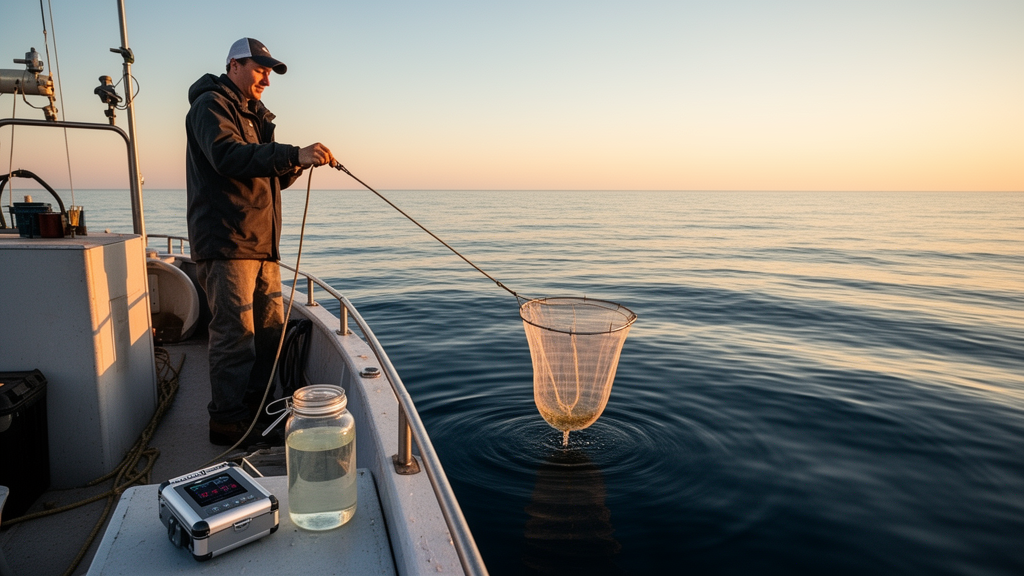
The research team, working in coastal waters along the KwaZulu-Natal shelf, designed a field experiment to isolate the effects of three sampling variables: the type of net deployed, the duration of each tow, and whether sampling took place during the day or at night. Three net types were compared. A conventional ring net with a diameter of 0.8 metres and 500-micrometre mesh was towed horizontally just below the sea surface. A Manta net, with a rectangular frame of 0.5 by 0.15 metres and the same mesh size, skimmed the very top of the water column. Finally, a WP2 net with a 0.55-metre opening and finer 200-micrometre mesh was lowered to within ten metres of the seafloor and hauled vertically, sampling a much deeper slice of the water column. Mechanical flow meters measured the volume of water filtered during each tow, while a CTD profiler recorded temperature, salinity, oxygen and chlorophyll fluorescence at every station.
The molecular workflow behind the study was deliberately rigorous. Samples were preserved in 97 percent ethanol, homogenised in the laboratory, and subjected to DNA extraction followed by polymerase chain reactions run in triplicate to minimise stochastic amplification errors. Rather than relying on a single universal primer, the team used a cocktail of five taxon-specific mini-barcode primers targeting mainly malacostracans — the crustacean group that includes crabs, lobsters, prawns and shrimps — and ray-finned fishes, plus one universal metazoan primer set to capture the broader community. The resulting amplicon libraries, 44 in total, one per individual tow, were sequenced on an Illumina MiSeq platform. Bioinformatic processing with the dada2 algorithm cleaned, filtered and merged the paired-end reads into amplicon sequence variants, which were then assigned to species using a 97 percent sequence similarity threshold against the BOLD and NCBI GenBank reference databases.
The scale of the detection effort was impressive. Across all 44 tows, metabarcoding revealed zooplankton belonging to 27 orders, 89 families, 160 genera and 224 species. Malacostracans dominated the species list with 110 species, followed by copepods with 48, ray-finned fishes with 46 and gastropods with 20. Crucially, the team did not simply accept these identifications at face value. Every species was cross-referenced against occurrence records in the World Register of Marine Species, the Ocean Biodiversity Information System, the Global Biodiversity Information Facility and the published literature. The validation exercise paid off: 170 species, or 76 percent, matched prior records from South Africa, and another 37 species were known from the wider Western Indian Ocean region. In total, 92 percent of the detected species were corroborated by independent distribution data, a strong indication that the 97 percent similarity threshold is robust for identifying zooplankton from COI barcodes.
The central experimental question — does sampling design change the picture? — yielded a strikingly consistent answer: mostly, no. Mean species counts per tow did not differ significantly between the three net types. Ring net samples yielded 106 species in total, WP2 samples 47 and Manta samples 34, but with only four tows for the latter two nets and high natural variability between individual tows, a single-factor analysis of variance found no statistically significant difference. The proportions of the major taxonomic classes also stayed within a narrow band across net types, with one telling exception: the WP2 net, which sampled deeper habitats and used a finer mesh, caught proportionally more copepods and fewer malacostracans than the surface-towed nets. This difference was attributed to the deeper water column it traversed and possibly to its smaller mesh size rather than to any inherent bias of the net design itself.
Tow duration, another long-standing source of concern in classical plankton surveys, proved equally unimportant for metabarcoding results. Species counts were statistically indistinguishable across five-, ten- and fifteen-minute tows, with 102, 109 and 101 species detected respectively in pooled samples, and mean counts per tow hovering around 26 to 27 species regardless of duration. This finding challenges expectations rooted in morphology-based studies, where longer tows historically increased species richness because they swept through more of the patchy distributions that characterise zooplankton in the water column. The authors argue that the extraordinary sensitivity of metabarcoding — which needs only a single DNA fragment, and therefore a single individual, to register a species — means that even short tows capture representative presence and absence data. For research cruises where ship time is expensive, this is a practical gift.
Day and night sampling produced another surprise. Classical studies have long documented diel vertical migration, the daily commute of zooplankton from deeper, darker waters to the surface to feed under cover of darkness. Yet the metabarcoding data showed no evidence of this phenomenon: daytime samples yielded 125 species and night samples 116, a difference that was not statistically significant, and mean counts per tow were nearly identical. The authors offer several plausible explanations. The stations sampled had bottom depths of only 20 and 100 metres, possibly too shallow for measurable vertical migration, and night tows may have begun too soon after sunset for deeper layers to reach the surface. More intriguingly, they suggest that individual-based molecular detection is inherently less sensitive to migration than population-based counting, because some individuals of a species always remain near the surface and are therefore detectable even when the bulk of the population has descended.
The study also confronted two stubborn problems of metabarcoding head-on. First, a substantial fraction of sequences could not be assigned to species: 40 percent in the net-type experiment and 56 percent in the day-night experiment failed to match reference barcodes at 97 percent similarity, meaning the 224 species count is almost certainly an underestimate of true diversity. Second, seventeen species, about 8 percent of the total, appeared to be false positives, matching barcodes but lacking any occurrence record from South Africa or the Western Indian Ocean. The researchers note that such mismatches can stem from errors in reference databases, from insufficient genetic divergence in the COI region between closely related species, or from species that are genuinely present but simply never documented — a real possibility in pelagic ecosystems where drifting larvae are dispersed widely by ocean currents and ballast water transport moves species across the globe.
Replicate tows at the same stations revealed the patchiness of zooplankton communities in vivid detail. Of four sets of three replicate ring net tows, the proportion of unique species within each set ranged from 38 to 82 percent, and the null hypothesis of equal species counts was rejected in half the cases. While this variability complicates statistical comparisons, it served a useful purpose: the low level of shared species between consecutive tows indicated minimal cross-contamination between samples, a potential pitfall when the same net is deployed repeatedly. Between tows, the nets were rinsed thoroughly with seawater, and the laboratory blender was washed with soap, bleach and ethanol between samples to degrade residual DNA.
The broader message of the study is one of methodological freedom. Because species composition proved consistent across net types, tow durations and times of day, research groups can adapt their sampling regimes to local logistics, vessel availability and survey goals without sacrificing comparability — a crucial step toward integrating metabarcoding data into the long-term morphology-based time series that underpin marine environmental management. The authors caution that their conclusions rest on modest sample sizes and a primer set biased toward crustaceans and fishes, and that finer mesh or deeper habitats can still shift the taxonomic balance of a sample. But as an empirical foundation for standardising zooplankton metabarcoding, the work offers something the field has lacked: direct evidence that, for presence-absence detection, the ocean’s smallest animals will show up in the data almost regardless of how you go about catching them.
Subject of Research: Effects of net type, tow duration and day/night sampling on marine zooplankton composition assessed by DNA metabarcoding
Article Title: Net type, tow duration and day/night sampling effects on the composition of marine zooplankton derived from metabarcoding
Article References: Govender, A., Willows-Munro, S., Singh, S. P., & Groeneveld, J. C. (2024). Net type, tow duration and day/night sampling effects on the composition of marine zooplankton derived from metabarcoding. Metabarcoding and Metagenomics, 8, Article e119614. https://doi.org/10.3897/mbmg.8.119614
Image Credits: AI Generated
Keywords: DNA metabarcoding, zooplankton, marine biodiversity, plankton nets, COI barcode, sampling protocols, biomonitoring, South Africa, diel vertical migration, high-throughput sequencing, species detection, ocean sampling
Cite Scienmag News
Margaret Porter. (October 19, 2026). Net Type, Tow Length and Time of Day Barely Matter for Zooplankton DNA Sampling. Scienmag. https://scienmag.com/net-type-tow-length-and-time-of-day-barely-matter-for-zooplankton-dna-sampling/
Margaret Porter. "Net Type, Tow Length and Time of Day Barely Matter for Zooplankton DNA Sampling." Scienmag, 19 October 2026, https://scienmag.com/net-type-tow-length-and-time-of-day-barely-matter-for-zooplankton-dna-sampling/. Accessed 19 October 2026.
Margaret Porter. "Net Type, Tow Length and Time of Day Barely Matter for Zooplankton DNA Sampling." Scienmag. October 19, 2026. https://scienmag.com/net-type-tow-length-and-time-of-day-barely-matter-for-zooplankton-dna-sampling/


