


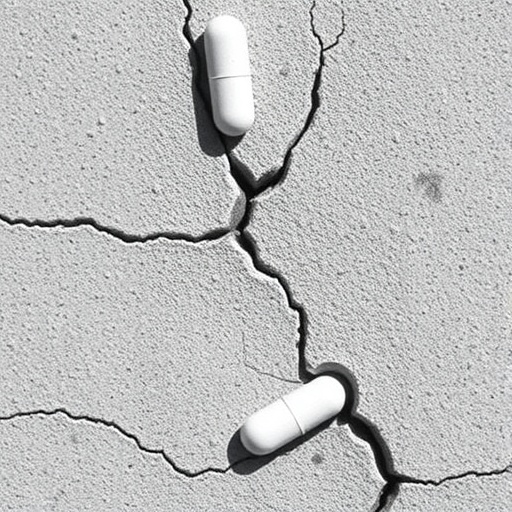
Concrete may be the backbone of modern infrastructure, but it has a built-in weakness: it is strong under compression and poor at resisting tension. Tiny fractures can form as cement hydrates, water evaporates, structures flex under load, or temperatures rise and fall. Over time, these cracks can grow into channels that carry moisture, chloride ions and carbon dioxide deep into the material. Chlorides can corrode steel reinforcement, while carbon dioxide can alter the chemistry of the cement matrix. The result is a slow erosion of strength and durability that can force expensive inspections, repairs and replacement. A new study describes a capsule-based concrete that does something conventional self-healing materials generally cannot: it repairs damage once, then retains a reserve of healing agent for a second cracking event. The researchers built “nested capsules”—large outer capsules containing smaller inner capsules—and embedded them in cement-based concrete. In laboratory tests, the material not only sealed cracks after an initial loading cycle, but also restored much of its performance after the concrete was deliberately cracked again.
The concept addresses one of the central problems in capsule-based self-healing concrete. In these materials, liquid chemicals are sealed inside small particles dispersed through the cement matrix. When a crack passes through a capsule, the shell breaks and the healing liquid flows into the fracture. The liquid then reacts with substances in the surrounding concrete, forming a solid polymer that bridges or fills the crack. This approach is more active and controllable than autogenous healing, in which unhydrated cement particles or crystalline compounds gradually close small cracks when water is available. But ordinary capsules are usually single-use devices: once their shells rupture, their contents are gone. The new architecture creates a staged delivery system. An outer shell breaks during the first damage event, releasing some healing agent while also exposing or redistributing intact inner microcapsules near the crack. When the healed zone is later reopened, renewed stress can rupture those surviving inner capsules and release a fresh supply. In principle, the material behaves less like a single emergency injection and more like a miniature, distributed repair kit.
The team, led by Wei Du and colleagues, made the inner capsules from polypropylene and isophorone diisocyanate, or IPDI. Polypropylene formed the inner shell, while IPDI served as the reactive healing agent. The researchers first melted polypropylene at about 200 degrees Celsius, mixed it with IPDI and then rapidly cooled the mixture by adding perfluorotributylamine. This melt-induced phase-separation process produced solid PP capsules containing the liquid chemical. They then melted ceresine wax at 100 degrees Celsius and mixed it with IPDI and the preformed inner capsules. Rapid solidification created the second layer, trapping both free healing agent and the smaller capsules inside a wax shell. Microscopy revealed the intended hierarchy: spherical inner particles embedded throughout the outer shell, whose average wall thickness was 9.6 micrometers, with a variation of 1.4 micrometers. Infrared spectroscopy detected the characteristic isocyanate group at roughly 2,237 inverse centimeters, indicating that chemically active IPDI remained in the capsules after fabrication.
The nested design required a compromise between resilience and sensitivity. The inner polypropylene capsules were harder and stiffer, with a measured hardness of about 0.33 gigapascals and an elastic modulus of 6.25 gigapascals. The nested capsules, softened by their ceresine-wax exterior, had a hardness of approximately 0.27 gigapascals and an elastic modulus of 5.17 gigapascals. That lower stiffness could be a disadvantage during mixing and service, but it also makes the outer shell easier to break when a crack tip reaches it. Particle size was another important difference. At a stirring speed of 600 revolutions per minute, the inner capsules averaged about 75 micrometers in diameter, whereas the nested capsules averaged about 750 micrometers. Higher stirring rates reduced particle size by increasing hydrodynamic shear and breaking the dispersed phase into finer droplets, but the nested system remained much larger because the embedded inner particles increased viscosity and hindered droplet breakup. The outer wax shell also lost slightly more mass during 28 days of dry storage than the polypropylene capsules, suggesting somewhat weaker sealing. Nevertheless, enough capsules survived concrete mixing, curing and repeated damage to remain functional.
The price of carrying a healing reserve was visible in the concrete’s initial properties. The researchers added capsules at 1.5, 3 or 4.5 percent of the combined mass of cement and fly ash, then compared the resulting mixtures with capsule-free concrete. Unlike fine conventional capsules, which can act as micro-fillers at moderate concentrations, the larger nested capsules disrupted particle packing and created more substantial interfacial transition zones around themselves. Low-field nuclear magnetic resonance measurements showed that the proportion of pores classified as harmful—those larger than 0.1 micrometers—increased from 35.76 percent in the control concrete to 36.17, 37.62 and 39.03 percent as nested-capsule content rose. Compressive strength fell by about 2.4 percent at 1.5 percent dosage, 5.6 percent at 3 percent and 10.2 percent at 4.5 percent. Chloride diffusion coefficients also increased by 1.1, 3.8 and 9.7 percent, respectively. These results underline a significant engineering trade-off: the material begins life somewhat more porous and mechanically compromised, but may repay that penalty when damage occurs.
To test the first healing cycle, the researchers loaded 28-day-old specimens to 60 percent of each mixture’s ultimate compressive strength, generating controlled microcracks without completely destroying the samples. The damaged concrete was then kept at 20 degrees Celsius and more than 95 percent relative humidity for up to 10 days. After that period, control specimens recovered only 51.2 percent of their original compressive strength. Concrete containing nested capsules recovered 77.6 percent, 91.3 percent and 91.5 percent at dosages of 1.5, 3 and 4.5 percent. Chloride-transport resistance showed a similar pattern: recovery reached 61.2, 73.1 and 73.7 percent for the three nested-capsule concentrations, compared with lower values for conventional capsules. The chemical explanation is that IPDI reacts with moisture and nearby chemical groups to form polyurea, a polymer capable of coating crack walls and filling open pathways. Fourier-transform infrared spectra of the material inside repaired cracks showed bands consistent with polyurea, including signals associated with amide and urea structures. Surface observations added a striking visual result: cracks about 0.35 millimeters wide in nested-capsule concrete closed completely after 10 days, while similarly sized cracks remained open in the control material.
The decisive experiment came after the first repair. Once the specimens had healed, the researchers subjected them to a second loading cycle at the same 60 percent relative load and allowed another 10 days for recovery. Conventional capsules performed only modestly the second time, restoring 51.2, 55.4 and 56.3 percent of compressive strength at the three dosages. The nested system, however, achieved recovery rates of 76.2, 87.5 and 88.1 percent. Its chloride-resistance recovery reached 57.2, 71.6 and 72.2 percent, substantially exceeding the conventional capsule system. The researchers also generated fresh surface cracks approximately 0.21 millimeters wide in ordinary capsule concrete and 0.25 millimeters wide in nested-capsule concrete. After the second healing period, the conventional-capsule cracks remained largely open, whereas the nested-capsule cracks closed completely. The proposed mechanism is sequential rather than simultaneous: the outer wax shell ruptures first, releasing IPDI and leaving inner capsules close to the damaged region. During reopening, stress concentrations activate those remaining capsules. X-ray computed tomography supported this interpretation by showing persistent capsule-like inclusions near the crack zone after the first cycle and a continuing, though declining, capsule fraction after the second.
The imaging also offered a cautious quantitative view of what happened inside the concrete. In a consistently scanned region of a specimen containing 3 percent nested capsules, the crack-related volume was 5.1 percent at the first healing observation and 3.7 percent at the secondary-healing observation—a 27.5 percent reduction. The researchers explicitly note that this difference should not be treated as a direct crack-closure ratio because the available scans did not provide a complete paired before-and-after dataset for every cycle. The segmented capsule-like volume fraction declined from 0.53 percent before loading to 0.49 percent after the first cycle and 0.44 percent after the second, consistent with gradual consumption of the healing reserve. The strongest overall balance appeared at the 3 percent dosage. At 4.5 percent, healing gains were only marginally higher, while the initial penalties to strength, porosity and chloride transport were considerably larger. The findings remain laboratory evidence rather than proof that roads, bridges or offshore structures could operate indefinitely without maintenance. Long-term chemical aging, large-scale crack patterns, field mixing, environmental cycling and the economics of manufacturing still require investigation. Even so, a concrete additive that can respond to repeated damage represents a notable step beyond one-shot repair systems. By arranging capsules inside capsules, the study turns self-healing from a single event into a staged process—one that could eventually help infrastructure remain functional through the repeated cracking that ordinary concrete is destined to endure.
Cite Scienmag News
Denise Maddox. (August 28, 2026). Nested Capsules Enable Secondary Self-Healing of Concrete Cracks. Scienmag. https://scienmag.com/nested-capsules-enable-secondary-self-healing-of-concrete-cracks/
Denise Maddox. "Nested Capsules Enable Secondary Self-Healing of Concrete Cracks." Scienmag, 28 August 2026, https://scienmag.com/nested-capsules-enable-secondary-self-healing-of-concrete-cracks/. Accessed 3 September 2026.
Denise Maddox. "Nested Capsules Enable Secondary Self-Healing of Concrete Cracks." Scienmag. August 28, 2026. https://scienmag.com/nested-capsules-enable-secondary-self-healing-of-concrete-cracks/


