


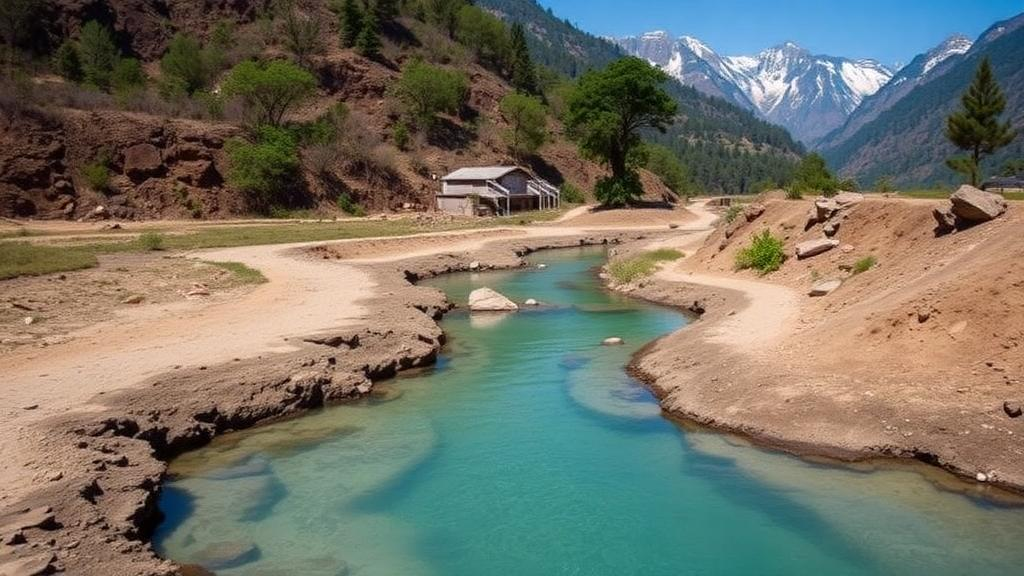
In the steep mid-hill country of western Nepal, springs are not a convenience; they are the lifeline. Villages perched on terraced slopes depend on these natural outlets of groundwater for drinking water, livestock, and irrigation, often with no realistic alternative supply. Yet a new three-year field study of 175 perennial springs has now quantified, with unusual statistical rigor, just how dramatically these sources weaken as the dry season wears on — and how differently they behave depending on the rock they drain. The research, published in Hydrogeology Journal by Gunanidhi Pokhrel and Moti Lal Rijal of Tribhuvan University together with Gopal Krishan of the National Institute of Hydrology in Roorkee, offers one of the most detailed seasonal portraits of Himalayan spring behavior to date, and its findings carry a blunt warning for dry-season water security across the region.
The team measured spring discharge at three carefully chosen moments in the hydrological cycle: during the post-monsoon high-flow periods of 2022 and 2023, designated Q1 and Q2, and again during the pre-monsoon low-flow period of 2024, designated Q3. This design allowed the researchers to separate two distinct signals — the natural seasonal recession that every spring undergoes as monsoon recharge drains away, and the interannual variability caused by differences in rainfall from one monsoon to the next. Discharge was measured in the field using volumetric gauging, in which the time taken to fill a container of known volume is recorded, and weir methods, in which flow is calculated from the height of water passing over a calibrated notch, with the choice of technique matched to the magnitude of each spring’s outflow.
The headline numbers tell a stark story. Mean spring outflow fell from 36.44 liters per minute in the 2022 post-monsoon period to 31.97 liters per minute in 2023, and then collapsed to just 15.66 liters per minute by the 2024 pre-monsoon measurement. In other words, average discharge more than halved between the wet-season peak and the dry-season trough. The decline between the two post-monsoon years, though smaller, was itself meaningful: monsoon rainfall dropped by 27.4 percent from 2022 to 2023, and the springs registered that shortfall in their own diminished flows. The pattern is a textbook illustration of how mountain aquifers act as buffers — storing monsoon water and releasing it slowly — but buffers that deplete steadily when the input weakens.
To confirm that these differences were not statistical noise, the researchers applied non-parametric tests suited to discharge data that are typically skewed and non-normally distributed. The Friedman test, which compares repeated measurements across the same set of springs, returned a chi-squared statistic of 298.16 with a p-value below 0.001, decisively confirming significant seasonal variation among the three measurement periods. Wilcoxon signed-rank tests then compared each pair of seasons individually, and every pairwise comparison proved significant. For a field in which anecdote and perception often dominate discussion of drying springs — local residents frequently report that their springs are failing, but hard multi-year datasets are scarce — this level of quantitative confirmation matters. It establishes that the seasonal collapse is real, systematic, and measurable across a large sample of springs.
Perhaps the most sobering figure concerns the distribution of flows rather than their average. By the pre-monsoon period of 2024, nearly two-thirds of the 175 springs had shifted into the minimal discharge class, defined as 10 liters per minute or less. For communities, that threshold is not an abstraction. A spring yielding a trickle of a few liters per minute cannot reliably fill household storage tanks, sustain gravity-fed piped schemes, or support even modest irrigation. The finding suggests that in a single dry season, the majority of the region’s perennial springs slip into a state where water scarcity becomes a daily, lived reality rather than a distant hydrological statistic. It also implies that the margin between a functioning water source and a failing one is thin, and that a modest further decline in recharge could push many more springs below usable thresholds.
Geology emerged as the crucial differentiator. The study area spans contrasting lithological and geomorphological settings, and the springs draining carbonate-dominant terrain behaved in a distinctly different manner from the rest. Springs in carbonate regions showed higher and more variable outflows, a signature the authors attribute to storage in fractured and karstic aquifers. In such systems, dissolution of limestone and dolomite along fractures creates networks of conduits and enlarged openings that can hold substantial volumes of water and transmit it rapidly. The result is a double-edged hydrogeology: karstic springs can deliver impressively large flows, but their discharge is also more volatile, responding quickly to recharge pulses and potentially to recharge deficits alike. Springs in other rock types, by contrast, draw on slower, more restricted storage in fractured hard rock and weathered regolith, producing smaller but often steadier flows.
This lithological contrast has direct implications for how springs should be managed and protected. Recharge enhancement techniques — such as recharge ponds, trenches, contour trenches, and the protection of recharge-zone vegetation — are increasingly promoted across the Hindu Kush Himalaya as nature-based responses to spring decline. But the study’s findings suggest that the same intervention will not perform identically everywhere. In carbonate terrain, where water moves quickly through conduits, recharge structures must be positioned with careful attention to the actual recharge areas of individual springs, or the added water may bypass the storage zones that sustain dry-season flow. In fractured hard-rock settings, where storage is limited and flow paths are slow, the priority may be maximizing infiltration over as wide an area as possible. The authors argue that their results support a priority-based approach to spring conservation, in which resources are directed first to the springs and aquifer settings where intervention offers the greatest dry-season benefit.
The study also addresses a subtle but critical conceptual point that has dogged debates about Himalayan water resources: the difference between seasonal recession and long-term depletion. A spring that flows weakly in April and strongly in October is behaving normally; a spring whose October flow is lower each successive year is in genuine decline. Distinguishing the two requires sustained, repeated monitoring over multiple years — precisely the kind of measurement campaign this study exemplifies. Without such data, communities and policymakers risk misdiagnosing natural seasonality as permanent decline, or, more dangerously, mistaking a genuine downward trend for a temporary dry spell. The authors emphasize that only continued observation can separate these signals, and their work provides a replicable protocol for doing so: fixed seasonal measurement windows, standardized gauging methods, and statistical tests capable of handling skewed discharge distributions.
The broader context makes the findings urgent. The mid-hills of Nepal sit within the Hindu Kush Himalaya, a region where climate change is altering monsoon timing and intensity, where spring decline is widely reported by local governments, and where millions of people depend on gravity-fed spring water. Previous research in the region has linked spring behavior to rainfall variability, land cover change, and the architecture of shallow groundwater systems, and studies from the Indian Himalaya and Sikkim have documented similar spring stress. What this study adds is a controlled, quantitative comparison across geological settings within a single landscape, demonstrating that the subsurface — the rock itself — is as important a control on spring resilience as the climate above it. That insight reframes spring conservation from a purely ecological or engineering problem into a hydrogeological one, in which understanding aquifer type and recharge geometry is the prerequisite for effective action.
For the villages of western Nepal’s mid-hills, the message is double-edged. The springs are indeed weakening each dry season, and a drier monsoon translates directly into weaker post-monsoon flows. But the research also shows that these systems are legible: their behavior follows measurable patterns tied to rock type, topography, and rainfall, which means targeted monitoring and geologically informed recharge work can make a real difference. The study, conducted as part of the first author’s doctoral research at Tribhuvan University with partial support from the university’s research directorate, closes with a call that echoes across the water-stressed mountains of South Asia — protect the springs that remain, enhance the recharge that feeds them, and keep measuring, because the line between a normal dry season and a slow-motion crisis can only be drawn with data gathered year after year.
Subject of Research: Seasonal variability of spring discharge and its hydrogeological controls in the western mid-hill region of Nepal
Article Title: Seasonal fluctuation of spring outflows in contrasting lithological and geomorphological environments of the western mid-hill region, Nepal
Article References: Pokhrel, G., Rijal, M. L., & Krishan, G. (2026). Seasonal fluctuation of spring outflows in contrasting lithological and geomorphological environments of the western mid-hill region, Nepal. Hydrogeology Journal. https://doi.org/10.1007/s10040-026-03184-2
Image Credits: AI Generated
DOI: 10.1007/s10040-026-03184-2
Keywords: springs, hydrogeology, Nepal, Himalaya, groundwater, karst, seasonal discharge, dry-season water security, monsoon rainfall, aquifer storage, spring conservation, mountain hydrology
Cite Scienmag News
Violet Maxwell. (October 13, 2026). Nepal’s Mountain Springs Are Drying Up Each Dry Season, Three-Year Study Finds. Scienmag. https://scienmag.com/nepals-mountain-springs-are-drying-up-each-dry-season-three-year-study-finds/
Violet Maxwell. "Nepal’s Mountain Springs Are Drying Up Each Dry Season, Three-Year Study Finds." Scienmag, 13 October 2026, https://scienmag.com/nepals-mountain-springs-are-drying-up-each-dry-season-three-year-study-finds/. Accessed 13 October 2026.
Violet Maxwell. "Nepal’s Mountain Springs Are Drying Up Each Dry Season, Three-Year Study Finds." Scienmag. October 13, 2026. https://scienmag.com/nepals-mountain-springs-are-drying-up-each-dry-season-three-year-study-finds/


