


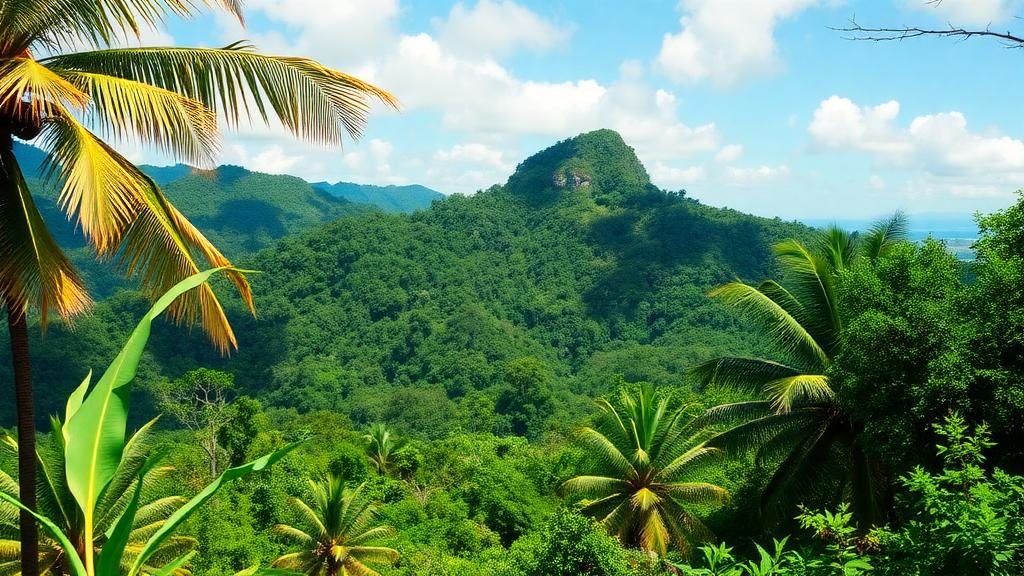
The Neotropics stretch from Mexico all the way to Tierra del Fuego, and they hold roughly 85,000 vascular plant species, more than any other biogeographic realm on Earth. Yet the vegetation of this immense region remains astonishingly poorly documented compared with the Palaearctic, the Nearctic, Australasia or Oceania. A new Special Collection published in the journal Vegetation Classification and Survey, produced in partnership with the Latin American and Caribbean Section of the International Association for Vegetation Science, takes direct aim at that gap. The collection comprises nine contributions, including four research papers that deliver new vegetation classifications of major Neotropical biomes, a novel bioclimatic-vegetation classification approach for Mexico, a sweeping synthesis of South American terrestrial biomes, and three vegetation databases that together open up vast troves of field data for the scientific community.
The stakes could hardly be higher. The Neotropics encompass some of the planet’s most celebrated biodiversity hotspots, among them Mesoamerica, the Caribbean islands, the Tropical Andes, the Atlantic Forest and the Cerrado. They also underpin ecosystem services vital to humanity and to keeping planetary boundaries intact, most famously global climate regulation through the enormous carbon sinks of tropical rainforests and mountain ecosystems such as the páramos. The region’s Mayan, Amazonian and Andean forests make it, in the editors’ words, the most diverse and extensive germplasm bank worldwide. Compared with other realms, the Neotropics have remained relatively well preserved, partly thanks to low population density and vast inhospitable landscapes, but assessing and predicting human impacts is now of the utmost importance for any hope of sustainable coexistence with nature.
Why has so little been synthesized? The editors highlight a few key barriers. Political instability and limited economic resources allocated to science are significant obstacles: in 2020, Latin America and the Caribbean invested just 0.62 percent of regional income in science, against 3.32 percent in North America and 2.28 percent in the European Union. The sheer immensity of Neotropical biodiversity is itself a challenge, because integrated taxonomic studies are lacking and a high proportion of diversity is missing altogether. Ecuador and Peru, for example, could harbor up to 30 percent of the total missing species worldwide across all taxa, which hinders representative and comprehensive biological studies. Data availability, data access and language barriers further interfere with efforts to compile large repositories of Neotropical vegetation information.
The biogeographic complexity of the region only adds to the difficulty. The Neotropical realm was first described and classified by Alfred Russel Wallace in 1876, and numerous subsequent classifications based on plants, animals or both have followed ever since, with no clear consensus to this day. One recent proposal recognized 50 biogeographic provinces grouped into 11 regions, from Caribbean-Mesoamerica to Valdivean-Magellanian. At a finer scale, the region’s extraordinary vegetation diversity reflects its unique biogeography, the complex evolution of its mountain building and soils, its role as an immense floristic cradle, and more recently human interactions. The Andean páramo alone, covering some 25,000 square kilometers of tropical alpine habitat, harbors more than 500 plant communities.
Among the research papers, Zeballos and colleagues provide an integral classification of the vegetation types of the Arid Chaco in central-western Argentina. Working from 654 vegetation relevés, the team characterized the flora, endemism, chorotypes and life forms of the region’s main vegetation types and linked them to environmental gradients, ultimately identifying nine vegetation types, with xerophytic shrublands dominant. The authors highlighted the effects of historical and present land use, which confer a clear Chaquenian identity to this area.
Ávila-Akerberg and colleagues conducted extensive work on the classification and nomenclature of temperate forest types in Mexico, providing a comprehensive analysis and synthetic update of the nomenclature of sub-humid and temperate forests in the country. Their research found that vegetation classification proposals tend to standardize criteria and nest hierarchical integrations at various levels based on physiognomic, climatic, phenological and floristic attributes. Crucially, they established that physiognomy serves as a primary divider at broader scales, whereas floristics typically divides at finer scales. Their work calls for a complete inventory of the phytosociological associations of Mexico’s temperate forests.
Two further studies turn to the high Andean wetlands that dot the world’s longest mountain chain. Casagranda and Izquierdo modeled the potential distribution of vegas, high Andean wetlands dominated by rushes and sedges of the families Juncaceae and Cyperaceae, in the Argentine Puna. Their models predicted that Juncaceae-dominated vegas occur chiefly in the northern region, at high elevation and in humid, cold conditions, while Cyperaceae-dominated vegas were mostly predicted in the southern region, at lower elevation and in drier, hotter conditions, providing planning tools to understand vega distribution under changing environmental conditions. Maldonado-Fonkén and colleagues, meanwhile, sampled a nearly 70-kilometer transect across high-Andean bofedal wetlands in southern Peru, identifying seven different plant communities that often form cushion and mat vegetation, dominated by species such as Distichia muscoides, Werneria pygmaea, Plantago tubulosa and Plantago rigida, findings that highlight the bofedal diversity of the region and suggest new lines of research and management.
From a more systematic angle, Gopar-Merino and colleagues coupled cartographic approaches between bioclimatology and vegetation formations of Mexico, a first attempt to unravel the intricate interplay between climate and vegetation and to unify a system for depicting Mexican vegetation patterns. Using a combined geobotanical and bioclimatological approach, the authors identified 13 distinct bioclimatic classes which, when combined with physiognomic types, depicted 11 forest, three shrubland and three herbaceous biomes. Navarro and colleagues went further still, proposing an innovative synthesis of South American terrestrial biomes as geocomplexes, a geobotanical landscape approach that associates vegetation units at the landscape level and shows how they interact and are conditioned by climatic, topographic and edaphic gradients. Their conceptual framework views the biome as a landscape complex comprising vegetation geoseries that in turn comprise geomorphologically linked zonal and azonal vegetation series. Applying this framework to South America, they identified and synoptically characterized 33 geocomplex biomes and 16 macrobiomes, to be summarized in a dataset for the scientific community.
The Special Collection also promotes three new vegetation data initiatives registered in the Global Index of Vegetation-Plot Databases. ArgVeg, the database of central Argentina, includes 1,092 vegetation-plot records containing 1,184 valid native and non-native vascular plant species as of September 2022, covering the main vegetation types of the Chaco, Espinal and Pampa and filling an important data gap. CACTUS, the vegetation database of the Dutch Caribbean Islands, currently contains 2,701 vegetation-plot records and can be used for vegetation classification in an undersampled region, tracking vegetation change over time, planning surveys, sourcing plant species distribution maps and informing conservation and policy. VegAndes, the vegetation database for the Latin American highlands, is the most extensive of the three: it compiles 5,340 vegetation plots sampled in 11 Latin American countries, with 5,804 taxon names, and spans over seven decades, supporting multi-scale studies in botany, ecology and biogeography, especially relevant given the impacts of climate change on vulnerable tropical mountains.
The collection suggests significant potential for collaboration among vegetation scientists from Latin America and the Caribbean and the IAVS journals. The IAVS regional section was launched in 2019 to connect researchers dedicated to vegetation science in the region, and it is expanding rapidly thanks to its broad regional interest and outreach. The group is currently conducting an extensive bibliometric review of regional works as an invited contribution to the Journal of Vegetation Science, an initiative that will help identify knowledge, geographical and topical gaps and promote new collaborations within and beyond the community. As global change reshapes vegetation in space and time, the growing need to understand those impacts is particularly urgent for the Neotropics, and it calls for rapid measures to improve data availability and research across this, the most phytodiverse realm on Earth.
Subject of Research: A special collection of nine studies delivers new vegetation classifications and databases for the Neotropics, Earth's most plant-diverse realm.
Article Title: Vegetation classification in the Neotropics – Novel insights from Latin America and the Caribbean
Article References: Peyre, G., Andrade, B. O., Velazquez, A., & Giorgis, M. A. (2024). Vegetation classification in the Neotropics – Novel insights from Latin America and the Caribbean. Vegetation Classification and Survey, 5, 219-223. https://doi.org/10.3897/vcs.133613
Image Credits: AI Generated
DOI: 10.3897/VCS.133613
Keywords: Vegetation, classification, Neotropics, Novel, insights, Latin, America, Caribbean, scientific research
Cite Scienmag News
Margaret Porter. (October 17, 2026). Neotropical vegetation gets a data boost from Latin America and the Caribbean. Scienmag. https://scienmag.com/neotropical-vegetation-gets-a-data-boost-from-latin-america-and-the-caribbean/
Margaret Porter. "Neotropical vegetation gets a data boost from Latin America and the Caribbean." Scienmag, 17 October 2026, https://scienmag.com/neotropical-vegetation-gets-a-data-boost-from-latin-america-and-the-caribbean/. Accessed 17 October 2026.
Margaret Porter. "Neotropical vegetation gets a data boost from Latin America and the Caribbean." Scienmag. October 17, 2026. https://scienmag.com/neotropical-vegetation-gets-a-data-boost-from-latin-america-and-the-caribbean/


