

Wednesday, July 15, 2026
Science
No Result
View All Result
  • Login
  • HOME
  • SCIENCE NEWS
  • CONTACT US
  • HOME
  • SCIENCE NEWS
  • CONTACT US
No Result
View All Result
Scienmag
No Result
View All Result
Home Science News Science Education

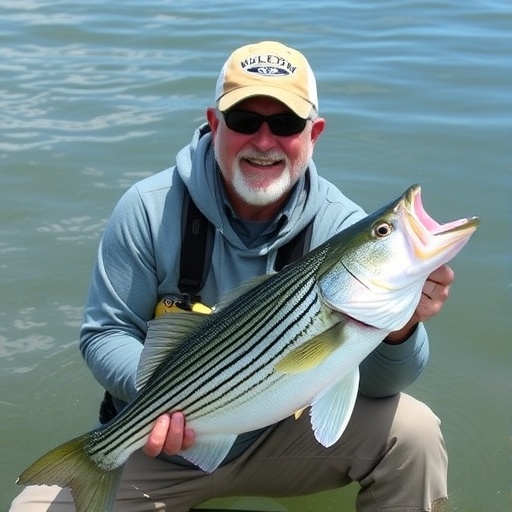
Nelson Researching Striped Bass Patterns and Population Health

July 14, 2026
in Science Education
Reading Time: 2 mins read
0
Nelson Researching Striped Bass Patterns and Population Health

Nelson Researching Striped Bass Patterns and Population Health

65
SHARES
587
VIEWS
Share on FacebookShare on Twitter
ADVERTISEMENT

Striped bass conservation may be on the verge of a more accurate, science-based turning point thanks to new research at George Mason University. Assistant Professor T. Reid Nelson is investigating how environmental conditions and angler-related factors shape the mortality risk that can occur after catch-and-release fishing.

For decades, catch-and-release mortality (CRM) has often been treated as a single fixed percentage—frequently cited as nine percent. But Nelson’s work challenges that simplification, arguing that CRM is not a constant. Instead, mortality likelihood can shift depending on salinity and water temperature, the type of fishing gear used, where the hook is placed, and how quickly and carefully fish are handled.

These variables matter because physiology responds to stress and injury in complex ways. In field conditions, fish may experience delayed recovery, oxygen limitations, or physical damage that varies with season and tactics. Angler experience can also influence outcomes, including how long fish are out of water and whether they are supported properly during release.

Nelson’s study is designed to produce a more precise estimate of CRM across all seasons of the year. Rather than relying on generalized assumptions, the project aims to quantify how real-world combinations of conditions translate into mortality risk for striped bass after release.

The goal is not only to refine ecological understanding, but also to improve fisheries management decisions. When managers use overly static mortality values, they may misjudge population impacts and set regulations that either underprotect the species or unnecessarily constrain fishing opportunities.

Equally important, better CRM estimates can reduce avoidable economic repercussions. Coastal communities and recreational fishing industries depend on sustainable stock assessments—especially when seasonal fishing pressure fluctuates.

Nelson is conducting this research with funding from the American Saltwater Guides Association. The support totals $152,708, with the project beginning in June 2026 and running through late August 2028.

As Nelson’s findings progress, they may help shift catch-and-release policies toward condition-specific risk models—an approach more consistent with how ecosystems actually behave.

Subject of Research: Catch-and-release mortality (CRM) in striped bass, and how environmental and human factors affect post-release mortality
Article Title: Striped Bass CRM May Vary Far More Than the “Nine Percent” Rule
Web References: https://www.gmu.edu/masonnow ; https://www.gmu.edu/about
References: American Saltwater Guides Association (funding)
Image Credits: Not provided
Keywords: striped bass, catch-and-release mortality, fisheries management, ecology, angler practices, salinity, temperature, gear type, hooking location

Tags: angler influence on fish healthcatch-and-release mortalityenvironmental factors affecting fish survivalfish handling and release techniquesfish physiology and stress responsefishing gear and hook placementGeorge Mason University fisheries researchimproving accuracy of catch-and-release mortality estimatesscience-based fish population managementseasonal variations in fish mortalityStriped bass conservationwater temperature and salinity impact
Share26Tweet16
Previous Post

Oregon Nearly 100-Partner Team Wins NSF Regional Innovation Award for Semiconductors

Next Post

UT partners secure up to $160M NSF funding for rural innovation growth

Related Posts

Early Technology Training Boosts Clinician Confidence in Patient Care
Science Education

Early Technology Training Boosts Clinician Confidence in Patient Care

July 15, 2026
NSF Names Rochester, New York as National Laser Innovation Hub
Science Education

NSF Names Rochester, New York as National Laser Innovation Hub

July 14, 2026
New Study Proposes Courageous Minority Theory for School Change in AI Era
Science Education

New Study Proposes Courageous Minority Theory for School Change in AI Era

July 14, 2026
Menstrual Health Remains Neglected Despite Impacting 2 Billion Globally
Science Education

Menstrual Health Remains Neglected Despite Impacting 2 Billion Globally

July 13, 2026
UTA Introduces New Doctor of Social Work Program
Science Education

UTA Introduces New Doctor of Social Work Program

July 13, 2026
Vitamin K Prevents Bleeding Risks in Newborns and Infants
Science Education

Vitamin K Prevents Bleeding Risks in Newborns and Infants

July 13, 2026
Next Post
UT partners secure up to $160M NSF funding for rural innovation growth

UT partners secure up to $160M NSF funding for rural innovation growth

  • Mothers who receive childcare support from maternal grandparents show more

    Mothers who receive childcare support from maternal grandparents show more parental warmth, finds NTU Singapore study

    27656 shares
    Share 11059 Tweet 6912
  • University of Seville Breaks 120-Year-Old Mystery, Revises a Key Einstein Concept

    1061 shares
    Share 424 Tweet 265
  • Bee body mass, pathogens and local climate influence heat tolerance

    682 shares
    Share 273 Tweet 171
  • Researchers record first-ever images and data of a shark experiencing a boat strike

    546 shares
    Share 218 Tweet 137
  • Groundbreaking Clinical Trial Reveals Lubiprostone Enhances Kidney Function

    531 shares
    Share 212 Tweet 133
Science

Embark on a thrilling journey of discovery with Scienmag.com—your ultimate source for cutting-edge breakthroughs. Immerse yourself in a world where curiosity knows no limits and tomorrow’s possibilities become today’s reality!

RECENT NEWS

  • Early Technology Training Boosts Clinician Confidence in Patient Care
  • CHEST Urges U.S. Government to Safeguard Research Advancing Patient Care
  • Scientists Reveal How Macrophages Age Differently Across the Body
  • Prey Access, Not Abundance, Drives Predator Behavior in Penguins

Categories

  • Agriculture
  • Anthropology
  • Archaeology
  • Athmospheric
  • Biology
  • Biotechnology
  • Blog
  • Bussines
  • Cancer
  • Chemistry
  • Climate
  • Earth Science
  • Editorial Policy
  • Marine
  • Mathematics
  • Medicine
  • Pediatry
  • Policy
  • Psychology & Psychiatry
  • Science Education
  • Social Science
  • Space
  • Technology and Engineering

Subscribe to Blog via Email

Enter your email address to subscribe to this blog and receive notifications of new posts by email.

Join 5,146 other subscribers

© 2025 Scienmag - Science Magazine

Welcome Back!

Login to your account below

Forgotten Password?

Retrieve your password

Please enter your username or email address to reset your password.

Log In
No Result
View All Result
  • HOME
  • SCIENCE NEWS
  • CONTACT US

© 2025 Scienmag - Science Magazine

Discover more from Science

Subscribe now to keep reading and get access to the full archive.

Continue reading
