


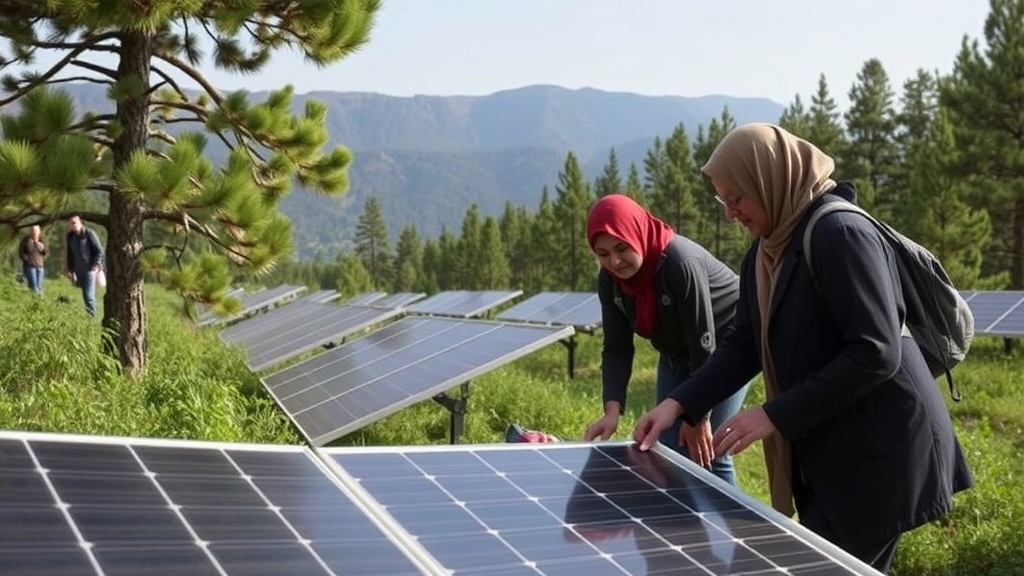
In the forested slopes of Iran’s Zagros Mountains, where more than 1.5 million people depend directly on woodland ecosystems for their livelihoods, the paradox of the global energy transition is on vivid display. These communities receive over 2,800 hours of sunshine each year, yet nearly 40 percent of surveyed households still cook and heat with firewood gathered from ecologically fragile forests, and adoption of household solar technology remains strikingly low. A new study published in Environmental and Sustainability Indicators argues that the obstacle is not engineering but psychology, economics and trust—and that policy designed around hardware alone will keep missing its targets.
Researchers Seyed Mohammad Javad Sobhani, Maryam Karimi Malek-Abadi and Morteza Taki surveyed 231 forest-dwelling households across 31 villages in Khuzestan Province, using multi-stage stratified random sampling drawn from a population of roughly 3,200 households. Their instrument measured eight latent constructs on a five-point Likert scale, from perceived usefulness and ease of use to cost burden, institutional trust, environmental awareness, subjective norms, behavioral intention and usage continuity. Data were collected face-to-face by trained local enumerators between June 2025 and February 2026, achieving a 93.1 percent effective response rate after quality screening.
The study’s central theoretical move is the introduction of an extended Socio-Ecological Technology Acceptance Model, or SETAM, which fuses the classic Technology Acceptance Model with the tripartite Social Acceptance Framework distinguishing socio-political, market and community acceptance. The authors argue that established frameworks such as TAM2, TAM3, UTAUT and UTAUT2 were built for stable institutional environments with formal credit systems and accessible after-sales markets, and therefore translate poorly to informal economies where upfront solar investment is psychologically weighed against immediate subsistence needs rather than long-term amortization.
SETAM departs from its predecessors in four ways. It folds maintenance literacy and post-installation support networks into perceived ease of use, recognizing that rural servicing logistics matter as much as technical complexity. It situates cost perception within irregular income streams. It treats institutional trust as a gatekeeper capable of amplifying or suppressing every other adoption driver. And it elevates subjective norms in tightly knit communities from a transient social influence to a structural determinant of whether a technology is seen as legitimate at all.
Empirically, the team combined Partial Least Squares Structural Equation Modeling with an artificial neural network to capture both linear causal pathways and non-linear thresholds. The model explained 58.3 percent of the variance in behavioral intention, with predictive relevance confirmed through blindfolding and PLSpredict procedures. The single-hidden-layer neural network, trained with Levenberg-Marquardt backpropagation and validated through Monte Carlo cross-validation, achieved a mean test RMSE of 0.178 against a training RMSE of 0.117, indicating robust generalization without overfitting.
The results are unambiguous about what drives adoption. Subjective norms emerged as the strongest predictor, with a standardized path coefficient of 0.33 and the highest normalized importance in the neural network at 100 percent. In collectivist settings, solar panels become socially legitimate only when neighbors endorse them and local leaders approve. Perceived cost and maintenance burden ranked second as the most formidable barrier, with a negative coefficient of 0.31. Institutional trust followed at 0.26, while perceived usefulness registered 0.28. Environmental awareness influenced intention primarily indirectly, mediated through perceived usefulness, accounting for 56 percent of its total effect—a finding that challenges awareness-centric campaigning.
Perhaps the most policy-relevant discovery comes from the neural network’s partial dependence analysis: adoption intention rises sharply only once perceived cost falls below a Likert-scale tipping point of 2.8. Cost perception, the authors conclude, does not behave linearly. Households operating under tight budget constraints experience a psychological threshold, below which marginal reductions in perceived financial burden yield disproportionate gains in willingness to adopt. Uniform subsidies, they argue, are inefficient because they ignore this tipping point; tiered, income-sensitive financing aimed at the households with the highest perceived burden would deliver far greater leverage per unit of public spending.
Multi-group analysis added a further nuance: first-time adopters are significantly more sensitive to cost and maintenance concerns than experienced solar users, with path coefficients of negative 0.423 versus negative 0.194 and a significant group difference at p equals 0.018. Institutional trust, by contrast, operated as a universal enabler with no significant difference between users and non-users, suggesting that credible subsidies, transparent warranty frameworks and consistent government communication reduce perceived risk for everyone. Robustness checks, including Gaussian copula tests for endogeneity and measurement invariance testing, confirmed that these estimates withstand omitted-variable bias and hold across education levels.
The authors translate their findings into four evidence-informed policy pathways for fossil-rich developing economies. First, replace uniform subsidies with tiered, income-sensitive co-payment structures that build financial literacy alongside ownership. Second, institutionalize community-based maintenance cooperatives—training local technicians, establishing spare-part supply chains and creating peer-support networks—to convert post-installation anxiety into sustained usage. Third, shift from top-down hardware deployment to participatory governance in which local leaders, forest authorities and energy agencies co-design subsidy timelines and guarantees. Fourth, exploit the power of social diffusion through visible demonstration installations and testimonial-based outreach, which the data suggest may be more cost-effective than traditional awareness campaigns, especially when reinforced by institutional credibility.
The stakes extend well beyond household convenience. The study frames solar adoption as a dual-purpose intervention advancing both SDG 7 on affordable clean energy and SDG 13 on climate action: every household that swaps firewood for photovoltaics eases deforestation pressure, reduces indoor air pollution and cuts carbon emissions from biomass combustion. By positioning social acceptance as a structural driver rather than an implementation afterthought, the Zagros research offers a transferable diagnostic framework for biomass-dependent communities across Sub-Saharan Africa, South Asia and Latin America. Its core message is deceptively simple: the energy transition will be won not on rooftops alone, but in the trust between governments and communities, and in the quiet consensus of neighbors watching a neighbor’s panels work.
Subject of Research: Socio-behavioral drivers and institutional enablers of household solar energy adoption among forest-dwelling communities in the Zagros Mountains of Iran.
Article Title: From fuelwood to photovoltaics: Socio-behavioral drivers and institutional enablers of household solar energy adoption in fossil-rich developing contexts
Article References: From fuelwood to photovoltaics: Socio-behavioral drivers and institutional enablers of household solar energy adoption in fossil-rich developing contexts. (n.d.). https://doi.org/10.1016/j.indic.2026.101515
Image Credits: AI Generated
DOI: 10.1016/j.indic.2026.101515
Keywords: solar energy adoption, Zagros Mountains, technology acceptance, institutional trust, subjective norms, energy poverty, PLS-SEM, artificial neural network, renewable energy policy, fuelwood, SDG 7, just energy transition
Cite Scienmag News
Faith Mcneil. (September 20, 2026). Neighbors and trust, not technology, decide who goes solar in Iran’s forests. Scienmag. https://scienmag.com/neighbors-and-trust-not-technology-decide-who-goes-solar-in-irans-forests/
Faith Mcneil. "Neighbors and trust, not technology, decide who goes solar in Iran’s forests." Scienmag, 20 September 2026, https://scienmag.com/neighbors-and-trust-not-technology-decide-who-goes-solar-in-irans-forests/. Accessed 5 October 2026.
Faith Mcneil. "Neighbors and trust, not technology, decide who goes solar in Iran’s forests." Scienmag. September 20, 2026. https://scienmag.com/neighbors-and-trust-not-technology-decide-who-goes-solar-in-irans-forests/


