


Pharmacokinetic studies live and die by the quality of their blood samples. To trace how a drug rises, peaks, and clears from the bloodstream, researchers must draw venous blood again and again at precisely timed intervals, and each additional puncture adds burden for participants and risk to the sampling schedule. A new pilot study suggests that a needle-free blood collection device can keep a single intravenous catheter working through an entire day of intensive sampling, potentially reshaping how early-phase drug research is conducted.
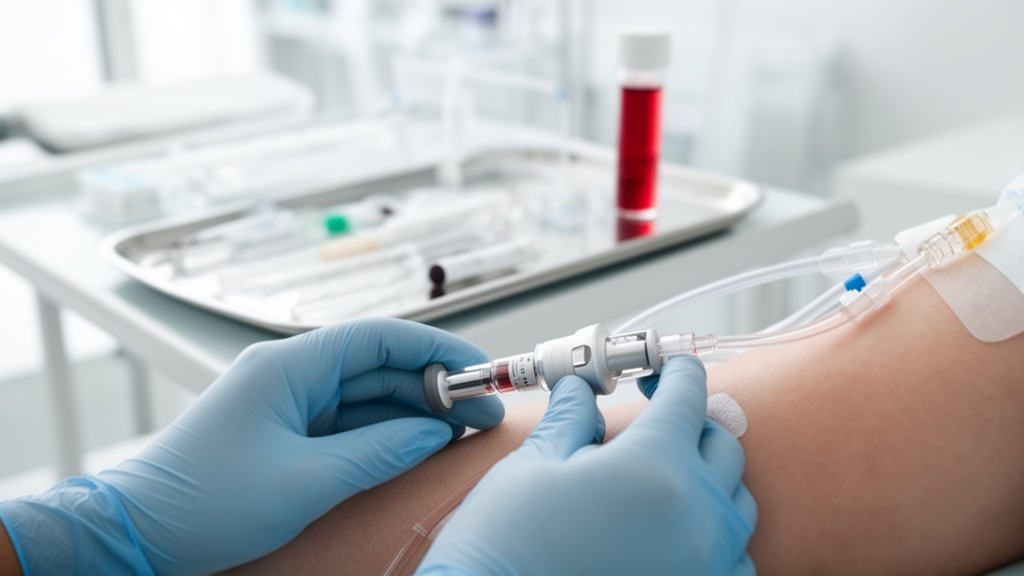
The study, published in Pharmacology Research & Perspectives, evaluated the PIVO Pro needle-free blood collection device, manufactured by BD of Franklin Lakes, New Jersey, in a phase 1 trial involving inhaled cannabinoids. Rather than repeatedly needle-sticking participants or aspirating blood directly through an IV line, the device inserts into an existing peripheral catheter and draws blood without any direct needle access. The research team, led by investigators at the University of Wisconsin-Madison, set out to determine whether this approach could sustain nine venous collections per dosing visit across sessions lasting roughly eight hours.
Five participants each completed a screening visit followed by three dosing visits, during which they received inhaled delta-8-tetrahydrocannabinol, delta-9-tetrahydrocannabinol, or a placebo. Because the protocol included full-scale driving simulator sessions, cognitive testing, and psychomotor assessments, the study took place in a university research facility rather than a clinical research unit, with a study physician and on-site clinical staff providing medical oversight throughout. Blood was drawn before dosing, immediately after, every 30 minutes for the first two hours, and again at three, four, and six and a half hours post-dose, yielding two 10-milliliter tubes per time point.
Venous access was established with a 20-gauge, 1.25-inch closed IV catheter system featuring a dedicated near-port for blood draws. A single clinician placed and maintained every catheter across all visits, a design choice that eliminated operator variability as a confounding factor. Before each collection, the catheter was flushed with saline, the needle-free device was inserted, blood was drawn, and the catheter was then flushed again and sealed with a disinfecting cap. When blood flow proved inadequate, the team followed a standardized escalation sequence: repositioning the device first, then replacing equipment, and only establishing new vascular access as a last resort.
Across 14 completed dosing visits, the approach proved operationally feasible. Approximately 42 percent of vascular access sites required replacement during the study, with six of the 14 initial IV sites failing. Notably, four of those six replacements occurred in a single participant, suggesting that individual vascular anatomy may have disproportionately influenced outcomes in this small cohort. The researchers point out that prior literature has reported failure rates as high as 69.2 percent for traditional open IV access systems, meaning the needle-free approach produced roughly 42 percent fewer instances of IV failure than anticipated. Most replacements happened early, within the first two hours of a visit, and were associated with poor initial blood return rather than progressive degradation later in the session.
Blood flow through the device was slower than standard venipuncture but generally sufficient to keep the demanding sampling schedule on track. Flow problems were frequently resolved through simple adjustments to catheter position, arm position, or the depth to which the device was advanced. The authors acknowledge that their troubleshooting protocol matured over the first few visits; early on, the team’s familiarity with direct IV aspiration sometimes led them to establish new access immediately rather than first attempting repositioning, which likely inflated the observed replacement rate.
Participant experience was uniformly positive. All five respondents to the post-study electronic survey indicated that the blood collection method was acceptable, and free-response feedback was sparse but telling. One participant described the blood collection component as minimally unpleasant, noting that finger sticks used for capillary microsampling were more bothersome than the IV-based draws. Only one adverse event attributable to vascular access was recorded across all 14 dosing visits: a single participant developed bruising and tenderness at an access site after a session in which a replacement catheter had been needed. The bruising resolved on its own without intervention and did not interfere with daily activities.
The safety implications extend beyond participants. Biological exposures are the leading cause of workplace injuries among healthcare workers, and the closed IV system with needle-free collection eliminated the syringe transfers typically required for IV aspiration while reducing sharps exposure. The authors note that federal regulations under 29 CFR 1910.030 specifically call out needleless systems as a means of minimizing uncontrolled release of potentially infectious material, giving research staff safety both an ethical and a statutory foundation in intensive sampling protocols.
The findings build on earlier hospital-based evaluations showing that the PIVO device can provide clinically valid specimens, reduce hemolysis, and improve patient acceptability while preserving catheter function for infusion. What distinguishes the new work is its setting: rather than routine inpatient workflows, the device was tested in a non-clinical research environment where protocol adherence demanded precise serial collections over eight-hour visits. A large multicenter implementation study of more than 150,000 PIVO blood collections reported only a modest reduction in catheter replacement rates, but that study excluded early implementation data, monitored patients within routine clinical workflows, and did not require catheter replacement solely because blood could not be obtained. Direct comparison with the present pilot is therefore difficult, and the authors caution that their captured learning curve may have inflated failure rates.
The study has clear limitations. It was small, lacked a comparator arm using standard venipuncture or direct IV aspiration, and was not designed to formally evaluate whether drug concentrations measured through the device are equivalent to those obtained conventionally. Flow characteristics and causes of catheter failure were not prospectively quantified. Still, the authors conclude that needle-free blood collection through an existing peripheral IV catheter is feasible and acceptable in pharmacokinetic-intensive research, may reduce repeated venipuncture and sharps exposure in early-phase or non-clinical settings, and warrants controlled comparative studies to establish analytical equivalence and long-term access performance relative to conventional methods.
Subject of Research: Needle-free blood collection device for maintaining IV patency in pharmacokinetic studies
Article Title: Maintaining IV Patency Throughout Pharmacokinetic Studies Through a Needle‐Free Blood Draw Device
Article References: Naviaux, W., Leinweber, D., & Barkholtz, H. (2026). Maintaining IV Patency Throughout Pharmacokinetic Studies Through a Needle‐Free Blood Draw Device. Pharmacology Research & Perspectives, 14(6), Article e70333. https://doi.org/10.1002/prp2.70333
Image Credits: AI Generated
DOI: 10.1002/prp2.70333
Keywords: pharmacokinetics, needle-free blood collection, IV catheter patency, PIVO Pro, clinical research methods, phase 1 trial, cannabinoid study, venous blood sampling, sharps exposure, participant safety, Maintaining, Patency
Cite Scienmag News
Louis Brooks. (October 19, 2026). Needle-Free Blood Draw Device Keeps IV Lines Open Through Intensive Pharmacokinetic Studies. Scienmag. https://scienmag.com/needle-free-blood-draw-device-keeps-iv-lines-open-through-intensive-pharmacokinetic-studies/
Louis Brooks. "Needle-Free Blood Draw Device Keeps IV Lines Open Through Intensive Pharmacokinetic Studies." Scienmag, 19 October 2026, https://scienmag.com/needle-free-blood-draw-device-keeps-iv-lines-open-through-intensive-pharmacokinetic-studies/. Accessed 19 October 2026.
Louis Brooks. "Needle-Free Blood Draw Device Keeps IV Lines Open Through Intensive Pharmacokinetic Studies." Scienmag. October 19, 2026. https://scienmag.com/needle-free-blood-draw-device-keeps-iv-lines-open-through-intensive-pharmacokinetic-studies/


