

Wednesday, October 21, 2026
Science
No Result
View All Result
  • Login
  • HOME
  • SCIENCE NEWS
  • CONTACT US
  • HOME
  • SCIENCE NEWS
  • CONTACT US
No Result
View All Result
Scienmag
No Result
View All Result
Home Science News Chemistry

Near-Freezing Water Balances Oxygen Evolution Activity and Catalyst Stability

October 21, 2026
in Chemistry
Bethany Barker
By Bethany Barker Scienmag Editorial Profile - Catalysis
Reading Time: 2 mins read
0
Near-Freezing Water Balances Oxygen Evolution Activity and Catalyst Stability

Near-Freezing Water Balances Oxygen Evolution Activity and Catalyst Stability

65
SHARES
587
VIEWS
Share on FacebookShare on Twitter
ADVERTISEMENT

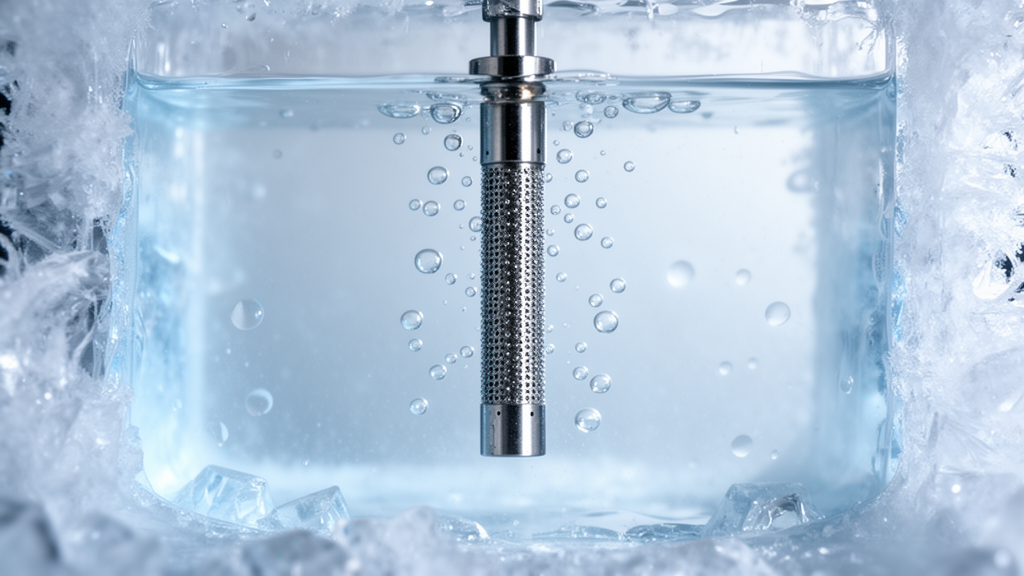
Cooling an electrolyte to just below 0 °C can extend the operating life of a manganese dioxide electrocatalyst for the oxygen evolution reaction, despite reducing its reaction rate. A study of γ-MnO2 found that near-freezing conditions suppressed catalyst degradation associated with permanganate formation more strongly than they slowed water oxidation. The result identifies a narrow temperature optimum in which activity and stability can be balanced, rather than a simple trade-off in which faster catalysis necessarily means faster deterioration. The reported behavior contrasts with the usual temperature dependence of chemical reactions, for which higher temperatures generally accelerate catalytic processes.

The experiments examined how the temperature dependence of oxygen evolution and permanganate formation changed across a broad range, with reported measurements spanning temperatures from 80 to −12 °C. At temperatures above the freezing point of water, the oxygen evolution reaction behaved conventionally: reducing the temperature decreased its rate. The degradation pathway followed a different pattern, however. Cooling from conventional operating temperatures toward 0 °C increasingly restrained permanganate formation, and the catalyst’s long-term stability improved. At −8 °C, long-term tests found substantially better retention than at higher temperatures, demonstrating that the enhancement was associated with durability rather than increased catalytic output.

Further cooling did not produce a continually better outcome. Below 0 °C, permanganate formation accelerated rather than being further suppressed, creating an optimum close to the freezing point. This reversal was linked to the supercooling of the electrolyte and a temperature-dependent structural transition in water. The findings indicate that the reactions respond differently to changes in the surrounding molecular environment: cooling can initially restrict degradation more effectively than it restricts oxygen evolution, but pushing the electrolyte farther below its normal freezing point changes the balance. The authors describe this as an anti-Arrhenius response, noting that it is a rare example of anomalous temperature-dependent electrocatalysis under subzero conditions.

For electrocatalysts susceptible to competing reaction pathways, temperature may therefore function as a selective control variable. Instead of maximizing water oxidation alone, operators could seek a temperature at which the useful reaction remains sufficiently active while degradation is minimized. The study’s implications extend to electrochemical systems that must operate during winter, in polar regions, or in extraterrestrial environments, where water may approach or fall below its freezing point. The work does not establish a universal operating temperature for electrolysis: its conclusions are based on γ-MnO2 in the tested electrolyte and conditions, and the central result is an optimum near 0 °C rather than a claim that colder is always better. It nevertheless shows that deliberately managing temperature can lengthen catalyst lifetime without eliminating catalytic activity, offering a design principle for balancing performance and durability in water-oxidizing systems.

Subject of Research: Temperature control of activity and degradation in manganese dioxide electrocatalysts for water oxidation

Article Title: Cooling water to near freezing breaks the activity–stability trade-off of water oxidation electrocatalysis

Article References: Wardhana, A. C., Ooka, H., Lim, T., Li, A., Adachi, K., Chen, C., Hashizume, D., & Nakamura, R. (2026). Cooling water to near freezing breaks the activity–stability trade-off of water oxidation electrocatalysis. Nature Chemistry. https://doi.org/10.1038/s41557-026-02274-8

Image Credits: AI Generated

DOI: 10.1038/s41557-026-02274-8

Keywords: electrocatalysis, manganese dioxide, oxygen evolution reaction, catalyst stability, permanganate formation, temperature control, subzero electrolytes, electrolyte supercooling, catalyst degradation, Cooling, water, near

Cite Scienmag News

Bethany Barker. (October 21, 2026). Near-Freezing Water Balances Oxygen Evolution Activity and Catalyst Stability. Scienmag. https://scienmag.com/near-freezing-water-balances-oxygen-evolution-activity-and-catalyst-stability/


Bethany Barker. "Near-Freezing Water Balances Oxygen Evolution Activity and Catalyst Stability." Scienmag, 21 October 2026, https://scienmag.com/near-freezing-water-balances-oxygen-evolution-activity-and-catalyst-stability/. Accessed 21 October 2026.

Bethany Barker. "Near-Freezing Water Balances Oxygen Evolution Activity and Catalyst Stability." Scienmag. October 21, 2026. https://scienmag.com/near-freezing-water-balances-oxygen-evolution-activity-and-catalyst-stability/

Tags: balancing activity and stability in water splittingcatalyst degradationcatalyst stabilitycoolingeffects of sub-zero temperatures on oxygen evolutionElectrocatalysisElectrocatalyst stability at near-freezing temperatureselectrolyte cooling impact on electrolysiselectrolyte supercoolingelectrolyte temperature optimization for durable catalystslong-term electrocatalyst performancemanganese dioxidemanganese dioxide oxygen evolution reactionnearoptimizing catalyst longevityoxygen evolution reactionpermanganate formationpermanganate formation suppressionsubzero electrolytestemperature controltemperature effects on catalyst degradationtemperature-dependent catalyst activitywaterwater oxidation at low temperatures
Share26Tweet16
Previous Post

Brazilian cancer biobank targets precision prevention for diverse population

Next Post

Research report: Patient characteristics and the safety of stent placement for malignant vena cava syndrome in Japan: a nationwide analysis

Related Posts

Water as we’ve never known it: Physicists test water beyond Earth-like conditions
Chemistry

Water as we’ve never known it: Physicists test water beyond Earth-like conditions

October 20, 2026
Spin fluctuations linked to superconductivity in electron-doped cuprate
Chemistry

Spin fluctuations linked to superconductivity in electron-doped cuprate

October 20, 2026
Magnetic probes reveal chemical environments inside molecular framework pores
Chemistry

Magnetic probes reveal chemical environments inside molecular framework pores

October 20, 2026
Spectroscopy and DFT characterize methyl 6-bromo-2-naphthoate
Chemistry

Spectroscopy and DFT characterize methyl 6-bromo-2-naphthoate

October 20, 2026
Imaging individual reactions reveals voltage-dependent catalyst design trade-offs
Chemistry

Imaging individual reactions reveals voltage-dependent catalyst design trade-offs

October 20, 2026
Statistical optimization yields nanoscale silver oxide for alkaline cathodes
Chemistry

Statistical optimization yields nanoscale silver oxide for alkaline cathodes

October 20, 2026
Next Post
Research report: Patient characteristics and the safety of stent placement for malignant vena cava syndrome in Japan: a nationwide analysis

Research report: Patient characteristics and the safety of stent placement for malignant vena cava syndrome in Japan: a nationwide analysis

  • Mothers who receive childcare support from maternal grandparents show more optimized

    Mothers who receive childcare support from maternal grandparents show more parental warmth, finds NTU Singapore study

    27656 shares
    Share 11059 Tweet 6912
  • University of Seville Breaks 120-Year-Old Mystery, Revises a Key Einstein Concept

    1061 shares
    Share 424 Tweet 265
  • Bee body mass, pathogens and local climate influence heat tolerance

    682 shares
    Share 273 Tweet 171
  • Researchers record first-ever images and data of a shark experiencing a boat strike

    546 shares
    Share 218 Tweet 137
  • Groundbreaking Clinical Trial Reveals Lubiprostone Enhances Kidney Function

    531 shares
    Share 212 Tweet 133
Science

Embark on a thrilling journey of discovery with Scienmag.com—your ultimate source for cutting-edge breakthroughs. Immerse yourself in a world where curiosity knows no limits and tomorrow’s possibilities become today’s reality!

RECENT NEWS

  • Research report: Patient characteristics and the safety of stent placement for malignant vena cava syndrome in Japan: a nationwide analysis
  • Near-Freezing Water Balances Oxygen Evolution Activity and Catalyst Stability
  • Brazilian cancer biobank targets precision prevention for diverse population
  • Three-layer sisal-biochar epoxy laminate achieves 88.1 MPa tensile strength

Categories

  • Agriculture
  • Anthropology
  • Archaeology
  • Athmospheric
  • Biology
  • Biotechnology
  • Blog
  • Bussines
  • Cancer
  • Chemistry
  • Climate
  • Earth Science
  • Editorial Policy
  • Marine
  • Mathematics
  • Medicine
  • Pediatry
  • Policy
  • Psychology & Psychiatry
  • Science Education
  • Science News
  • Social Science
  • Space
  • Technology and Engineering

Subscribe to Blog via Email

Enter your email address to subscribe to this blog and receive notifications of new posts by email.

Join 5,150 other subscribers

© 2025 Scienmag - Science Magazine

Welcome Back!

Login to your account below

Forgotten Password?

Retrieve your password

Please enter your username or email address to reset your password.

Log In
No Result
View All Result
  • HOME
  • SCIENCE NEWS
  • CONTACT US

© 2025 Scienmag - Science Magazine

Discover more from Science

Subscribe now to keep reading and get access to the full archive.

Continue reading