


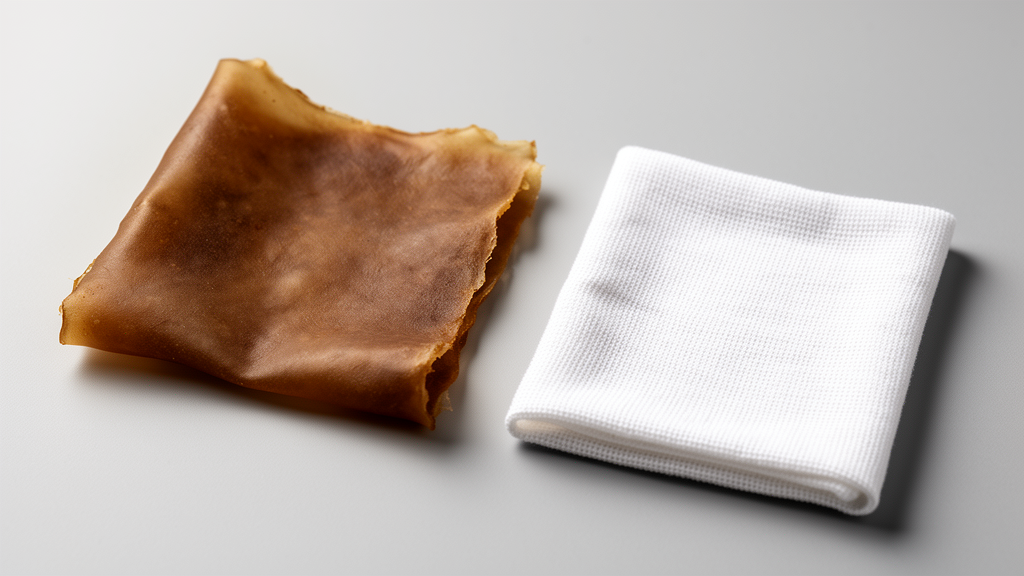
Kombucha leather, the dried bacterial cellulose biofilm harvested from fermented tea, has become one of the most talked-about candidates for a biodegradable alternative to synthetic fashion materials. A new study has now put that promise to a rigorous test, and the results reveal a material that is chemically sound and naturally colourable but still far behind conventional fabrics in the properties that matter for real garments. Researchers cultivated bacterial cellulose with a kombucha culture, dyed it with three natural colourants including waste coffee grounds, and then measured shrinkage, button strength and wicking behaviour against a standard cotton textile fabric. The gap was substantial on every performance measure.
The team grew six bacterial cellulose samples from the same SCOBY mother culture in a medium of white sugar and black tea, using strains of Acetobacter indonesiensis alongside Bacillus subtilis and Saccharomyces cerevisiae identified in earlier work by MALDI testing. After two weeks of fermentation at controlled ambient temperature and humidity, the pellicles were harvested, rinsed and soaked in a mild detergent solution for 24 hours to remove residual impurities. The samples were then dyed under two conditions: in-situ dyeing, where wet fabric went directly into the dye bath for 48 hours, and ex-situ dyeing, where the pellicles were first dried and then dyed. Three dye sources were used: gardenia pods, sappan wood and, in a nod to circular economy thinking, spent coffee grounds collected from a nearby coffee outlet.
The dye chemistry varied by source. Gardenia pods contain water-soluble carotenoid glycosyl esters, including crocetin derivatives, and have been reported to impart antioxidant, antibacterial and UV-protection properties to cellulosic textiles. Sappan wood contains brazilin, a dye precursor oxidised to brazilein, the compound responsible for the characteristic red to red-orange hues. The coffee waste dye bath was prepared at 57 grams per litre and mixed with aged iron water, itself recovered from old motorbike components, as a colour modifier. Each extracted dye liquor was divided between paired in-situ and ex-situ baths drawn from the same extraction batch, ensuring that any differences between the two dyeing conditions reflected the dyeing method rather than the dye preparation.
Scanning electron microscopy showed how strongly the dye source shaped the surface architecture of the fabric. Coffee-dyed samples displayed dense, granular surfaces with large ellipsoidal or rod-shaped structures, possibly associated with embedded bacterial cells and coffee ground particles. Gardenia-dyed samples differed from each other markedly: the in-situ sample showed a porous, elongated structure with continuous long fibrils on top, while its ex-situ counterpart was denser and more irregularly granular. Sappan wood samples revealed dense networks of intricately interwoven sub-micron nanofibres characteristic of pure bacterial nanocellulose. Measured with ImageJ software, fibre diameters across the samples ranged from 800 to 2000 nanometres, and the authors attribute the morphological variation to both the dye sources and the inherent growth variability of fermentation.
Fourier transform infrared spectroscopy confirmed that all six samples retained the core cellulosic structure, with broad O-H stretching peaks between 3200 and 3400 cm⁻¹, C-H vibrations around 2900 to 3000 cm⁻¹, carbonyl peaks near 1630 cm⁻¹ and the characteristic C-O fingerprint region between 1000 and 1100 cm⁻¹. Crucially, the spectra of dyed samples showed identical peaks with no new functional groups, indicating that the natural dyes were physically incorporated within the bacterial cellulose matrix rather than covalently bonded to the fibres. The researchers suggest this physical presence, rather than chemical fixation, may underlie the relatively poor colour fastness of the dyed kombucha fabric, a limitation they acknowledge openly when comparing the depth of shades with traditional dye systems.
Dimensional stability emerged as a serious concern. Shrinkage of the dyed samples ranged from 2.5 to 7.3 percent lengthwise and 2.2 to 7.3 percent crosswise, with the highest values recorded for the gardenia-dyed pair and the lowest lengthwise value for a sappan wood sample. By comparison, the reference cotton fabric shrank by less than 3 percent. The authors explain that bacterial cellulose is a highly hydrated gel-like membrane during growth, and that immersion in warm dye baths followed by drying generates capillary tension, fibre aggregation and thermal densification of the nanofibrillar network, driving the size reduction. Since some fashion brands specify a maximum shrinkage of 2 percent for certain products, the researchers conclude that garments made from kombucha fabric would require careful design or chemical and mechanical finishing to control dimensional change. Statistical analysis found the differences among the six samples insignificant in both directions, and no consistent trend linked dye type or dyeing method to shrinkage.
Button strength, a measure of how firmly fasteners stay attached under stress, revealed an even starker deficit. The standard cotton fabric held buttons at 72 newtons, while the kombucha fabrics ranged from just 3 to 8 newtons, with the ex-situ sappan wood sample performing best and the ex-situ gardenia sample worst. The authors attribute the weakness to the material’s nonwoven nanofibrillar architecture: unlike woven fabrics, where continuous yarns share load across the structure and friction redistributes stress around the button, bacterial cellulose behaves more like paper or felt, with randomly oriented nanofibres and low inter-fibre adhesion. The fabric’s high stiffness and low flexibility also caused visible damage during needle attachment, further reducing holding strength. Analysis of variance confirmed the differences between the textile and kombucha groups were statistically significant, as were the differences among the kombucha samples themselves.
Comfort-related wicking properties were similarly poor. In horizontal wicking tests, the cotton fabric spread water 55 to 90 millimetres within one minute, while the kombucha samples managed at most 2 millimetres, and four of the six samples showed zero wicking entirely. Vertical wicking told the same story: the reference fabric reached 96 millimetres in ten minutes, whereas no kombucha sample exceeded 9 millimetres. The researchers explain that although bacterial cellulose is hydrophilic when wet and can hold up to 15 percent moisture at standard conditions, its dried structure lacks the interconnected capillary pathways needed for liquid transport. Its pores are mostly nanoscale and tortuous, so water is absorbed locally and retained rather than spread across the surface, which could leave a next-to-skin garment feeling damp and clingy instead of drawing perspiration away.
The study’s environmental framing is measured rather than promotional. Using waste coffee grounds for dyeing valorises a major food-industry byproduct, and the composted grounds, sun-dried gardenia pods and sappan wood, low-temperature processing, shade drying without electrical equipment and the recovered iron-water modifier all reduce energy use and resource consumption. Yet the authors caution that the overall sustainability claim depends heavily on substrate type, cultivation and harvesting methods, water usage, drying and dyeing techniques and the scale of production, and they recommend a full lifecycle assessment following ISO 14040, 14044 and 14067 standards to quantify the carbon footprint properly. Bacterial cellulose avoids the agricultural land demands of cotton and the fossil fuel dependence of synthetics, but genuine ecofriendliness at scale remains unproven.
The findings suggest that dyeing conditions and dye type affected fibre morphology and functional performance, but no single dyeing technique consistently improved all properties. The researchers state that future work will focus on chemical finishes to improve button strength, hydrophilic treatments to enhance wicking, optimised drying to create a less dense and more porous structure, and improved dimensional stability, while also testing natural dyes from other geographic regions. For now, kombucha leather remains a chemically confirmed, naturally colourable biomaterial with demonstrated potential, but the measured performance data show it is not yet ready to replace conventional textiles in durable, comfortable garments. The value of this study lies precisely in benchmarking how far the material still has to go.
Subject of Research: Characterisation of naturally dyed kombucha bacterial cellulose fabric for sustainable fashion and textile applications
Article Title: Characterisation of natural dyed kombucha fabric as a sustainable material for fashion and textile applications
Article References: Nayak, R., Prendergast, C., & Cleveland, D. (2026). Characterisation of natural dyed kombucha fabric as a sustainable material for fashion and textile applications. Results in Engineering, 32, Article 113393. https://doi.org/10.1016/j.rineng.2026.113393
Image Credits: AI Generated
DOI: 10.1016/j.rineng.2026.113393
Keywords: kombucha leather, bacterial cellulose, natural dyes, sustainable textiles, coffee waste valorisation, shrinkage, button strength, wicking, SEM, FTIR spectroscopy, biodegradable materials, fashion sustainability
Cite Scienmag News
Denise Maddox. (October 25, 2026). Naturally Dyed Kombucha Leather Falls Short of Cotton on Textile Performance. Scienmag. https://scienmag.com/naturally-dyed-kombucha-leather-falls-short-of-cotton-on-textile-performance/
Denise Maddox. "Naturally Dyed Kombucha Leather Falls Short of Cotton on Textile Performance." Scienmag, 25 October 2026, https://scienmag.com/naturally-dyed-kombucha-leather-falls-short-of-cotton-on-textile-performance/. Accessed 25 October 2026.
Denise Maddox. "Naturally Dyed Kombucha Leather Falls Short of Cotton on Textile Performance." Scienmag. October 25, 2026. https://scienmag.com/naturally-dyed-kombucha-leather-falls-short-of-cotton-on-textile-performance/


