


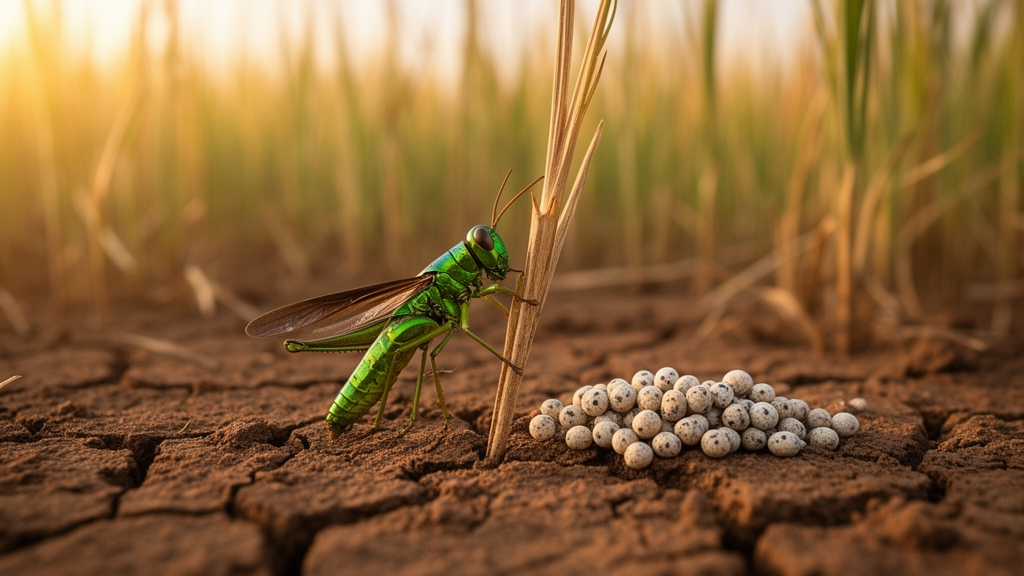
Locusts and grasshoppers, members of the family Acrididae, represent some of the most devastating agricultural pests on Earth. These insects thrive in dry grassland and desert environments, where their rapid population growth can lead to catastrophic levels of crop destruction. The economic and social impact of these outbreaks is profound, affecting the livelihoods of one in every ten people worldwide. When populations explode, the nymphal stages of certain species congregate into dense bands, while winged adults form swarms capable of migrating hundreds of kilometers in a single day. This rapid expansion allows them to invade previously uninfested regions, stripping vegetation and causing significant socio-economic losses on an international scale. The destruction of food sources not only threatens human food security but also impacts wildlife and contributes to soil erosion by removing protective vegetation cover.
Recent history provides a stark example of the scale of these threats. From 2018 to 2020, Africa, the Middle East, and Southeast Asia experienced one of the most severe outbreaks of the desert locust, Schistocerca gregaria. The crisis began in the Arabian Peninsula, with swarms spreading by the end of 2019 to cover a vast area from the Horn of Africa to India and Pakistan. This event highlighted the urgent need for effective control strategies that do not rely solely on conventional chemical pesticides. Traditional control methods often utilize chemicals such as malathion, lambda-cyhalothrin, and fipronil. However, the injudicious use of these substances has raised serious concerns regarding human health, biodiversity loss, and hazards to environmentally sensitive areas, including waterways and national parks.
Consequently, researchers and agricultural managers are increasingly turning to biological control as a vital component of integrated pest management. This approach leverages the natural enemies of locusts and grasshoppers to suppress outbreaks in an eco-friendly manner. More than 70 natural enemies have been reported to attack these pests, ranging from microscopic pathogens to large vertebrate predators. These organisms include entomopathogenic fungi, bacteria, nematodes, predatory insects, birds, reptiles, and mammals. By conserving and maintaining these natural enemies, it is possible to achieve natural suppression of outbreaks while augmenting control efforts with specific biological agents. This strategy offers a reliable method for pest control that minimizes negative effects on human and animal health while preserving ecological balance.
Entomopathogenic fungi stand out as particularly effective biological control agents. Unlike other microorganisms, these fungi do not need to be ingested to infect their hosts. Instead, they infect by direct contact with the host’s cuticle, penetrating the haemocoel through hyphal body penetration. The most notable species in this category is Metarhizium acridum, which has been widely studied and deployed in various regions. This fungus exhibits a wide distribution pattern, colonizing environments from the Arctic to the tropics, including forests, savannahs, and deserts. It is highly selective, posing no significant threat to non-target species such as birds, amphibians, and reptiles. In fact, fungal-infected insects often become sluggish and easier prey for birds, creating a synergistic effect that enhances the overall impact of biological control.
Microsporidia, specifically Paranosema locustae, represent another critical class of biological control agents. This obligate parasite reproduces within the host’s target cells, primarily the adipose tissue, causing high mortality rates in locusts and grasshoppers. Its infection mechanism involves the polar tube of the spore injecting plasma into the target cells. P. locustae has a broad host spectrum within the order Orthoptera, with more than 120 grasshopper species susceptible to the pathogen. Despite its effectiveness against these pests, it is considered safe for humans, animals, and other non-target organisms. The pathogen’s ability to sporulate in infected hosts and its potential for vertical transmission make it a promising tool for long-term population management in deserts and grasslands.
Entomopathogenic viruses and bacteria also play significant roles in the biological control of acridids. Viruses, such as Entomopoxvirus B, can infect multiple species of locusts and grasshoppers, offering a precise and ecologically stable alternative to chemical pesticides. Bacteria like Serratia marcescens and Bacillus thuringiensis have been isolated from locusts and shown to be effective in laboratory settings. B. thuringiensis, in particular, is widely used against various insect pests due to its production of specific protein toxins that are lethal to target insects. These microbial agents can be incorporated into integrated pest management programs, often alongside chemical pesticides, to prolong the effectiveness of control measures and reduce the overall reliance on synthetic chemicals.
Beyond microbial agents, arthropods and vertebrates serve as essential natural enemies in the regulation of locust and grasshopper populations. Predatory insects, such as ants, parasitic wasps, and beetles, feed on locust hoppers and eggs, causing significant mortality. For instance, the larvae of blister beetles and bee flies are important predators of grasshopper eggs, while parasitoids like Scelio species can destroy a substantial percentage of egg capsules. Mites, such as Eutrombidium trigonum, also contribute to population control by parasitizing grasshoppers in their larval stages and preying on eggs in later stages. These interactions highlight the complexity of the ecological networks that keep pest populations in check, demonstrating that the removal of any single natural enemy can lead to increased chances of outbreaks.
Vertebrate predators, including birds, reptiles, and mammals, are also crucial components of the biological control system. Birds can reduce acridid densities by 30 to 50 percent, with at least 537 bird species known to prey on locusts and grasshoppers in Africa alone. Some bird families are specialized acridivores, while others, such as storks and starlings, synchronize their movements with the seasonal migrations of grasshoppers. In certain regions, bird predation is actively used as a management tool, with herded ducks and chickens helping to control locust populations. Reptiles and mammals, including lizards, snakes, foxes, and ground squirrels, also feed on these insects, further contributing to the natural suppression of outbreaks. This diverse array of predators ensures that locust and grasshopper populations remain below catastrophic levels in balanced ecosystems.
The commercial availability of biological control agents has further advanced the field. Formulations of Metarhizium acridum, such as Green Guard, Green Muscle, Novacrid, and Metacridium, are now used in various countries, including Australia, the United Kingdom, Africa, and Mexico. In China, over 100,000 hectares are sprayed with M. acridum and Paranosema locustae annually. These commercial products demonstrate the practical viability of biological control on a large scale. By integrating these natural enemies with other sustainable pest control practices, it is possible to reduce reliance on chemical pesticides, safeguard agricultural productivity, and promote healthier ecosystems. The preservation of natural habitats and the provision of favorable conditions for these natural enemies are essential for fostering ecologically sound management strategies that benefit both agriculture and the environment.
Subject of Research: Biological control of locusts and grasshoppers using natural enemies
Article Title: Biological control of locusts and grasshoppers: A review
Article References: Yasin, M., Khan, A., Qayyum, M. A., Yousuf, H. M. B., Mehfooz, A., & Hunter, D. (2024). Biological control of locusts and grasshoppers: A review. Journal of Orthoptera Research, 33(2), 289-304. https://doi.org/10.3897/jor.33.114472
Image Credits: AI Generated
Keywords: locusts, grasshoppers, biological control, entomopathogenic fungi, Metarhizium acridum, integrated pest management, agricultural pests, ecological balance, natural enemies, sustainable agriculture, Biological, control
Cite Scienmag News
Roger Howard. (October 18, 2026). Natural Enemies Offer Eco-Friendly Locust Control. Scienmag. https://scienmag.com/natural-enemies-offer-eco-friendly-locust-control/
Roger Howard. "Natural Enemies Offer Eco-Friendly Locust Control." Scienmag, 18 October 2026, https://scienmag.com/natural-enemies-offer-eco-friendly-locust-control/. Accessed 18 October 2026.
Roger Howard. "Natural Enemies Offer Eco-Friendly Locust Control." Scienmag. October 18, 2026. https://scienmag.com/natural-enemies-offer-eco-friendly-locust-control/


