


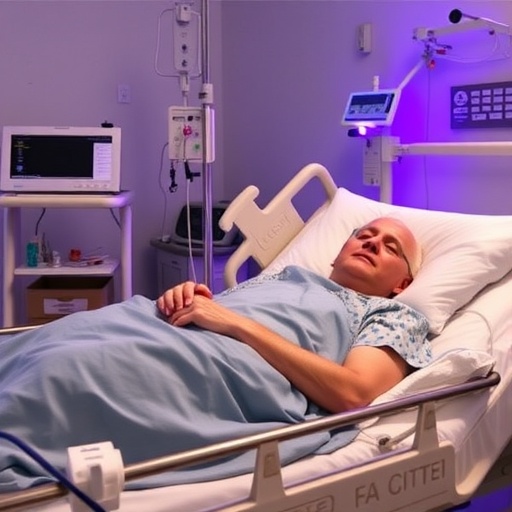
UC San Diego Health has embarked on a landmark five-year multi-center clinical research initiative dedicated to advancing our understanding of sleep and delirium management in adults undergoing care in Intensive Care Units (ICUs) across the United States. This extensive study targets the critical intersection of sleep physiology and acute critical illness, addressing a pervasive yet often overlooked complication experienced in ICUs: the disruption of normal sleep patterns. The research is positioned to fill significant gaps in current critical care practices, with potentially transformative implications for patient outcomes.
The ICU environment, while indispensable for delivering life-sustaining care to patients with severe trauma, acute medical crises, or postoperative recovery needs, is frequently characterized by noise, constant light exposure, and routine interruptions linked to monitoring and interventions. These factors contribute to profound disturbances in circadian rhythms and sleep architecture, which are hypothesized to exacerbate delirium—a common neuropsychiatric syndrome marked by acute cognitive dysfunction and fluctuating mental status observed in severely ill patients.
Funded by a $12 million award from the Patient-Centered Outcomes Research Institute (PCORI), this multi-institutional study spans eight major hospitals nationwide. The research is spearheaded by Biren Kamdar, MD, MHS, a pulmonologist and critical care specialist at UC San Diego Health, who serves as the principal investigator. UC San Diego Health also plays a central role as the clinical coordinating center, applying its expertise in critical care research infrastructure to standardize protocols and optimize study execution across all participating sites.
The research team’s focus is to systematically evaluate the efficacy of various sleep-promotion strategies currently employed or proposed in ICU settings. These strategies encompass non-pharmacological interventions such as noise and light reduction, sleep hygiene protocols, and the use of earplugs and eye masks, alongside pharmacological approaches involving sedatives and melatonin analogues. Given the heterogeneity in ICU practices and patient populations, the study aims to determine which interventions are not only effective but also scalable and sustainable in real-world hospital environments.
Dr. Kamdar emphasizes that impaired sleep is among the most common and distressing complaints reported by hospitalized patients, often correlating with poorer recovery trajectories. Delirium itself is associated with increased mortality, prolonged ICU stays, and long-term cognitive decline. By elucidating the relationship between sleep and delirium, the study seeks to quantify how improvements in sleep quality might mitigate delirium incidence and severity, ultimately leading to enhanced patient outcomes and reduced healthcare costs.
Another cornerstone of the project is its patient-centered approach, incorporating feedback and engagement from patients, families, and frontline ICU clinicians. This inclusive methodology ensures that sleep-promotion interventions are tailored to the lived experiences and practical constraints of critical care settings, thereby facilitating adoption and adherence. The integration of stakeholder perspectives is anticipated to address barriers to implementation and optimize intervention designs for diverse ICU contexts.
Technological innovation plays a pivotal role in this study. State-of-the-art sleep monitoring tools—including polysomnography and wearable actigraphy devices—are utilized to capture objective sleep metrics within the ICU. These data allow researchers to characterize disruptions in sleep stages, sleep efficiency, and circadian rhythm entrainment in critically ill patients more precisely than ever before. Advanced analytical techniques will link these sleep parameters with delirium assessment scores, biochemical markers of inflammation, and patient-reported outcomes.
The study also delves into the mechanistic underpinnings of delirium development in relation to sleep disturbances. Evidence suggests that disrupted sleep exacerbates neuroinflammation, oxidative stress, and neurotransmitter imbalances, which collectively precipitate acute brain dysfunction. Understanding these pathophysiological mechanisms could guide the development of targeted therapeutics to complement non-pharmacological sleep interventions and further reduce delirium burden.
By focusing on ICU populations, where delirium prevalence ranges from 20% to over 80% depending on patient acuity and setting, this research has the potential to shift paradigms in critical care. Traditional ICU protocols seldom prioritize sleep health, yet this project advocates for its elevation as a fundamental component of holistic critical illness management. If successful, it could inform evidence-based clinical guidelines and promote widespread adoption of sleep-protective strategies in ICUs worldwide.
Moreover, the study is uniquely structured to address implementation science challenges by evaluating not just whether sleep improvements reduce delirium but also how these interventions can be systematically integrated into everyday ICU workflows. This approach acknowledges the complexity of ICU environments and the necessity for adaptable, clinician-friendly protocols without adding burdensome procedures.
In summary, UC San Diego Health’s initiative represents a pioneering effort to unravel the complex nexus between sleep and delirium in critical care, leveraging cutting-edge technology, patient engagement, and rigorous clinical methodology. The outcomes promise to pave the way for enhanced patient experiences, improved clinical outcomes, and potentially substantial reductions in healthcare costs associated with ICU delirium and its sequelae.
This research is a beacon of hope for critically ill patients and their families, shining a light on the intrinsic value of sleep even amidst the most challenging medical circumstances. The interdisciplinary collaboration, robust funding, and leadership of Dr. Kamdar affirm the commitment to elevating critical care standards and advancing knowledge that could reverberate across medical disciplines.
Cite Scienmag News
Ophelia Keating. (May 7, 2026). Nationwide Study Aims to Enhance Sleep Quality in ICU Patients. Scienmag. https://scienmag.com/nationwide-study-aims-to-enhance-sleep-quality-in-icu-patients/
Ophelia Keating. "Nationwide Study Aims to Enhance Sleep Quality in ICU Patients." Scienmag, 7 May 2026, https://scienmag.com/nationwide-study-aims-to-enhance-sleep-quality-in-icu-patients/. Accessed 4 September 2026.
Ophelia Keating. "Nationwide Study Aims to Enhance Sleep Quality in ICU Patients." Scienmag. May 7, 2026. https://scienmag.com/nationwide-study-aims-to-enhance-sleep-quality-in-icu-patients/


