


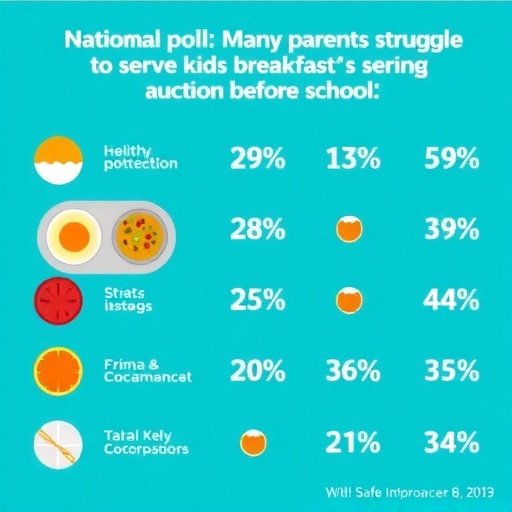
As families across the United States rebuild school-day routines, a familiar morning problem is taking on new significance: how to get children to eat a nutritious breakfast before they leave home. A nationally representative survey from the University of Michigan Health C.S. Mott Children’s Hospital indicates that the challenge is not simply whether children eat in the morning, but whether their breakfast supplies the nutrients needed to support satiety, concentration and energy through the first hours of the school day. Three-quarters of parents surveyed reported at least one obstacle to providing a healthy breakfast on a typical school day, revealing how time pressure, behavior and food preferences intersect at the kitchen table.
The most frequently reported barriers were picky eating, children being slow or irritable after waking and insufficient time before school. Television and other screens were identified less often as distractions, suggesting that the central difficulty may be the compressed structure of the morning rather than technology alone. The findings come from responses provided in July by 1,037 parents who had at least one child between 6 and 12 years old. Although the survey describes family experiences rather than measuring children’s health outcomes directly, it offers a detailed picture of how breakfast decisions are made during one of the day’s most constrained periods.
Most children do eat something before or during the school day. Approximately two-thirds of parents said their child typically eats breakfast at home, while nearly one in four reported that their child eats at school. Smaller proportions said children eat on the way to school or usually skip breakfast. Yet the amount of time available for eating is often limited. One in three parents said their child has 15 minutes or less for breakfast, nearly half reported a window of 15 to 25 minutes, and only about one in five said their child has at least 30 minutes. Such narrow time frames can make foods requiring preparation, cooling or extended eating difficult to include, even when parents understand their nutritional value.
The survey also points to a gap between eating breakfast and eating a nutritionally balanced breakfast. Fewer than half of parents said their child’s morning meal includes protein, fiber or whole or cut fruit on most days of the week. Only about one-third reported that breakfast is typically low in added sugar. These components have distinct physiological roles. Protein can slow gastric emptying and help maintain fullness, while dietary fiber contributes to digestive function and can moderate the rate at which carbohydrates are absorbed. Whole fruit provides fiber and micronutrients in addition to naturally occurring sugars. By contrast, frequent intake of added sugars can increase the energy density of a meal without necessarily producing sustained satiety.
Parents’ priorities reveal why convenient foods often dominate the morning menu. More than two-thirds considered it very important to offer something their child likes, while two in five placed strong importance on speed and convenience. About one in four prioritized foods the child could prepare independently. Among children who eat at home or on the way to school, slightly more than half usually decide what they will eat. This autonomy can support the development of food preferences and practical independence, but the survey found that children taking the lead were also associated with fewer days in which breakfast included protein, fiber or fruit, or was low in added sugar. The pattern does not establish that children’s choices cause poorer nutritional quality, but it suggests that the range of available options strongly shapes the outcome.
Breakfast cereal illustrates this tension between preference and nutrition. When buying cereal, parents most commonly consider what their child likes, followed by nutritional characteristics such as protein and fiber. Calories, added sugar, price and artificial coloring are also considered. From a nutritional perspective, two products that appear similar in a bowl may produce different effects depending on their fiber content, protein contribution and sugar concentration. A cereal that is higher in fiber and paired with fruit, milk or yogurt may provide a more substantial combination of carbohydrates, protein and micronutrients than a highly sweetened cereal eaten alone. However, forcing a child to eat an unfamiliar food may turn breakfast into a conflict and make regular eating less likely.
For that reason, pediatrician Susan Woolford, co-director of the Mott Poll, recommends that parents shape the food environment while allowing children to choose among nutritious options. This approach reflects a broader principle in feeding research: adults determine what foods are offered, when they are served and where eating occurs, while children are given an appropriate degree of control over whether and how much they eat. The strategy can reduce pressure and preserve a child’s sense of agency without abandoning nutritional goals. It also allows gradual exposure to new flavors and textures, which may be more effective than insisting that a child immediately accept a food they have rejected.
Improving breakfast does not necessarily require a new menu or substantially more time. Small substitutions can alter the nutritional profile of familiar foods. Whole-grain bread can replace white bread, peanut butter can add protein and energy-dense unsaturated fats to toast, and fruit can accompany a usual breakfast rather than being offered as a separate replacement. A smoothie made with whole or cut fruit can provide an alternative to juice, although its nutritional value depends on the ingredients and portion size. Vegetables can be added to an omelet, and a higher-fiber cereal can replace a lower-fiber option. Preparing some foods in advance may also reduce the time burden during the morning rush, especially for families managing multiple school schedules.
The breakfast setting may influence more than nutrient intake. About two-thirds of parents said their child typically eats with a sibling, while approximately half said the child eats with a parent. Around one in six reported that the child usually eats alone. Shared meals can create opportunities for adults to model eating behavior, observe appetite and encourage conversation, but busy mornings make a single routine unrealistic for every household. The survey’s central message is therefore not that families must produce an ideal breakfast each day. Instead, a workable morning meal is one that fits the family’s schedule, contains at least some meaningful sources of protein, fiber or fruit, and is acceptable enough that the child will actually eat it. In the race to get children out the door, modest changes may be more sustainable—and more scientifically useful—than perfection.
Web References: https://mottpoll.org/reports/starting-day-healthy-way
Cite Scienmag News
Ophelia Keating. (August 24, 2026). National Poll: Many Parents Struggle to Serve Kids Healthy Breakfast Before School. Scienmag. https://scienmag.com/national-poll-many-parents-struggle-to-serve-kids-healthy-breakfast-before-school/
Ophelia Keating. "National Poll: Many Parents Struggle to Serve Kids Healthy Breakfast Before School." Scienmag, 24 August 2026, https://scienmag.com/national-poll-many-parents-struggle-to-serve-kids-healthy-breakfast-before-school/. Accessed 3 September 2026.
Ophelia Keating. "National Poll: Many Parents Struggle to Serve Kids Healthy Breakfast Before School." Scienmag. August 24, 2026. https://scienmag.com/national-poll-many-parents-struggle-to-serve-kids-healthy-breakfast-before-school/


