

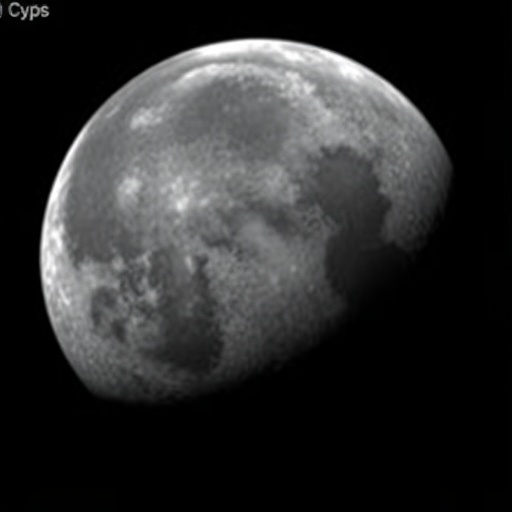
A groundbreaking investigation led by researchers at the University of Hawaiʻi at Mānoa is reshaping our understanding of lunar water ice distribution within the Moon’s elusive permanently shaded regions (PSRs). Published recently in Science Advances, this compelling research delivers the most intricate and nuanced examination to date of these shadowed craters where sunlight never reaches. The findings challenge existing paradigms by indicating that water ice is far less abundant on the lunar surface than once anticipated, existing only in sparse pockets or at low concentrations, upending expectations about the Moon’s polar deposits.
The research team, spearheaded by Dr. Shuai Li of the Hawaiʻi Institute of Geophysics and Planetology, builds on nearly a decade of lunar exploration and data synthesis. Notably, Dr. Li’s earlier work in 2018 first confirmed surface ice on the Moon using data from India’s Chandrayaan-1 mission, a major milestone in lunar science. This latest study elevates the methodology by utilizing NASA’s ShadowCam, an extraordinarily sensitive imaging device aboard South Korea’s Korea Pathfinder Lunar Orbiter (KPLO), also known as Danuri, which specializes in elucidating the deepest shadows on the lunar surface by capturing subtle sunlight reflected off crater walls.
ShadowCam’s unique ability to image these darkest craters enables a novel approach to exploring the Moon’s ice reservoirs. By employing advanced stereoscopic imaging techniques, the team captured multiple perspectives of illumination and reflectance in the PSRs. This has enabled an unprecedented analysis of the scattering properties of reflected light—a key optical fingerprint that distinguishes water ice from lunar regolith. Unlike the Moon’s rocky surface, which predominantly reflects light back toward its source (backscattering), water ice exhibits a forward-scattering characteristic, sending more light in the direction of the incoming rays’ path.
Quantitative results from these stereo observations presented an unexpected revelation: no evidence was found of extensive, high-concentration ice deposits above 20% to 30% by weight within the studied PSRs. This is particularly surprising given the Moon’s frigid polar environments, which are even colder than those found on Mercury or the asteroid Ceres—both bodies known for abundant, nearly pure ice at their poles. The scarcity of lunar ice deposits prompts a reevaluation of the processes that influence water stability and retention in these permanently shadowed locales.
One hypothesis put forth attributes this disparity to the distinct surface conditions present on Mercury. Mercury’s significantly higher surface temperatures might encourage more efficient water production via solar wind implantation and subsequent chemical reactions, whereas the Moon’s colder, static surface could impede similar mechanisms. Additionally, lunar processes such as intense space weathering by solar and cosmic radiation, ongoing volcanic degassing, and constant overturning of the regolith by micrometeorite impacts likely act to degrade or conceal ice from detectable surface layers, effectively reducing the observable ice concentration.
Delving deeper into the optical properties, Dr. Li and colleagues showcased how analyzing light scattering through stereo imaging revolutionizes lunar ice detection. This technique was previously unattainable and represents a novel intersection of photometric and lunar geological analysis. Light scattering patterns emerge as a convincing diagnostic tool—rock and dust exhibit classic backscattering, while water ice’s forward-scattering pattern acts as an unmistakable signature. Identifying even subtle forward-scattering signals allows for greater confidence in asserting the presence of surficial ice deposits.
The high-resolution ShadowCam data revealed several localized sites approximately 20 to 50 meters across, which displayed both heightened reflectivity and the unique forward-scattering directional optical behavior indicative of ice concentrations surpassing 10% by weight. Although these findings affirm the presence of water ice in some lunar PSRs, Dr. Li expressed unexpected surprise at the limited number and size of these bright patches, underscoring the rarity of significant ice concentrations on the lunar surface.
Moreover, the spatial distribution of these ice-bearing regions tends to correlate with relatively young impact craters, suggesting recent exposure or concentration mechanisms might be at play. It is plausible that water ice lies beneath the surface layers, shielded from harsh space weathering by regolith or other geological processes, evading current surface detection methods. As a result, subsurface reservoirs might represent a more abundant and stable water source on the Moon, awaiting future exploration technologies to reveal their extent.
At the time of publication, comprehensive stereo imaging was limited to only six sites within the PSRs. However, the extended mission duration of ShadowCam until early 2028 will allow further stereo observations to expand the dataset and potentially unveil more ice-rich areas. The mission’s finite power supply, projected to end during a lunar eclipse, adds urgency to these ongoing investigations.
While this high-sensitivity lunar reconnaissance marks a significant leap forward, the study emphasizes that future missions equipped with detectors capable of discerning water ice concentrations below 1% will be essential for comprehensive mapping of the Moon’s remaining water resources. Such advancements could uncover widespread low-level deposits that escape detection by current instrumentation, providing pivotal insights for potential in situ resource utilization (ISRU) strategies critical to sustained human presence on the Moon.
The implications of this research extend far beyond lunar science. Understanding ice stability and distribution in permanently shaded environments informs planetary geology, astrochemistry, and the evolving narratives of water delivery throughout the inner solar system. It illuminates the complex interactions between solar wind, micrometeorite bombardment, thermal gradients, and geological activity on airless bodies, compelling scientists to refine models of volatile retention and loss.
Dr. Li’s work thus invites the scientific community to reevaluate longstanding assumptions about lunar water ice, encouraging new hypotheses and innovative observational strategies. The subtle mirrors of light reflecting within the Moon’s perpetual darkness are proving both elusive and enriching, heralding a new era of lunar exploration grounded in cutting-edge photometric and remote sensing techniques.
As humanity prepares for renewed lunar exploration under Artemis and other programs, deciphering the Moon’s water ice inventory is pivotal not only for scientific discovery but for establishing sustainable off-world outposts. This research underscores the multifaceted challenges inherent in detecting and utilizing extraterrestrial water, setting the stage for future missions that will venture deeper into the Moon’s shadowed craters and, ultimately, unlock secrets spread quietly across its frozen soils.
Subject of Research: Not applicable
Article Title: Searching for surficial water ice in lunar permanently shaded regions (PSRs) with ShadowCam
News Publication Date: 18-Mar-2026
Web References: http://dx.doi.org/10.1126/sciadv.aec8211
References: Science Advances, DOI: 10.1126/sciadv.aec8211
Image Credits: NASA
Keywords
Lunar ice, Permanently shaded regions, Moon, ShadowCam, Korea Pathfinder Lunar Orbiter, Light scattering, Space weathering, Solar wind, Lunar exploration, Remote sensing, Water ice detection


