


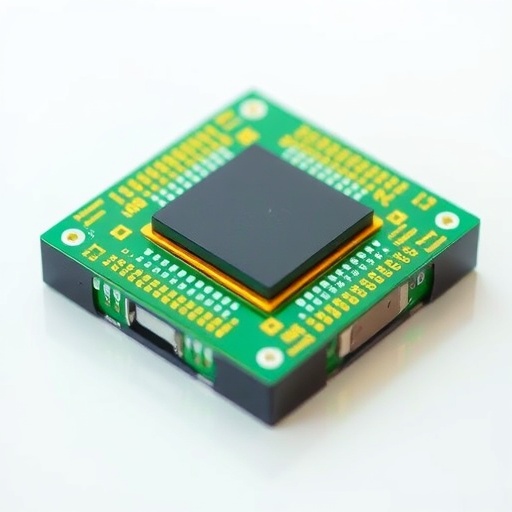
In a groundbreaking advancement, researchers at the National Institute of Standards and Technology (NIST) have pioneered a revolutionary technique to package photonic integrated circuits (PICs) capable of enduring and operating flawlessly under extreme environmental conditions. These tiny chips, which use light rather than electrical currents to transfer information, overcome the limitations faced by conventional semiconductor chips, paving the way for transformative applications in fields that demand resilience to heat, radiation, vacuum, and cryogenic temperatures.
Photonic integrated circuits offer remarkable advantages over their electronic counterparts, including extraordinarily high data transmission speeds and significantly reduced power consumption. However, their deployment has been restricted by the fragility of their optical connections, which tend to fail under harsh environmental stresses. The fundamental obstacle that has long impeded progress is the reliable attachment of optical fibers to photonic chips—a delicate interface whose integrity is critical to the chip’s performance.
Traditional bonding methods rely heavily on organic polymer adhesives, which are prone to degradation through cracking, outgassing, and chemical breakdown when exposed to extreme conditions such as intense radiation, ultrahigh vacuum, and rapid thermal cycling. Once these adhesive bonds fail, the photonic system becomes inoperable, limiting the practical use of PICs primarily to benign laboratory settings and mild industrial environments.
To surmount this formidable challenge, the NIST team adapted hydroxide catalysis bonding (HCB), a sophisticated technique originally developed by NASA for the assembly of large, ultra-stable optical components utilized in space telescopes and ground-based astronomical observatories. Unlike conventional glues, HCB employs a minute quantity of sodium hydroxide solution to initiate a chemical reaction that fuses the surfaces of the chip and the optical fiber at the molecular level. This inorganic glasslike bond forms an exceptionally rigid and stable connection, adroitly preserving optical alignment.
The researchers demonstrated for the first time that HCB provides the precise optical fiber alignment and efficient light coupling required for photonic circuits while simultaneously creating a packaging solution that can withstand punishing environmental stresses. When subjected to a battery of hostile conditions—including cryogenic cooling to near absolute zero temperatures, rapid temperature cycling, intense ionizing radiation, and ultrahigh vacuum—the HCB-bonded fiber connection remained flawlessly intact without impairing the chip’s performance.
This resilience has profound implications for quantum computing and quantum technology platforms, where photonic chips frequently must operate within ultrahigh vacuum environments at temperatures just above absolute zero. The stability of these bonds ensures robust, long-term functionality in these settings, enabling quantum sensors and processors to maintain delicate coherence and signal integrity that would otherwise be compromised by conventional packaging failures.
Beyond quantum technologies, this breakthrough opens exciting new avenues for deploying photonic chips in some of the most challenging environments known. High-radiation zones in nuclear reactors, the vacuum and temperature extremes of space exploration, and the high-temperature, chemically aggressive conditions common in industrial and energy sectors can now accommodate photonics-based sensors and communication systems thanks to this innovative packaging.
While direct high-temperature testing on fully assembled photonic chips was limited due to constraints inherent in commercial optical fibers, supplementary experiments demonstrated the astounding mechanical stability of HCB bonds well beyond the thermal tolerance of typical adhesives. This indicates an exceptional environmental operating window that far surpasses prior photonic packaging solutions.
The holistic approach redefines the concept of chip packaging by eschewing polymer-based materials in favor of inorganic chemical bonding techniques optimized for longevity and environmental resistance. This paradigm shift not only addresses chronic reliability issues but also significantly broadens the horizon for integrated photonics to serve missions and applications where previously deemed impossible.
Despite the current hydroxide catalysis bonding process requiring several days to complete, the NIST team underscores that this limitation is fundamentally an engineering challenge rather than a scientific obstacle. With targeted development and refinement, it is anticipated that the procedure can be accelerated dramatically, paving the way for scalable, cost-effective manufacturing of photonic packaged systems for extreme environments.
Nikolai Klimov, a physicist at NIST and the lead scientist on this project, highlighted the significance of achieving a bond as resilient as the optical fiber itself, emphasizing that this technology ushers photonic integrated circuits into environments that were off-limits until now. This leap forward is poised to catalyze advances in telecommunications, sensing, quantum computing, and space instrumentation.
The study’s findings represent a major step toward the integration of photonics into the next generation of technologies, offering unparalleled speed and power efficiency with the durability demanded by extreme operational conditions. Through innovative chemical bonding methodologies, photonic integrated circuits are now on the cusp of revolutionizing applications across disciplines previously constrained by environmental obstacles.
This pioneering research, recently published in the journal Photonics Research, exemplifies the marriage of fundamental materials science with applied photonic engineering, heralding a future where light-based circuitry can reliably venture into the most inhospitable realms while maintaining peak performance and precision.
Cite Scienmag News
Grant Pearson. (March 30, 2026). Advancing Photonic Chip Packaging for Harsh and Extreme Environments. Scienmag. https://scienmag.com/advancing-photonic-chip-packaging-for-harsh-and-extreme-environments/
Grant Pearson. "Advancing Photonic Chip Packaging for Harsh and Extreme Environments." Scienmag, 30 March 2026, https://scienmag.com/advancing-photonic-chip-packaging-for-harsh-and-extreme-environments/. Accessed 3 September 2026.
Grant Pearson. "Advancing Photonic Chip Packaging for Harsh and Extreme Environments." Scienmag. March 30, 2026. https://scienmag.com/advancing-photonic-chip-packaging-for-harsh-and-extreme-environments/


