

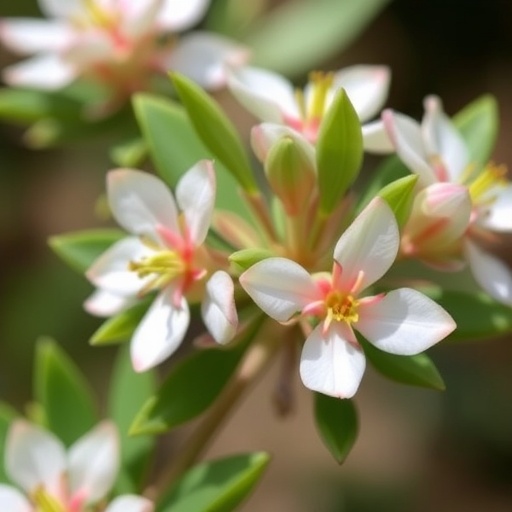
In a promising stride towards alternative therapies for Alzheimer’s disease, researchers have embarked on an innovative study that highlights the potential benefits of an age-old herb: Myrtus communis, commonly known as myrtle. The study stands as a pioneering randomized, double-blind parallel-group clinical trial investigating the effects of hydroalcoholic capsules of myrtle extract on patients diagnosed with mild to moderate Alzheimer’s disease. This groundbreaking research marks a significant exploration into the realm of herbal medicine within the context of neurodegenerative disorders that have long puzzled the medical community.
The emergence of Alzheimer’s disease as one of the leading causes of dementia worldwide necessitates urgent research for alternative and complementary therapeutic approaches. Traditional medications often come with an array of side effects, prompting a quest for natural alternatives that could potentially offer safe and effective treatment options. Myrtle, recognized for its various therapeutic properties, could serve as a beacon of hope for patients and healthcare providers alike. Researchers are now turning their eyes towards the potential neuroprotective benefits of this herb, assessing its efficacy in preserving cognitive function in affected individuals.
Myrtus communis has a rich history of use in traditional medicine systems, attributed to its antioxidant, anti-inflammatory, and antimicrobial properties. The extract derived from the leaves and berries of this plant has been analyzed for various health benefits over the years. Previous studies indicated promising results in cognitive enhancements and neuroprotection, paving the way for more rigorous clinical evaluation. The research team aimed to elucidate whether the encapsulated hydroalcoholic extract would demonstrate tangible effects on memory, cognition, and overall quality of life in individuals with Alzheimer’s disease.
In the study, participants were carefully selected based on stringent inclusion and exclusion criteria, ensuring that a homogenous group was represented. Those enrolled in the study were adults diagnosed with mild to moderate stages of Alzheimer’s disease. The randomized design of the trial meant that participants were assigned to either receive the myrtle extract capsules or a placebo, thereby setting the stage for an unbiased assessment of the extract’s impact. The use of double-blind methodologies eliminated the risk of bias from both researchers and participants, lending credibility to the findings.
Throughout the trial, a comprehensive array of evaluation tools was employed to assess memory, cognition, and daily living activities. The mini-mental state examination (MMSE) served as a fundamental measure of cognitive function, while quality of life was gauged using established questionnaires. These multifaceted assessments allowed researchers to gather a well-rounded overview of the impacts, ensuring that both subjective and objective data were collected. Such meticulous methodologies enhance the robustness of the study and provide a clearer picture of the extract’s potential benefits.
Initial results have stirred considerable excitement within the scientific community. Many participants showed marked improvement in cognitive domains such as attention, memory recall, and problem-solving tasks. Specifically, the study observed a noteworthy enhancement in short-term memory and daily functioning among those receiving the myrtle extract compared to the placebo group. Such findings bolster the premise that natural compounds like those found in myrtle can significantly contribute to enhancing cognitive function and offer a semblance of relief to Alzheimer’s patients yearning for alternatives to conventional pharmacotherapy.
The potential mechanisms through which Myrtus communis exerts its effects are beginning to be delineated. Researchers postulate that the antioxidant properties of the extract could play a pivotal role in reducing oxidative stress—one of the key contributors to the progression of Alzheimer’s disease. Furthermore, the anti-inflammatory properties may help mitigate neuroinflammatory responses, thus preserving neuronal health and promoting neurogenesis. This insight into the underlying biology heralds a new chapter in understanding how herbal compounds can inform therapeutic strategies in Alzheimer’s care.
Continuing studies will aim to identify the longevity of these effects and whether sustained use of myrtle extract could lead to lasting improvements in patient outcomes. One intriguing aspect of the research is the investigation into dosages and individual variations in response; these factors will be crucial in tailoring treatments to fit patient-specific needs. Understanding how different demographics respond to myrtle will enhance the broader application of this therapy in clinical settings.
Moreover, as the research progresses, the importance of interdisciplinary collaboration has become evident. By integrating pharmacological insights with traditional herbal medicine practices, researchers can pave the way for innovative treatment modalities. This partnership between modern science and age-old wisdom symbolizes a transformative approach to healthcare, where diverse methods coalesce to address complex diseases like Alzheimer’s in a holistic manner.
Given the widespread prevalence of Alzheimer’s disease and the limited effectiveness of current treatments, the implications of this research extend far beyond individual patient care. If further studies confirm the efficacy of Myrtus communis as a therapeutic agent, healthcare systems may embrace herbal extracts as legitimate components of dementia management protocols. Such developments could encourage further investments into research focused on understanding the pharmacological benefits of other traditional herbs, thus enriching the therapeutic landscape for patients across the globe.
In conclusion, the preliminary clinical evaluation of Myrtus communis in the context of Alzheimer’s disease symbolizes a pivotal moment in herbal medicine’s evolution into mainstream healthcare. It highlights not only the potential for improving cognitive function among patients but also the importance of exploring natural treatments that can complement existing therapies. As we stand at the intersection of tradition and innovation, it becomes clear that the future of Alzheimer’s treatment may very well involve a return to our natural roots.
While this study reflects promising initial findings, it also calls for more extensive research to validate the results. Moving forward, the quest for effective Alzheimer’s therapies cannot solely rest on singular studies but must involve a continuous cycle of research, testing, and refinement. Each step taken in this direction will undoubtedly contribute to a deeper understanding of Alzheimer’s disease and the role that natural extracts like myrtle can play in alleviating its burden.
As the scientific community awaits the final results of this groundbreaking trial, the excitement surrounding Myrtus communis crescendos. Patients, caregivers, and researchers alike are left with a glimmer of hope that future avenues of treatment may finally illuminate a pathway to better cognitive health and improved quality of life for those grappling with this devastating disease.
Subject of Research: Effects of Myrtus communis on cognitive function in mild to moderate Alzheimer’s disease.
Article Title: Preliminary clinical evaluation of capsules containing standard hydroalcoholic extract of Myrtus communis L. in patients with mild to moderate Alzheimer’ disease: a randomized, double-blind parallel-group clinical trial.
Article References:
Kamali, M., Ansari, M., Nooraee, P. et al. Preliminary clinical evaluation of capsules containing standard hydroalcoholic extract of Myrtus communis L. in patients with mild to moderate Alzheimer’ disease: a randomized, double-blind parallel-group clinical trial. BMC Complement Med Ther (2026). https://doi.org/10.1186/s12906-025-04994-9
Image Credits: AI Generated
DOI:
Keywords: Alzheimer’s disease, Myrtus communis, herbal medicine, neurodegenerative disorders, cognitive function, randomized controlled trial, antioxidant properties, anti-inflammatory properties.


