


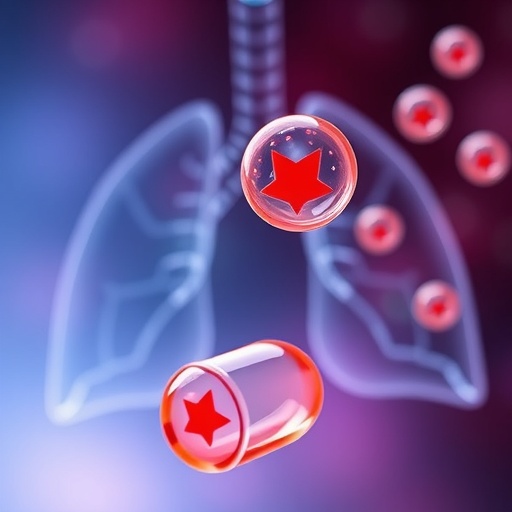
Lung cancer continues to stand as one of the most formidable challenges in oncology, consistently ranking among the leading causes of cancer-related mortality worldwide. The prognosis for many patients remains bleak, largely due to late-stage diagnoses when curative surgical options are limited or non-viable. Chemotherapy, despite its indispensable role in the current therapeutic arsenal, is often hindered by systemic toxicities and a narrow therapeutic window, which constrains the dose intensity clinicians can safely administer. These limitations necessitate the exploration of innovative drug delivery systems that can selectively target tumor cells while sparing healthy tissues.
In addressing this imperative, extracellular vesicles (EVs) have emerged as a cutting-edge solution in the realm of targeted drug delivery. These nanoscale, membrane-enclosed particles are naturally secreted by virtually all cell types and possess unique biological properties that make them highly attractive for therapeutic applications. EVs are inherently biocompatible and non-immunogenic, enabling them to circulate in the bloodstream without eliciting adverse immune responses. Moreover, their capacity to traverse biological barriers and bypass lysosomal degradation pathways permits efficient cytosolic delivery of payloads, making them superior to many synthetic carriers in terms of intracellular drug transport.
Capitalizing on these attributes, a research team led by Dr. Ramesh at the University of Oklahoma has pioneered a sophisticated EV-based platform specifically engineered for lung cancer therapy. This platform ingeniously integrates nanotechnology with biochemical targeting strategies and controlled drug release mechanisms to create a multifunctional therapeutic vector. Central to their design is the surface modification of EVs with transferrin (Tf), a protein that selectively binds to the transferrin receptor (TfR), which is markedly overexpressed on the surface of lung cancer cells. This targeted approach significantly enhances the selective uptake of the drug-loaded EVs by tumor cells, thus amplifying therapeutic efficacy.
The therapeutic payload encapsulated within these engineered EVs consists of gold nanoparticle (GNP)-cisplatin conjugates, a conjugate that merges the potent cytotoxicity of cisplatin with the versatile photothermal properties of gold nanoparticles. This innovative combination ensures a pH-responsive release of cisplatin; the acidic microenvironment characteristic of tumor sites triggers the accelerated release of the drug, thereby providing spatially and temporally controlled chemotherapy. The strategic design maximizes the cytotoxic impact on malignant cells while minimizing collateral damage to healthy lung tissue and other organs, such as the kidneys, where cisplatin-induced nephrotoxicity is a significant clinical concern.
Extensive in vitro studies demonstrated that these tumor-targeted multifunctional extracellular vesicles (tt-Mfn-EVs) exhibit enhanced cellular internalization and intracellular drug delivery specifically in TfR-overexpressing lung cancer cells. This selective cytotoxicity was corroborated by increased markers of apoptosis and DNA damage within the treated cancer cells. Importantly, the platform displayed minimal toxicity toward normal human lung and kidney cells, underscoring the potential of this delivery system to reduce systemic side effects compared to conventional chemotherapy regimens.
Beyond their chemotherapeutic capabilities, the GNP-loaded EVs possess intrinsic photothermal properties, enabling their use in combined photothermal and chemotherapy treatments. Upon near-infrared irradiation, the gold nanoparticles convert light energy into heat, causing localized hyperthermia that further sensitizes tumor cells to chemotherapeutic agents. This combinatorial strategy not only intensifies tumor cell eradication but also expands the therapeutic versatility of the platform, opening avenues for multimodal cancer treatments that can be tailored to individual patient needs.
This multifunctional EV platform marks a significant departure from traditional passive drug carriers by functioning as an active, tumor-targeted system that responds dynamically to the tumor microenvironment. The incorporation of pH-responsive drug release and receptor-mediated cellular uptake mechanisms exemplifies a precision medicine approach, designed to maximize therapeutic benefit while mitigating the risk of off-target toxicities. The ability to fine-tune drug release kinetics and employ external stimuli such as photothermal activation positions this platform at the forefront of next-generation nano-bio therapeutics.
The implications of this research transcend lung cancer, as the modular nature of the EV platform allows for adaptation to various cancer types and potentially other diseases characterized by aberrant receptor expression or distinct microenvironmental features. Moreover, the biocompatibility and intrinsic targeting capabilities of EVs make them well-suited for theranostic applications, combining therapeutic and diagnostic functions into a single nanoscale vector. This convergence could revolutionize current patient monitoring paradigms by enabling real-time tracking of drug delivery and therapeutic response.
Published in the journal Extracellular Vesicles and Circulating Nucleic Acids, the study titled “Tumor-targeted multifunctional extracellular vesicles as drug carriers for lung cancer therapy” provides a comprehensive blueprint for harnessing the synergistic potential of EV biology and nanotechnology. The paper meticulously details the synthesis of GNP-cisplatin conjugates, EV isolation and surface functionalization protocols, and in vitro efficacy assessments, furnishing a robust foundation for future preclinical and clinical investigations.
As the oncology field moves toward personalized medicine, the ability to deploy such sophisticated, responsive drug delivery systems augurs well for enhancing patient outcomes. The study’s demonstration of minimized nephrotoxicity and systemic side effects highlights a critical advance in chemotherapeutic precision, addressing long-standing clinical challenges associated with cisplatin-based regimens. The integration of nanotechnology and biological delivery vehicles represents a promising frontier that could reshape cancer therapeutics in the coming decades.
In summary, the research by Dr. Ramesh and colleagues epitomizes the potential of extracellular vesicle-based nanomedicine to provide targeted, efficient, and safer cancer therapies. By engineering multifunctional EVs capable of selective tumor targeting, environment-responsive drug release, and adjunct photothermal therapy, this platform stands poised to offer a transformative impact on lung cancer treatment and beyond. Continued advancements and clinical translation of such technologies will be pivotal in realizing the promise of precision oncology.
Cite Scienmag News
Nathaniel Bowman. (February 4, 2026). Multifunctional Extracellular Vesicles: Pioneering Advances in Lung Cancer Drug Delivery. Scienmag. https://scienmag.com/multifunctional-extracellular-vesicles-pioneering-advances-in-lung-cancer-drug-delivery/
Nathaniel Bowman. "Multifunctional Extracellular Vesicles: Pioneering Advances in Lung Cancer Drug Delivery." Scienmag, 4 February 2026, https://scienmag.com/multifunctional-extracellular-vesicles-pioneering-advances-in-lung-cancer-drug-delivery/. Accessed 3 September 2026.
Nathaniel Bowman. "Multifunctional Extracellular Vesicles: Pioneering Advances in Lung Cancer Drug Delivery." Scienmag. February 4, 2026. https://scienmag.com/multifunctional-extracellular-vesicles-pioneering-advances-in-lung-cancer-drug-delivery/


