

Monday, July 27, 2026
Science
No Result
View All Result
  • Login
  • HOME
  • SCIENCE NEWS
  • CONTACT US
  • HOME
  • SCIENCE NEWS
  • CONTACT US
No Result
View All Result
Scienmag
No Result
View All Result
Home Science News Biology

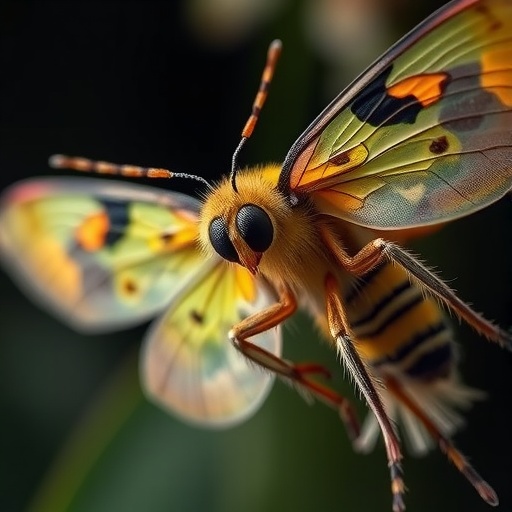
Moth Wings Detect Smells Using Specialized Chemosensory Structures

July 27, 2026
in Biology
Reading Time: 2 mins read
0
Moth Wings Detect Smells Using Specialized Chemosensory Structures

Moth Wings Detect Smells Using Specialized Chemosensory Structures

65
SHARES
587
VIEWS
Share on FacebookShare on Twitter
ADVERTISEMENT

Insect wings are packed with sensory equipment, but the question of whether moths could truly “smell” with their wings has remained largely open. New work from Sonja Bisch-Knaden and Bill Hansson at the Max Planck Institute for Chemical Ecology now shows that hawkmoth wings are more than touch-sensitive—they have an olfactory capability that can help guide egg-laying choices.

The researchers focused on the tobacco hawkmoth, Manduca sexta. By examining the wing surface at high resolution, they looked for the biological hardware expected for smell detection: specialized odour-sensitive hairs distributed across the wings.

Their imaging and measurements revealed two key hair types embedded along the wing edges. Alongside slender touch hairs (~120 μm), they found shorter, stubbier porous hairs (~80 μm), a structural signature consistent with scent sensing. But morphology alone can’t confirm smell—so the team tested the wing’s underlying molecular machinery.

Using wing tissue to collect messenger RNA, the researchers mapped odor-related receptor genes. They identified mRNA for 33 taste and scent receptors in total, with 15 specifically expressed along the wing edge where scent hairs cluster.

Next, electrical recordings provided functional evidence. When airborne odor puffs were delivered to a prepared wing, most tested chemicals elicited little response—except two malodorous amines: pyrrolidine and piperidine. These compounds occur in the leaves of nightshade plants, which are the insects’ preferred sites for laying eggs.

Even when the wing edges were trimmed away, the moth wing still detected these same amines, implying that smell-detection hairs are not confined to edges alone. The sensing system appears distributed across the wing surface.

To pinpoint which receptors might be responsible, the researchers used AI-based modeling to predict three-dimensional protein structures. They then computationally docked pyrrolidine and piperidine into candidate receptor binding pockets, finding that two receptor candidates could plausibly bind both molecules and trigger the sensory pathway.

Taken together, the results establish that hawkmoth wings carry functional odor receptors and matching sensory structures, effectively giving the insect a wing-based nose. The study, published in the Journal of Experimental Biology, links this wing olfaction to ecologically relevant host-plant chemistry.


Subject of Research: Olfactory capacity of hawkmoth wings (wing-based smell detection)
Article Title: Noses on the wing: the olfactory capacity of hawkmoth wings
News Publication Date: 27-Jul-2026
Web References: https://doi.org/10.1242/jeb.252047
References: Ismaieel, A. R. Stieber, R., Hansson, B. S. and Bisch-Knaden, S. (2026). Noses on the wing: the olfactory capacity of hawkmoth wings. J. Exp. Biol. 229, jeb252047. DOI: 10.1242/jeb.252047
Image Credits: Anna Schroll
Keywords: hawkmoth, wing olfaction, odour-sensitive hairs, scent receptors, pyrrolidine, piperidine, host-plant detection, Manduca sexta, insect sensory biology

Tags: chemical ecology of hawkmothselectrophysiological testing of insect sensory hairshawkmoth wing chemosensationinsect olfactory receptor genesinsect wing morphology and functioninsect wing sensory structuresmolecular mechanisms of insect smellmoth olfactory capabilitiesodor response in moth wingsrole of wing-based chemosensation in egg-layingscent detection in insect wingsspecialized odor-sensitive hairs
Share26Tweet16
Previous Post

Coral’s Swiss Army Knife: How Cilia Enable Multiple Functions

Next Post

Study Reveals New Insights Into Texas Hill Country Floods

Related Posts

Sericin directs silk fibroin assembly into ordered nanofibrils, study finds
Biology

Sericin directs silk fibroin assembly into ordered nanofibrils, study finds

July 27, 2026
Scientists identify compound that could help muscles remain strong with age
Biology

Scientists identify compound that could help muscles remain strong with age

July 27, 2026
All-Trans Retinoic Acid Suppresses Severe Fever With Thrombocytopenia Virus Inflammation in Mice
Biology

All-Trans Retinoic Acid Suppresses Severe Fever With Thrombocytopenia Virus Inflammation in Mice

July 27, 2026
Saber-Toothed Cats’ Spinal Tumors Reveal How Inbreeding Threatened Survival
Biology

Saber-Toothed Cats’ Spinal Tumors Reveal How Inbreeding Threatened Survival

July 27, 2026
Infection Study Maps Protein Contact Sites, Shows Influenza Hijacks Paraspeckles
Biology

Infection Study Maps Protein Contact Sites, Shows Influenza Hijacks Paraspeckles

July 27, 2026
Study Finds Species-Specific MANF Function in Nonhuman Primates
Biology

Study Finds Species-Specific MANF Function in Nonhuman Primates

July 27, 2026
Next Post
Study Reveals New Insights Into Texas Hill Country Floods

Study Reveals New Insights Into Texas Hill Country Floods

  • Mothers who receive childcare support from maternal grandparents show more

    Mothers who receive childcare support from maternal grandparents show more parental warmth, finds NTU Singapore study

    27656 shares
    Share 11059 Tweet 6912
  • University of Seville Breaks 120-Year-Old Mystery, Revises a Key Einstein Concept

    1061 shares
    Share 424 Tweet 265
  • Bee body mass, pathogens and local climate influence heat tolerance

    682 shares
    Share 273 Tweet 171
  • Researchers record first-ever images and data of a shark experiencing a boat strike

    546 shares
    Share 218 Tweet 137
  • Groundbreaking Clinical Trial Reveals Lubiprostone Enhances Kidney Function

    531 shares
    Share 212 Tweet 133
Science

Embark on a thrilling journey of discovery with Scienmag.com—your ultimate source for cutting-edge breakthroughs. Immerse yourself in a world where curiosity knows no limits and tomorrow’s possibilities become today’s reality!

RECENT NEWS

  • Validation of NEO-READY model for predicting discharge dates in preterm NICU patients
  • AI Detection Model Uses Noncontact Multimodal Data for Early Parkinson’s Diagnosis
  • Planetary trapped waves link South America and Africa through ocean teleconnections
  • Cocrystal Enables Fixed-Dose Empagliflozin and Metformin Bilayer for Bioequivalence

Categories

  • Agriculture
  • Anthropology
  • Archaeology
  • Athmospheric
  • Biology
  • Biotechnology
  • Blog
  • Bussines
  • Cancer
  • Chemistry
  • Climate
  • Earth Science
  • Editorial Policy
  • Marine
  • Mathematics
  • Medicine
  • Pediatry
  • Policy
  • Psychology & Psychiatry
  • Science Education
  • Social Science
  • Space
  • Technology and Engineering

Subscribe to Blog via Email

Enter your email address to subscribe to this blog and receive notifications of new posts by email.

Join 5,146 other subscribers

© 2025 Scienmag - Science Magazine

Welcome Back!

Login to your account below

Forgotten Password?

Retrieve your password

Please enter your username or email address to reset your password.

Log In
No Result
View All Result
  • HOME
  • SCIENCE NEWS
  • CONTACT US

© 2025 Scienmag - Science Magazine

Discover more from Science

Subscribe now to keep reading and get access to the full archive.

Continue reading
