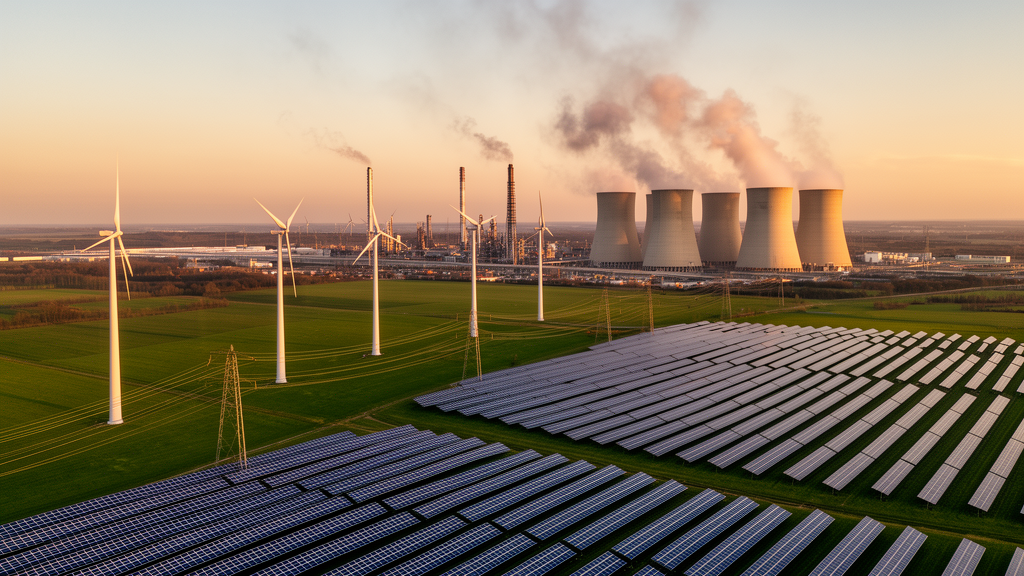
A new study of the world’s top 20 carbon dioxide-emitting economies finds that fewer than half have managed to use their recent renewable energy expansion to actually displace fossil fuels. The research, published in Discover Sustainability by Hrishikesh Vijay and Sanjay Kumar Mangla, examined energy data from 2015 to 2023 and asked a deceptively simple question: does growing non-fossil energy signal a genuine structural transition, or is it merely padding out an ever-larger energy supply?
The authors built a system-level framework based on total primary energy supply to separate two very different outcomes. In one, new renewable capacity substitutes for fossil energy, cutting absolute fossil use. In the other, described as “energy addition,” renewables simply absorb part of rising demand while fossil consumption continues to grow. To distinguish between these pathways, the team applied a decomposition approach that splits changes in fossil energy into a demand-growth component, called the activity effect, and a fuel-substitution component, called the growth effect.
Two indicators anchor the analysis: a fossil displacement ratio, which measures how far non-fossil additions reduce absolute fossil energy use, and demand absorption ratios, which show how much new clean energy is taken up by expanding consumption rather than by replacing fossil fuels. Applying these measures across the sample revealed substantial variation between countries, the study reports.
The headline result is sobering for climate accounting. Although most of the top 20 emitters added non-fossil energy over the study period, fewer than half could convert that addition into a reduction in absolute fossil energy use. In many emerging economies, renewable expansion largely accommodated rising energy demand, a pattern consistent with the energy-addition perspective rather than true displacement.
The findings carry a clear methodological message: progress toward decarbonization should be judged with absolute metrics, not by tracking the share of renewables in the energy mix alone. A rising renewable share can coexist with growing fossil consumption when total demand climbs fast enough. The study covers the period through 2023 and is limited to the top 20 emitting economies, so it does not speak to smaller energy systems, but for the countries that dominate global carbon dioxide emissions, the authors argue, the distinction between substitution and addition is central to assessing whether an energy transition is genuinely underway.
Subject of Research: Decomposition analysis of fossil fuel displacement versus energy addition in major emitting countries
Article Title: Assessing energy transition in major carbon emitting countries using decomposition logic
Article References: Vijay, J. H., & Mangla, S. K. (2026). Assessing energy transition in major carbon emitting countries using decomposition logic. Discover Sustainability. https://doi.org/10.1007/s43621-026-04679-4
Image Credits: AI Generated
DOI: 10.1007/s43621-026-04679-4
Keywords: energy transition, fossil fuel displacement, renewable energy, CO2 emissions, decomposition analysis, primary energy supply, energy addition, decarbonization, top 20 emitters, energy demand, Assessing, energy
Cite Scienmag News
Faith Mcneil. (October 27, 2026). Most Big Emitters Are Adding Clean Energy, Not Replacing Fossil Fuels. Scienmag. https://scienmag.com/most-big-emitters-are-adding-clean-energy-not-replacing-fossil-fuels/
Faith Mcneil. "Most Big Emitters Are Adding Clean Energy, Not Replacing Fossil Fuels." Scienmag, 27 October 2026, https://scienmag.com/most-big-emitters-are-adding-clean-energy-not-replacing-fossil-fuels/. Accessed 28 October 2026.
Faith Mcneil. "Most Big Emitters Are Adding Clean Energy, Not Replacing Fossil Fuels." Scienmag. October 27, 2026. https://scienmag.com/most-big-emitters-are-adding-clean-energy-not-replacing-fossil-fuels/