


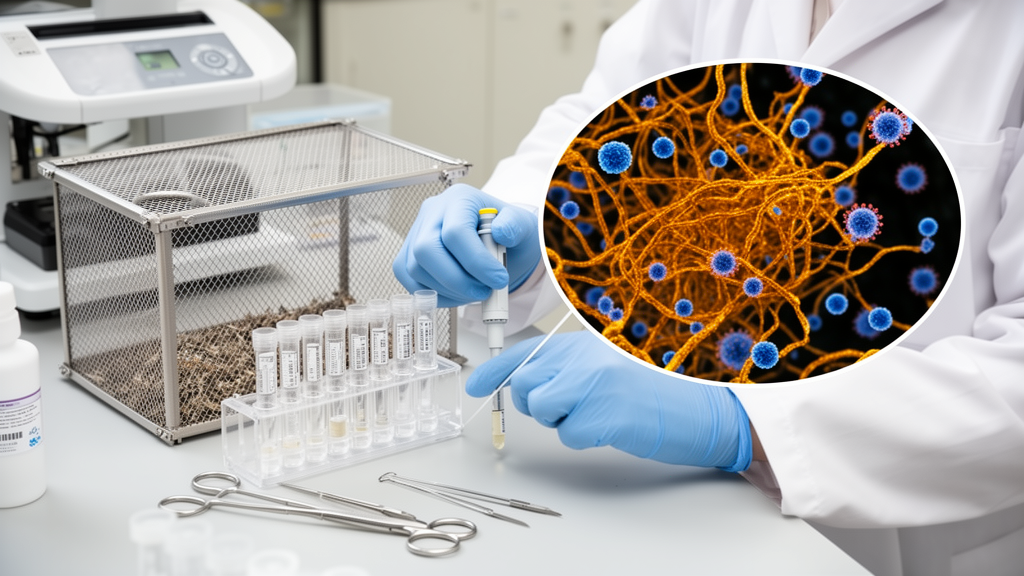
Genetic material recovered from mosquito waste contained a complete, high-quality genome of West Nile virus, the first reported evidence in the Americas of a Hedwig-like virus and several sequences that may represent previously undescribed viruses. The findings came from a peer-reviewed experiment in which researchers collected droplets deposited by 100 wild Culex mosquitoes and analyzed the waste with shotgun metagenomic sequencing. By searching broadly rather than testing only for named pathogens, the team detected both familiar viruses and biological sequences that had not previously been reported in the Americas. The study presents mosquito excreta as a possible addition to surveillance systems for circulating pathogens, while also showing that its usefulness beyond the laboratory remains to be demonstrated.
The collection device was developed by Dana Price, an associate professor in Rutgers University’s Department of Entomology and Center for Vector Biology and a lead author of the study in Microbiology Spectrum. At its center is a 3D-printed funnel coated with a superhydrophobic, or water-repelling, material. Liquid waste striking the coated surface beads up and slides into a collection tube. The researchers placed the mosquitoes in a screened container over this funnel and provided sugar solution, then gathered the droplets they produced. The arrangement was described by Price as a “mosquito toilet,” but its function was to capture genetic traces without grinding up the insects that produced them.
The idea drew on the principle behind wastewater surveillance, which can reveal organisms circulating in a community through material shed into sewage. Mosquitoes excrete small amounts of liquid that can contain genetic traces of viruses and other organisms. Because the waste contains far less mosquito tissue, and therefore less mosquito DNA, than a crushed insect, the researchers reasoned that viral material might be easier to find in the collected droplets. Conventional mosquito surveillance often involves capturing large numbers of insects, sorting them by species, combining them into pools and grinding them for laboratory testing. Careful preservation is needed to prevent degradation of genetic material, while pathogen-specific assays require investigators to know in advance which organisms they are seeking.
For the experiment, researchers collected two groups of 50 wild Culex mosquitoes from a yard in New Brunswick, New Jersey, in 2021 and 2022. Each group was transferred to a screened container over the collection funnel in a laboratory. The resulting waste was subjected to shotgun metagenomic sequencing, which generates sequence data from all genetic material in a mixed sample. Computers assembled millions of fragments and compared the assembled sequences with known sequences in scientific databases. This untargeted approach differs from conventional tests that target specified pathogens: investigators could search the data for known viruses while also examining sequences that did not resemble familiar examples.
The 2022 sample produced a complete West Nile virus genome assigned to the NY07 genetic variant previously found in the region. West Nile virus can cause serious neurological illness in people. A whole-genome sequence carries more information than a simple positive or negative test result because it permits genetic comparisons and detailed examination of viral variation. Such information could eventually help researchers investigate how variants emerge, spread and change. The experiment did not demonstrate that any particular mosquito could transmit the detected virus. Waste alone also cannot establish whether the virus was infecting the mosquito, infecting another organism inside it or passing through the insect.
Evidence of a Hedwig-like virus was another striking result. Hedwig virus was first identified in Europe in tissue from a snowy owl, and some of the infected birds also carried West Nile virus. Its appearance in the New Jersey sample provided the first known evidence of a Hedwig-like virus in the Americas, despite the researchers not specifically searching for it. Scientists do not know whether Hedwig-like viruses cause disease in birds, facilitate West Nile infections or coexist with other viruses without any detectable effect. The Rutgers finding therefore does not establish that the virus is a health threat. It shows that it was present where researchers had not previously looked, although a first detection cannot distinguish between recent arrival and circulation that went unnoticed for years.
The metagenomic analysis also identified sequences that differed sufficiently from known examples for the researchers to classify them as potentially new. These included a partiti-like virus, a picorna-like virus and a possible new virus associated with single-celled parasites infecting the mosquitoes. The classifications are provisional, and further study is required to determine whether the sequences represent species not previously described. Most of the viruses detected in the waste appear to infect mosquitoes, other insects or microorganisms living inside mosquitoes, and they are not known to cause human disease. The source material also notes that some insect-specific viruses may interfere with mosquitoes’ ability to carry West Nile, dengue or Zika viruses, but the reported findings do not establish whether that interference occurred.
Waste samples also contained traces of trypanosomatids, a group of single-celled parasites known to infect mosquitoes. Analysis of mosquito DNA indicated that the insects belonged primarily to the Culex pipiens group, a carrier of West Nile virus. Recovering DNA from the excreta therefore allowed the researchers to obtain information about both the organisms circulating in the mosquitoes and the mosquito community that produced the sample. Price described the work as an initial demonstration rather than a replacement for existing surveillance. Its scope was limited to 100 mosquitoes from one New Jersey location that were transferred to a laboratory apparatus, so the study did not establish prevalence, host range, seasonal persistence or geographic distribution for the detected viruses.
Even with those limitations, the experiment shows that mosquito waste can answer a broad environmental question: whether a pathogen is circulating in a particular setting. A waste-based method could reduce reliance on whole-insect tissue and allow a laboratory to examine a wider mixture of microbial evidence in a single analysis. It could also complement targeted assays by making it possible to look for known pathogens and unfamiliar sequences at the same time. The authors cautioned that the method does not replace established mosquito surveillance, which remains capable of collecting and identifying insects directly. Any broader application would require adaptation and validation outside the laboratory, across more sites, seasons and mosquito populations.
The team is working toward a field-ready trap that could collect mosquitoes and their waste in outdoor environments. Price’s longer-term vision is a device that could be placed in a forest, prepare samples, sequence genetic material, analyze results remotely and transmit information to scientists in near real time. Such a system could be especially valuable in remote or resource-limited areas, where routine insect collection and centralized laboratory testing may be difficult. The demonstrated result is more limited but concrete: in waste collected from 100 New Jersey mosquitoes, metagenomic sequencing recovered a complete West Nile virus genome, the first Americas evidence of a Hedwig-like virus and several candidates for previously undescribed viruses. Whether that breadth can translate into dependable, timely surveillance remains the next stage of development.
Subject of Research: Metagenomic analysis of mosquito excreta for broad surveillance of circulating viruses and microbial agents.
Article Title: Mosquito waste reveals viruses hiding in plain sight
Article References: Mosquito waste reveals viruses hiding in plain sight. Original publication (Bibliographic details unavailable.)
Image Credits: AI Generated
DOI: Not provided
Keywords: mosquito excreta, metagenomic sequencing, West Nile virus, virome surveillance, Hedwig-like virus, mosquito surveillance, viral discovery, Culex pipiens, environmental monitoring, parasites, Mosquito, waste
Cite Scienmag News
Kristina Jarvis. (October 26, 2026). Mosquito waste sequencing finds West Nile genome and novel viral candidates. Scienmag. https://scienmag.com/mosquito-waste-sequencing-finds-west-nile-genome-and-novel-viral-candidates/
Kristina Jarvis. "Mosquito waste sequencing finds West Nile genome and novel viral candidates." Scienmag, 26 October 2026, https://scienmag.com/mosquito-waste-sequencing-finds-west-nile-genome-and-novel-viral-candidates/. Accessed 26 October 2026.
Kristina Jarvis. "Mosquito waste sequencing finds West Nile genome and novel viral candidates." Scienmag. October 26, 2026. https://scienmag.com/mosquito-waste-sequencing-finds-west-nile-genome-and-novel-viral-candidates/


