


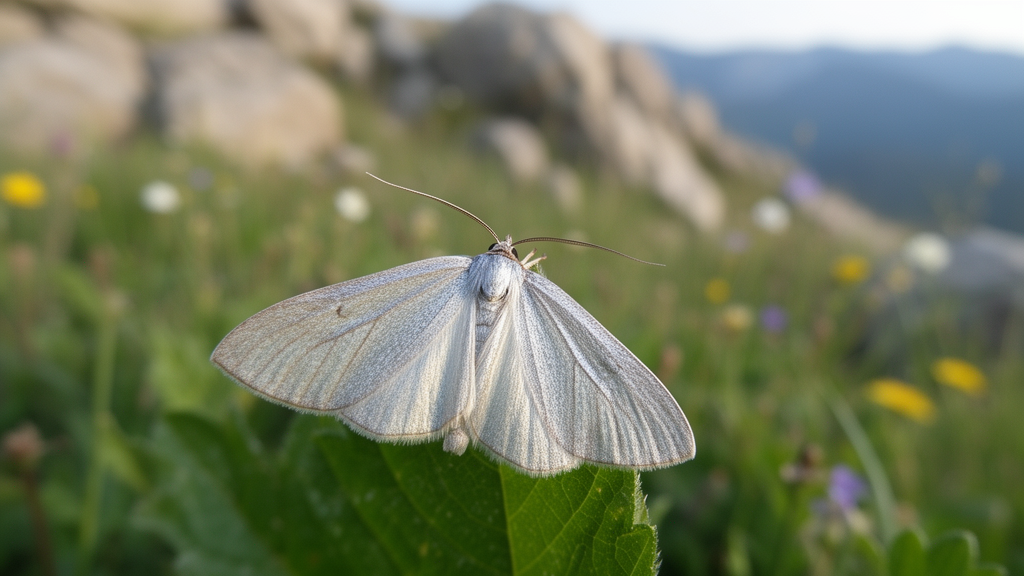
A morphological and DNA-barcode study has formally described Cedestis granadensis sp. nov., a new species in the ermine moth family Yponomeutidae. The taxonomic description is based on two adult specimens, a male holotype and a female paratype, collected at two localities in Granada province, Spain. Their identification and separation from other species in the genus were supported by adult morphology, dissected genitalia and mitochondrial DNA barcoding.
The female was collected on 11 July 2010 in the Sierra de Huétor mountains at an elevation of about 1,400 metres while the Lepidoptera fauna of Granada province was being surveyed. It was initially treated as an unknown member of Elachistidae, but DNA analysis showed that it did not belong to that family. Examination of its female genitalia subsequently placed it in Yponomeutidae.
The male was collected on 18 July 2021 in the highlands north of Puebla de Don Fadrique at 1,508 metres. Both adults had been attracted to light. A single hind leg from each specimen was used to generate DNA barcodes for a target region of the mitochondrial cytochrome c oxidase subunit 1 gene.
Processing was conducted at the Canadian Centre for DNA Barcoding at the Biodiversity Institute of Ontario, University of Guelph, using a standard high-throughput protocol. Four public sequences, representing three C. exiguata and one C. nathani , were added from the Barcode of Life Data System. The molecular dataset comprised 31 sequences with available lengths of 544 to 658 base pairs.
Genetic distances were calculated with the Kimura two-parameter model, and a Neighbor-Joining tree was constructed in MEGA7. Barcode Index Numbers, which the study describes as algorithm-based operational taxonomic units that often approximate valid species, separated the analyzed Cedestis records into distinct clusters. The two specimens of C. granadensis formed the unique BIN BOLD:AAZ9164, represented by specimen identifiers TLMF Lep 32615 and MM19987.
The nearest barcode cluster was BOLD:ADG4688, representing C. civitatensis . The minimum p-distance between the new species and that cluster was 3.25%. Although this interspecific divergence was relatively low for Cedestis , the authors considered it supportive of species-level separation when considered with the anatomical differences.
Intraspecific variation reached 2.85% in C. subfasciella . The identification was also prompted when analysis of barcode data associated with C. civitatensis revealed a separate cluster containing sequences from both Granada specimens. Adults of C. granadensis have wingspans of 9.5 to 10.0 millimetres.
Males and females are nearly identical externally, although the female’s forewing markings are slightly less pronounced. The forewing has a white to creamy-white ground colour with sparse light yellowish-brown scales tipped in dark brown. These form an indistinct bent fascia and scattered markings toward the costa, dorsum and apex.
The authors identified the pale ground colour and sparse pattern as features distinguishing the species from all other known Cedestis species. The male and female genitalia most closely resemble those of C. civitatensis . In the male, C. granadensis has a broad uncus with slightly protruding, rounded lobes, while the uncus of C. civitatensis is truncated.
The female can be separated by its longer posterior and anterior apophyses and by differences in the lamella postvaginalis. Its lamella includes an oval ostium bursae covered with microtrichia between a pair of small setose humps. These features, together with the barcode divergence, provide the basis for the new species’ diagnosis.
So far, the species is known only from the two Granada localities: the highlands north of Puebla de Don Fadrique and the Sierra de Huétor mountains, both at approximately 1,400–1,500 metres. The first locality is a small rocky-steppe plateau surrounded by groups of pines; the second is a clearing in sparse pine forest on dolomitic sands. Both adults were on the wing in July.
The immature stages, host plants and broader life history remain unknown. Although the larvae of two other European Cedestis species feed in needles of Pinaceae, the authors present pine-family plants at the type localities only as a possible host-plant hypothesis, not a documented association. The two-specimen record leaves the species’ distribution and rarity uncertain.
The authors consider it doubtful that C. granadensis is endemic to southern Spain, given the widespread occurrence of potential larval host plants in the genus Pinus , but no additional populations or life-history data are documented. The specific epithet “granadensis” refers to Granada province. The morphological and molecular results support a close relationship between C. granadensis and C. civitatensis .
Separately, the authors state that the generic placement of several species in the related genus Zelleria appears doubtful and requires revision informed by genetic data.
Subject of Research: Taxonomic description of a DNA-barcoded Cedestis moth species from Granada, Spain
Article Title: Cedestis granadensis sp. nov., a new species from Spain ( Lepidoptera , Yponomeutidae )
Article References: Tokár, Z., Graf, F., & Huemer, P. (2024). Cedestis granadensis sp. nov., a new species from Spain (Lepidoptera, Yponomeutidae). Nota Lepidopterologica, 47, 81-91. https://doi.org/10.3897/nl.47.121152
Image Credits: AI Generated
DOI: 10.3897/nl.47.121152
Keywords: Cedestis granadensis, new moth species, Granada, Spain, Yponomeutidae, taxonomy, DNA barcoding, moth morphology, genitalia, Mediterranean biodiversity, Cedestis, granadensis
Cite Scienmag News
Gavin Prescott. (October 20, 2026). Morphological and DNA-barcode study describes a new Cedestis moth from Granada, Spain. Scienmag. https://scienmag.com/morphological-and-dna-barcode-study-describes-a-new-cedestis-moth-from-granada-spain/
Gavin Prescott. "Morphological and DNA-barcode study describes a new Cedestis moth from Granada, Spain." Scienmag, 20 October 2026, https://scienmag.com/morphological-and-dna-barcode-study-describes-a-new-cedestis-moth-from-granada-spain/. Accessed 20 October 2026.
Gavin Prescott. "Morphological and DNA-barcode study describes a new Cedestis moth from Granada, Spain." Scienmag. October 20, 2026. https://scienmag.com/morphological-and-dna-barcode-study-describes-a-new-cedestis-moth-from-granada-spain/


