


A review of riparian wetland monitoring in Europe identifies persistent fragmentation in biodiversity data, methods and institutional arrangements, and argues for monitoring systems that connect long-term ecological observation with shorter assessments of restoration interventions. The article synthesises research and European initiatives rather than reporting a new field trial or a demonstrated effect of a monitoring programme.
Long-term monitoring is presented as a way to detect trends in hydrology, vegetation and fauna, distinguish natural variability from anthropogenic pressures and establish baselines for restoration. Restoration monitoring has a different scope: it examines interventions such as hydrological reconnection, sediment reactivation and vegetation re-establishment over shorter, management-relevant periods. The authors argue that combining these approaches supplies rapid feedback on interventions while showing whether observed changes persist over time.
European policy already offers several mechanisms for measuring and improving wetland condition. The Bern Convention promotes cooperation on threatened species and habitats across Europe, while the EU Habitats and Birds Directives support the Natura 2000 network through Special Areas of Conservation and Special Protection Areas. The Water Framework Directive assesses aquatic ecosystems using biological, physicochemical and hydromorphological indicators. The adopted Nature Restoration Regulation adds legally binding restoration targets and requirements for consistent monitoring and reporting, but the review notes that realizing their full potential requires coherent implementation across Europe, including beyond the EU.
For river–floodplain systems, the review recommends a landscape-scale perspective combining hydrological connectivity, geomorphology, biodiversity and ecosystem services. Periodic inundation links rivers and floodplains and regulates exchanges of water, nutrients and sediment that support habitat diversity and ecological integrity. In large rivers, competing demands from navigation, flood control, hydropower, agriculture and settlements can make full naturalisation infeasible, so the review presents process-based, multifunctional restoration as a practical approach to recovering ecological processes while balancing economic and social needs.
Systematic evaluation of restoration outcomes remains limited despite the expansion of river and floodplain restoration across Europe, and the review reports that post-restoration monitoring is rarely included in wetland restoration guidelines. Policy-driven assessments focus on selected organism groups and therefore capture only part of floodplain biodiversity. As one highlighted example, the BioAu-Tool is a stakeholder co-designed method for riverbanks and floodplains that assesses vascular plants, terrestrial and aquatic molluscs, ground beetles, amphibians and birds across 18 Central European floodplain types. It offers habitat-screening and detailed species-analysis levels and supports before-and-after or space-for-time comparisons; nationwide testing of its efficiency and user-friendliness was still underway, with no results reported in the review.
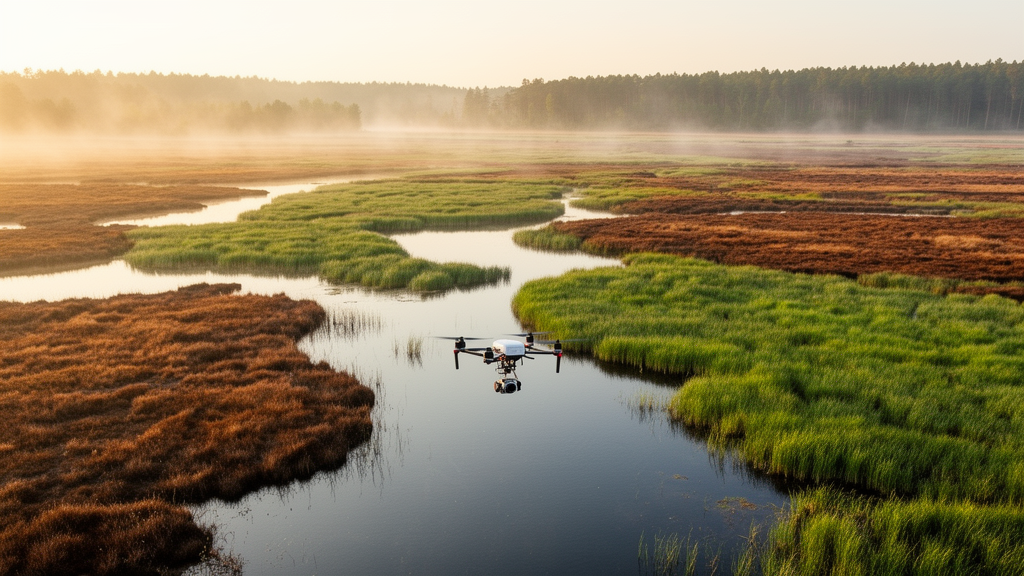
Remote sensing and artificial intelligence can add capacity but carry technical and operational limits. Cited work using Sentinel-1 and Sentinel-2 data reported wetland classification accuracies above 85%, and some studies identified flooded areas with accuracy of up to approximately 98%. UAV photogrammetry achieved reported accuracies of 80–95% when classifying macrophyte taxa and functional groups, although submerged vegetation was harder to detect in deeper or turbid water. Satellite data can be affected by cloud cover, gaps, limited ground validation and insufficient fine-scale resolution, while UAV surveys require personnel, time and money. Separately, a convolutional neural network trained on 90 EPT taxa—mayflies, stoneflies and caddisflies—reported 98.7% overall classification accuracy; the review also describes potential identification speed gains, rather than results from a Europe-wide deployment.
Other approaches can also provide alternatives to conventional observation or identification. Sensor networks can transmit water-level, soil-moisture, connectivity and flow measurements to cloud-based analytical systems, which the review describes as potential support for detecting inundation shifts, moisture anomalies and connectivity changes. Environmental DNA metabarcoding detects species presence or community composition from water, sediment or soil and, in cited studies, revealed fish community structure and invasive species more rapidly than conventional methods. Citizen science has produced results closely matching professional monitoring in Germany’s FLOW project, where volunteers used protocols aligned with the Water Framework Directive to assess macroinvertebrates, hydromorphology and pesticide pressures in small streams.
Climate information is necessary for interpreting ecological change because temperature, precipitation, drought and extreme events affect wetlands, while wetlands themselves influence water storage, greenhouse-gas fluxes and local microclimates. The review cites IPCC projections of significantly greater risks from weather extremes, drought and intense precipitation by 2081–2100 under high-emission scenarios, and European projections indicating temperature increases of 1.9–6.1 °C relative to pre-industrial levels. Proposed indicators include water-table depth, inundation duration, consecutive dry days, maximum five-day precipitation, water temperature, inflow and outflow volumes, soil moisture and vegetation greenness. Modelled coastal scenarios involving habitat loss exceeding 50% with sea-level rise of 0.25 m or less are described as possible tipping-point conditions, not observed outcomes across Europe.
Initiatives including RESI, SWOS, Restore4Life, SELINA, Biodiversa+, eLTER, DANUBIUS-RI, LifeWatch ERIC and MAMBO provide components for a more connected European monitoring architecture. The review nevertheless describes progress as fragmented and project based, with overlapping but disconnected datasets and indicators. It proposes shared standards, interoperable databases and coordinated governance linking field observations, hydrological measurements, remote sensing, ecosystem-service models, climate-informed modelling and citizen-generated data. Limitations include uneven standards and capacity, particularly between EU and non-EU countries, institutional fragmentation, underfunded monitoring and the difficulty of upscaling local observations across dynamic floodplains. The review’s central conclusion is that sustained monitoring should connect ecological condition, ecosystem services and governance to support adaptive restoration and policy evaluation across Europe.
Subject of Research: Review of integrated biodiversity and restoration monitoring for European riparian wetlands
Article Title: Towards effective and integrated riparian wetland monitoring in Europe: challenges and opportunities
Article References: Cvijanović, D., Stammel, B., Novković, M., Adamescu, M., Baumane, M., Bonn, A., Ehlert, T., von Gönner, J., Januschke, K., Kaden, U. S., Schipper, C., Schulz-Zunkel, C., & Scholz, M. (2026). Towards effective and integrated riparian wetland monitoring in Europe: challenges and opportunities. Nature Conservation, 62, 121-148. https://doi.org/10.3897/natureconservation.62.167089
Image Credits: AI Generated
DOI: 10.3897/natureconservation.62.167089
Keywords: riparian wetlands, biodiversity monitoring, wetland restoration, hydrology, remote sensing, artificial intelligence, environmental DNA, citizen science, European policy, ecosystem services, Towards, effective
Cite Scienmag News
Margaret Porter. (October 20, 2026). European riparian wetland review calls for integrated, standardised monitoring. Scienmag. https://scienmag.com/european-riparian-wetland-review-calls-for-integrated-standardised-monitoring/
Margaret Porter. "European riparian wetland review calls for integrated, standardised monitoring." Scienmag, 20 October 2026, https://scienmag.com/european-riparian-wetland-review-calls-for-integrated-standardised-monitoring/. Accessed 20 October 2026.
Margaret Porter. "European riparian wetland review calls for integrated, standardised monitoring." Scienmag. October 20, 2026. https://scienmag.com/european-riparian-wetland-review-calls-for-integrated-standardised-monitoring/


