


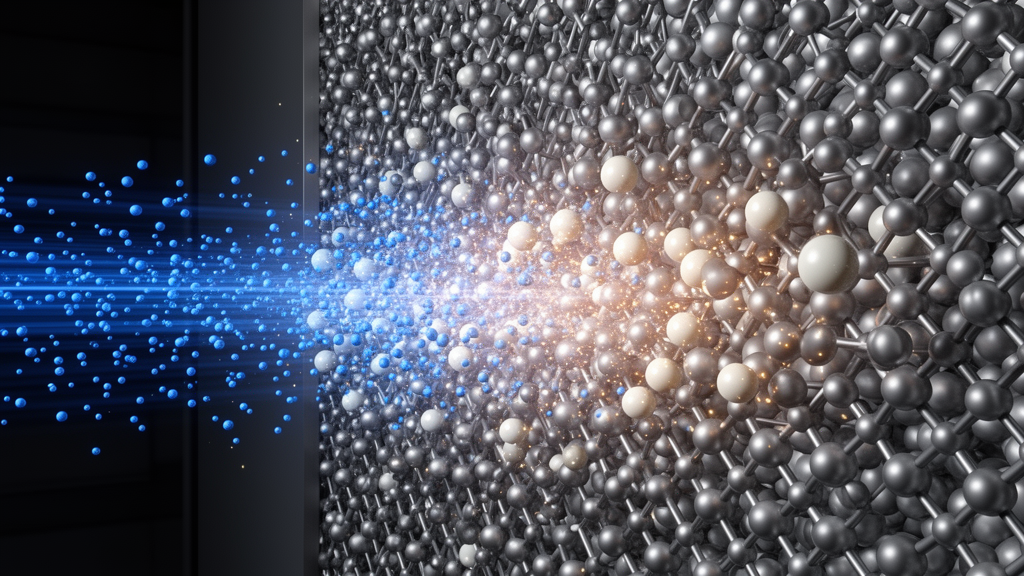
Monte Carlo simulations found that homogeneous doping reduced modeled primary radiation damage in tungsten-based targets exposed to deuterium ions, but the composition with the strongest effect depended on the incident energy and the damage measure evaluated. The study examined pure tungsten and four nominally homogeneous composites: tungsten–titanium, tungsten–lanthanum oxide, tungsten–titanium carbide and tungsten–zirconium carbide.
Using SRIM 2013, the investigators modeled deuterium ions with incident energies from 10 eV to 10 MeV and focused on primary damage estimates, including energy deposition, displacement collisions, vacancy production, ion range and sputtering yield. The multi-phase targets were represented as statistically homogeneous continuous media with density calculated by the rule of mixtures. Most comparative analyses used 3 wt.% dopant and 100 keV deuterium ions, while a separate series of calculations used 200 keV ions and dopant contents from 0.5 to 15 wt.%.
At 100 keV, all five targets had a peak in the initial ballistic implantation distribution at a depth of about 0.5 micrometres. Pure tungsten had the highest energy-deposition peak, while every doped system had a lower peak; tungsten–titanium carbide had the lowest. The simulation also predicted fewer displacement collisions in the doped targets than in pure tungsten, with tungsten–titanium carbide producing the lowest value. These results indicate reduced localization of deuterium-ion energy in the doped systems under the specified conditions.
Vacancy profiles provided a more depth-dependent result. At depths below 5,000 angstroms, pure tungsten had the highest calculated vacancy production and tungsten–titanium carbide the lowest, while the other three doped targets had similar levels. Beyond 5,000 angstroms, the vacancy trends for the five materials were essentially consistent. The results therefore support reduced vacancy production in the doped targets within the analyzed near-surface interval, rather than a uniform difference extending through the full target depth.
For the 200 keV calculations, vacancy production was integrated over the full target thickness and reported as vacancies per incident ion, rather than as the local vacancies-per-angstrom-per-ion distribution used in the 100 keV analysis. Under this separate condition, modeled vacancy production decreased approximately linearly as dopant content increased in all four composite systems. Titanium produced the strongest vacancy reduction, followed by lanthanum oxide, titanium carbide and zirconium carbide. The different energy and metric mean this ranking should not be treated as a universal ordering of dopant effectiveness.
The simulated deuterium-ion range also increased approximately linearly with dopant content at 200 keV. Tungsten–titanium carbide was the most sensitive to changing concentration, while tungsten–lanthanum oxide and tungsten–zirconium carbide showed similar trends. The range in tungsten–titanium varied least with dopant concentration. A larger modeled range corresponds to lower energy loss per unit distance and deeper penetration, but it does not by itself establish reduced total damage.
Sputtering yield behaved differently from the other composition-dependent outputs. It fluctuated without a consistent pattern as dopant content increased, and the researchers reported large sampling variations that made it unreliable for evaluating dopant performance. Changing the number of simulated incident ions while holding other settings constant could change the calculated sputtering yield by more than twofold, with a Poisson standard deviation reaching 30% of the mean in some conditions. By comparison, vacancy counts and the other tested outputs were much more stable.
Across the modeled incident-energy range, electronic stopping was greater than nuclear stopping in all five targets, indicating that deuterium-ion energy loss was dominated by electronic energy loss in the simulations. Ion range increased with incident energy. Below 2,000 keV, the ranges in the five materials were nearly identical; above 2,000 keV, tungsten–titanium carbide had a slightly greater range and pure tungsten the smallest. At 10 MeV, the maximum range was approximately 0.127 millimetres, consistent with the study’s focus on near-surface effects.
The work is a computational simulation study rather than an experimental assessment of manufactured tungsten components. Its homogenized representation cannot resolve grain boundaries, discrete particles, phase interfaces or local segregation, and SRIM calculates instantaneous primary ballistic damage without simulating defect recombination, defect-cluster evolution, thermal diffusion or long-term processes such as swelling, creep, hardening and bubble formation. The authors also note numerical artifacts in full-cascade calculations, so relative comparisons are considered more reliable than absolute damage values, and they call for multiscale modeling to quantify interface effects and long-term damage evolution.
Subject of Research: Monte Carlo assessment of primary deuterium-ion radiation damage in doped tungsten targets
Article Title: Study on radiation damage of tungsten-based targets induced by deuterium ions
Article References: Zhang, Y., Zheng, F., Feng, J., Cao, Z., & Meng, Q. (2026). Study on radiation damage of tungsten-based targets induced by deuterium ions. PLOS One, 21(10), e0360154. https://doi.org/10.1371/journal.pone.0360154
Image Credits: AI Generated
DOI: 10.1371/journal.pone.0360154
Keywords: tungsten, deuterium ions, radiation damage, Monte Carlo simulation, SRIM 2013, titanium carbide, vacancy production, fusion materials, dopant concentration, radiation, damage, tungsten-based
Cite Scienmag News
Janet Harlan. (October 20, 2026). Monte Carlo simulations compare deuterium-ion primary damage in doped tungsten targets. Scienmag. https://scienmag.com/monte-carlo-simulations-compare-deuterium-ion-primary-damage-in-doped-tungsten-targets/
Janet Harlan. "Monte Carlo simulations compare deuterium-ion primary damage in doped tungsten targets." Scienmag, 20 October 2026, https://scienmag.com/monte-carlo-simulations-compare-deuterium-ion-primary-damage-in-doped-tungsten-targets/. Accessed 20 October 2026.
Janet Harlan. "Monte Carlo simulations compare deuterium-ion primary damage in doped tungsten targets." Scienmag. October 20, 2026. https://scienmag.com/monte-carlo-simulations-compare-deuterium-ion-primary-damage-in-doped-tungsten-targets/


