


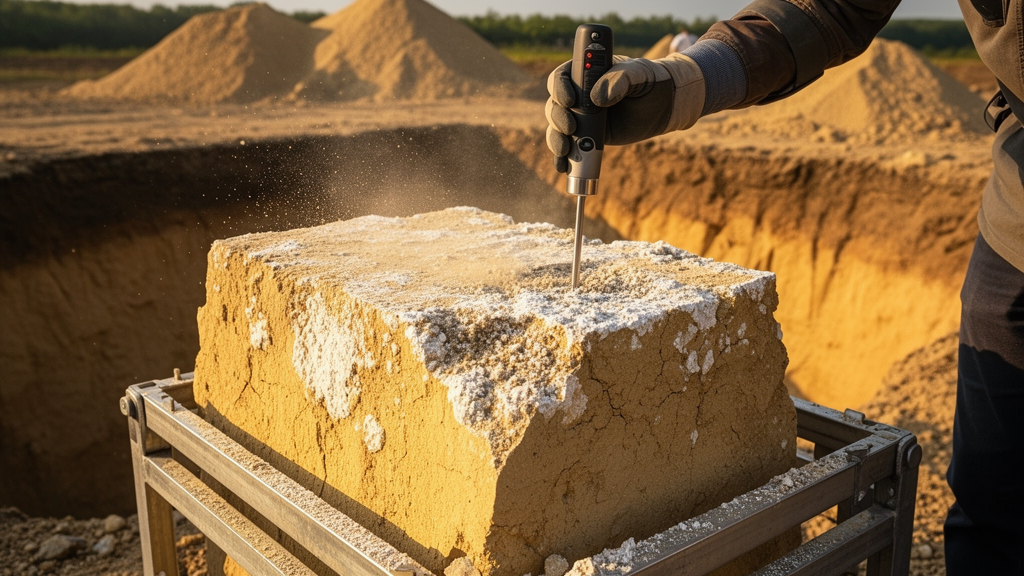
Laboratory experiments described in a Scientific Reports abstract mapped how preparation conditions and soil properties influenced the unconfined compressive strength of loess treated with enzyme-induced calcium carbonate precipitation (EICP). The reported maximum occurred among specimens prepared at a dry density of 1.55 g/cm³ with 4% sodium montmorillonite content. The abstract does not provide an untreated-loess comparison, so it does not establish the magnitude of any treatment-versus-control difference.
The researchers used an orthogonal test design to assess enzyme concentration during the mineralization process. Experiments controlled cementing-solution concentration, soybean powder concentration, skimmed milk powder concentration, pH and standing time, with the results used to determine an optimal mineralization condition. The abstract identifies that condition as 200 g/L soybean powder, 1.50 mol/L cementing solution, 2 g/L skimmed milk powder, pH 7 and a standing time of 120 hours. It does not report the resulting calcium carbonate content in the supplied text.
Unconfined compressive strength tests examined the effects of dry density, cementing-solution content, the enzyme-to-cementation-solution ratio and sodium montmorillonite content. Within the tested ranges, measured strength increased as initial dry density and sodium montmorillonite concentration increased. Strength followed a non-linear response to cementing-solution content: it first increased and then decreased as that content rose, reaching the reported maximum at 14%. Likewise, strength first increased and then decreased as the enzyme-to-cementation-solution ratio decreased, with the maximum reported at a ratio of 2:3. The stress–strain curve for EICP-treated loess was divided into four observed stages: a slowly ascending stage, a fast-growing stage, a slow-growth stage and an attenuation-decrease stage.
The available evidence is limited to the abstract of an experimental laboratory study. It does not state specimen counts, numerical UCS values, statistical uncertainty, an untreated comparison, long-term durability results or performance under field conditions. Although the authors said the findings could support practical implementation of EICP for foundation treatment, the abstract describes no field trial or broader validation. The reported trends and maxima therefore apply to the preparation conditions and test scope described in the abstract.
Subject of Research: Laboratory evaluation of preparation conditions and compressive strength in EICP-treated loess
Article Title: Research on the mechanical properties of loess solidified via enzyme induced calcium carbonate precipitation (EICP)
Article References: Chen, S., Liu, J., Li, G., & Chen, C. (2026). Research on the mechanical properties of loess solidified via enzyme induced calcium carbonate precipitation (EICP). Scientific Reports. https://doi.org/10.1038/s41598-026-75677-9
Image Credits: AI Generated
DOI: 10.1038/s41598-026-75677-9
Keywords: loess, enzyme-induced calcium carbonate precipitation, EICP, unconfined compressive strength, soil stabilization, sodium montmorillonite, cementing solution, laboratory testing, Research, mechanical, properties, solidified
Cite Scienmag News
Denise Maddox. (October 20, 2026). Laboratory tests map compressive-strength trends in EICP-treated loess. Scienmag. https://scienmag.com/laboratory-tests-map-compressive-strength-trends-in-eicp-treated-loess/
Denise Maddox. "Laboratory tests map compressive-strength trends in EICP-treated loess." Scienmag, 20 October 2026, https://scienmag.com/laboratory-tests-map-compressive-strength-trends-in-eicp-treated-loess/. Accessed 20 October 2026.
Denise Maddox. "Laboratory tests map compressive-strength trends in EICP-treated loess." Scienmag. October 20, 2026. https://scienmag.com/laboratory-tests-map-compressive-strength-trends-in-eicp-treated-loess/


