


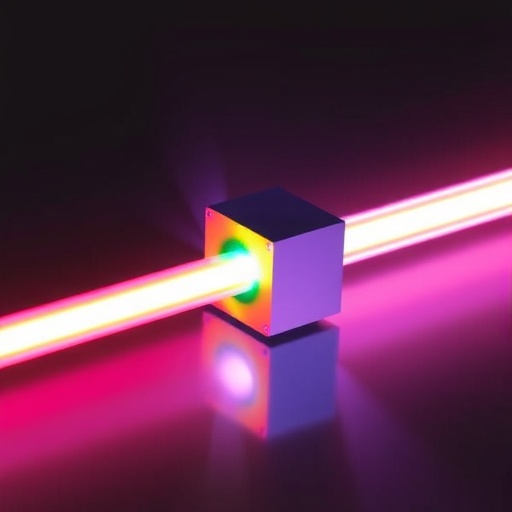
In a groundbreaking development that promises to redefine the boundaries of photonic device engineering, a research team led by Ye, S., Chen, J., and He, J. has unveiled a novel monolithic microcavity laser that uniquely combines simultaneous upconversion and frequency-doubled lasing. This pioneering achievement, detailed in their January 2026 publication in Light: Science & Applications, showcases a sophisticated crystal-in-glass engineering technique that merges disparate nonlinear optical phenomena within a compact, integrated platform. As demands for miniaturized, highly efficient light sources continue to surge across telecommunications, quantum computing, and biomedical imaging, this work marks a significant leap forward in multifunctional laser device design.
At the core of this innovation is the ingenious integration of crystal structures within a glass matrix, employing an advanced fabrication method that ensures robust optical confinement while preserving the nonlinear susceptibilities of the embedded crystals. The microcavity architecture is meticulously engineered to support resonant modes that facilitate both frequency doubling and upconversion processes concurrently. Frequency doubling, or second harmonic generation, involves converting photons into light at twice their original frequency, yielding emissions in shorter wavelengths. Simultaneously, upconversion processes promote the absorption of multiple lower-energy photons to produce a higher-energy photon, enabling emissions beyond the initial excitation frequency. Achieving both within a single device and cavity has been a persistent challenge due to phase matching constraints and material compatibility issues.
The crystal-in-glass engineering approach spearheaded by the authors circumvents these difficulties by embedding rare-earth ion-doped nonlinear crystals into a host glass environment that is highly transparent and exhibits excellent thermal and mechanical stability. This hybrid composite maintains the nonlinear coefficients imperative for frequency conversion while benefiting from the structural advantages of glass, such as ease of shaping and durable microcavity formation. Optical simulations guided the design parameters to optimize light-matter interactions. The resulting microcavity exhibits exceptional quality (Q) factors, ensuring prolonged photon lifetimes and enhanced nonlinear optical efficiency without sacrificing device compactness.
Experimentally, the researchers used finely tuned pump lasers to excite the microcavity, triggering the emission of two distinct yet synchronously generated laser outputs. The simultaneous upconversion lasing produced emissions at shorter wavelengths typically inaccessible via conventional pumping schemes, while the frequency-doubled output confirmed efficient second harmonic generation within the same resonator. This dual-functionality not only broadens operational flexibility but also paves the way for multiwavelength photonic sources from a single monolithic device, greatly reducing system complexity and cost.
Moreover, thermal management strategies and waveguide designs integral to the monolithic fabrication ensured minimal cross-talk and spectral interference between the two lasing modes. This meticulous control over modal interactions highlights the potential for deploying these lasers in integrated photonic circuits where signal purity and stability are paramount. Importantly, the device demonstrated impressive operational stability across extended durations, a key criterion for real-world applicability in demanding environments.
Beyond fundamental optics, the research opens intriguing avenues in quantum photonics, where compact sources capable of frequency conversion are essential for interfacing disparate quantum systems operating at different wavelengths. The team’s ability to realize simultaneous upconversion and harmonic generation in a single chip-scale platform suggests potential for on-chip wavelength multiplexing and quantum frequency translation—crucial for scalable quantum networks.
Incorporation of rare-earth elements within the crystal phase contributes to the tailored emission wavelengths and enhances nonlinear optical responses. This synergy between material selection and cavity design is a testament to the multidisciplinary expertise fueling such advancements. The work underscores the critical role of materials science in overcoming longstanding barriers related to phase matching and optical losses, traditionally limiting the integration of multiple nonlinear processes.
The research community has long sought compact, multifunctional laser sources to meet the increasingly intricate demands of integrated photonics. Conventional approaches often rely on cascading separate devices or employing bulky external components, adding to system footprint and alignment complexity. The monolithic microcavity laser presented here disrupts this paradigm, showcasing a path towards streamlined, scalable solutions with broad application potential—from ultrafast spectroscopy to advanced biomedical diagnostics.
Future iterations of this technology could explore expanded wavelength tunability through doping variations or cavity geometry changes, enhancing adaptability for diverse photonic systems. Additionally, integrating electrical pumping mechanisms might transform these microcavity lasers into fully autonomous sources, further expanding their practical utility in portable and embedded devices.
The underlying fabrication technique also lends itself to mass production, leveraging established glass processing methods supplemented by precision crystal growth and insertion. This combination of accessibility and high performance is poised to accelerate commercialization, bringing multifunctional microcavity lasers from the lab bench to industrial adoption.
In conclusion, the monolithic microcavity laser with simultaneous upconversion and frequency-doubled lasing stands as a landmark achievement that marries innovative materials engineering with advanced photonic design. Its capacity to deliver multiple nonlinear optical outputs within a compact, stable device heralds new horizons for integrated laser technology, signaling exciting possibilities for future photonics research and practical applications alike. The January 2026 publication by Ye, S., Chen, J., He, J., and colleagues in Light: Science & Applications sets a formidable benchmark, inspiring continued exploration at the frontiers of light manipulation at the microscale.
Cite Scienmag News
Denise Maddox. (January 26, 2026). Monolithic Microcavity Laser Enables Dual Upconversion, Frequency Doubling. Scienmag. https://scienmag.com/monolithic-microcavity-laser-enables-dual-upconversion-frequency-doubling/
Denise Maddox. "Monolithic Microcavity Laser Enables Dual Upconversion, Frequency Doubling." Scienmag, 26 January 2026, https://scienmag.com/monolithic-microcavity-laser-enables-dual-upconversion-frequency-doubling/. Accessed 6 September 2026.
Denise Maddox. "Monolithic Microcavity Laser Enables Dual Upconversion, Frequency Doubling." Scienmag. January 26, 2026. https://scienmag.com/monolithic-microcavity-laser-enables-dual-upconversion-frequency-doubling/


