


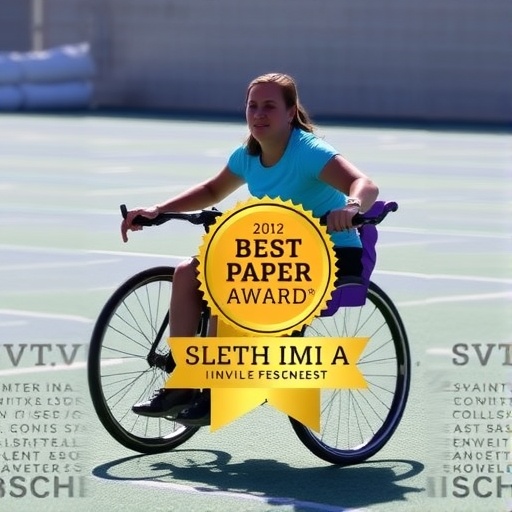
In a groundbreaking advancement at the nexus of computer science and adaptive sports, Harvard’s Visual Computing Group has unveiled BRIDGE, an ambitious simulation system that transforms standard standing-basketball footage into highly realistic wheelchair-basketball videos. This innovative platform emerges as a profound tool designed to dismantle longstanding barriers in sports training for athletes with disabilities. By harnessing state-of-the-art computer vision and embodiment-aware reconstruction techniques, BRIDGE offers an unprecedented avenue for para-athletes and coaches to access video analysis tools traditionally limited to non-disabled sports, effectively democratizing high-performance training resources.
Central to BRIDGE’s innovative framework is its “embodiment-aware” reconstruction pipeline. This sophisticated methodology begins with the extraction and 3D tracking of players and the basketball from conventional broadcast footage initially meant for stand-up basketball. The system then meticulously remaps crucial biomechanical elements—specifically, the head, trunk, and wheelchair base orientations—ensuring the resultant simulation authentically respects the physical realities and constraints intrinsic to wheelchair basketball. This multi-layered orientation mapping does not merely replicate movement; it conveys player gaze, strategic intention, and locomotion mechanics within the adaptive sport context, which has been a critical missing piece in prior training methodologies.
The impetus behind BRIDGE’s development stems from a nuanced understanding of the cognitive hurdles faced by wheelchair basketball athletes. Unlike their non-disabled counterparts who can directly interpret and analyze tactical videos, para-athletes frequently expend significant mental effort to translate stand-up basketball footage into wheelchair-compatible scenarios. This discovery, facilitated through collaboration with the Japanese national wheelchair basketball team, underscored the need for a domain-specific visual analytic tool that could bridge these interpretive gaps, thus inspiring researchers to embed embodiment differences explicitly within BRIDGE’s design philosophy.
This embodiment transformation approach signifies a paradigm shift in adaptive sports analytics. Rather than treating the bodies of athletes with disabilities as outliers or exceptions, BRIDGE positions these physical differences as fundamental design parameters. By doing so, it redefines the concept of inclusivity in sports visualization, emphasizing authenticity and functional relevance. This shift prompts a reevaluation of computational modeling in sports, compelling researchers to create tailored and empathetic technologies that align closely with the physiological and strategic realities of para-athletes.
The meticulous reconstruction pipeline is powered by cutting-edge algorithms capable of detecting player and ball positions despite the video source being two-dimensional broadcast footage. Once these elements are tracked in three-dimensional space, the system applies its hallmark embodiment-aware reconfiguration module. This module decomposes and remaps physical movements, incorporating wheelchair base dynamics—movements that are absent in traditional basketball analytics. By explicitly modeling trunk and head mobility variations alongside wheelchair constraints, BRIDGE achieves a level of biomechanical fidelity that resonates deeply with its target athlete community.
Empirical evaluation with 20 participants, evenly split between Japanese national wheelchair basketball players and non-elite athletes, has demonstrated BRIDGE’s tangible impact on training and tactical comprehension. Participants unanimously reported that the adjusted videos reflected natural, realistic player postures and greatly facilitated the understanding of tactical intentions. This validation underscores the platform’s potential not only as a training enhancer but also as a cognitive aid that mitigates the substantial mental workload previously experienced by wheelchair basketball players when interpreting traditional footage.
BRIDGE’s technology challenges pre-existing assumptions within the domain of sports analytics that non-disabled athletic bodies are the default users of visualization tools. By expanding the paradigm to include embodiment variations, it invites a broader reflection on how inclusivity can be operationalized in AI and computer vision systems. This research heralds a future where functional ability, movement constraints, and diverse bodily forms collectively inform the design of analytical tools, thereby supporting nuanced athletic development across a spectrum of abilities.
The potential applications of embodiment transformation extend well beyond wheelchair basketball. The Harvard research team envisions integrating BRIDGE’s core principles with emerging technologies such as augmented reality (AR), virtual reality (VR), and advanced artificial intelligence (AI) to facilitate inclusive sport experiences for athletes in other parasports, rehabilitation settings, and even for youth and elder athletes. Such interdisciplinary applications could redefine training, recovery, and competitive visualization paradigms across numerous domains where physical diversity is significant.
This study, published and honored with a Best Paper Award at the ACM Conference on Human Factors in Computing Systems (CHI), represents a milestone in human-computer interaction research, especially within adaptive sports technologies. The collaborative work spearheaded by senior author Hanspeter Pfister, An Wang Professor of Computer Science at Harvard SEAS, alongside co-lead authors Chunggi Lee and Hayato Saiki, paves a path toward more accessible, detailed, and user-centered sports analytics tools that engage with the physics and tactics of wheelchair basketball authentically.
BRIDGE also exemplifies how interdisciplinary collaboration between computer scientists, sports professionals, and athletes can yield tools that not only address technical challenges but also resonate with lived athletic experiences. The partnership with the Japanese wheelchair basketball team was instrumental in grounding the research in real-world needs, driving home the importance of user feedback in refining embodiment-aware visualization methods.
Looking ahead, the research ushers in new inquiry directions, including refining the fidelity of 3D tracking, expanding the range of modeled movements, and developing scalable platforms accessible in typical practice environments. Additionally, the integration of AI-driven predictive analytics could further enhance tactical insights, while immersive technologies might democratize access through virtual coaching scenarios tailored to embodiment-specific constraints.
In summary, BRIDGE stands as a pioneering system that transcends conventional sports video analytics by weaving inclusivity and embodiment transformation into its core, thereby redefining the possibilities for para-athlete training and tactical understanding. Its introduction signals a transformative moment for adaptive sports, heralding a future where technology holistically embraces human diversity, fostering equitable and effective athletic development.
Web References:
References:
- Lee, C., Saiki, H., Takahashi, H., Lin, T., Kishi, H., Tachibana, K., Suzuki, Y., Suzuki, K., & Pfister, H. (2024). BRIDGE: Borderless Reconfiguration for Inclusive and Diverse Gameplay Experience Via Embodiment Transformation. Proceedings of the ACM CHI Conference on Human Factors in Computing Systems. DOI: 10.1145/3772318.37908.
Keywords
adaptive sports, wheelchair basketball, computer vision, embodiment-aware reconstruction, human-computer interaction, sports analytics, virtual reality, augmented reality, artificial intelligence, inclusion, para-athlete training, biomechanics, tactical visualization, inclusive technology, simulation system
Cite Scienmag News
Denise Maddox. (May 19, 2026). Innovative Technology Transforming Parasports Wins Best Paper Award at CHI. Scienmag. https://scienmag.com/innovative-technology-transforming-parasports-wins-best-paper-award-at-chi/
Denise Maddox. "Innovative Technology Transforming Parasports Wins Best Paper Award at CHI." Scienmag, 19 May 2026, https://scienmag.com/innovative-technology-transforming-parasports-wins-best-paper-award-at-chi/. Accessed 4 September 2026.
Denise Maddox. "Innovative Technology Transforming Parasports Wins Best Paper Award at CHI." Scienmag. May 19, 2026. https://scienmag.com/innovative-technology-transforming-parasports-wins-best-paper-award-at-chi/


