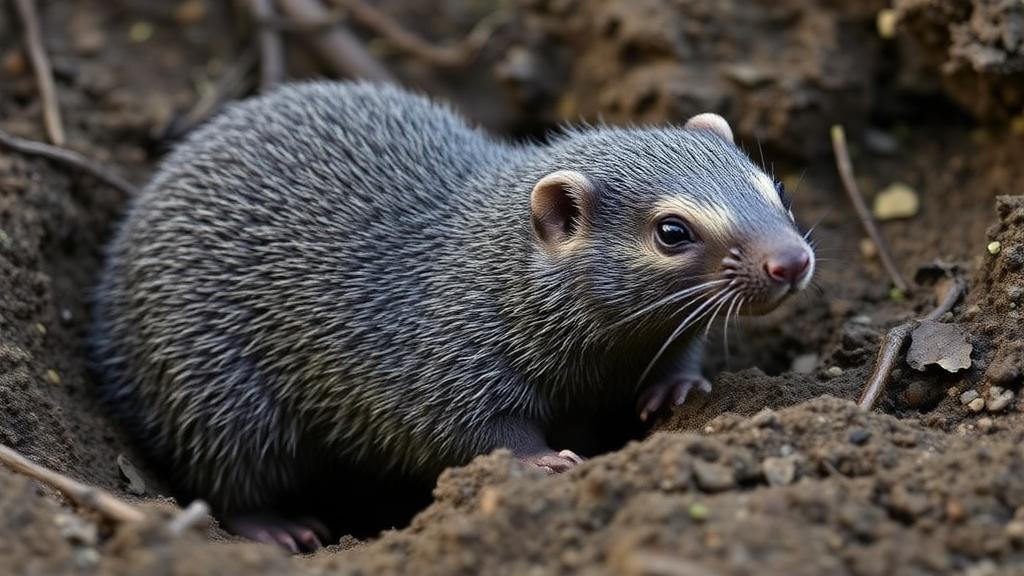
Beneath the lawns and forests of the Northern Hemisphere, moles perform one of the most demanding feats in the mammalian world: they swim through soil, using their forelimbs as shovels to excavate networks of tunnels that can stretch for hundreds of meters. That subterranean lifestyle has reshaped their skeletons in dramatic ways, from shortened, powerful forearms to an unusual stance in which the forelimbs jut out sideways like oars. Now, a new study from the University of Tsukuba has revealed that this burrowing posture did more than change the outward shape of the mole’s body. It fundamentally rewired the way forces travel through the shoulder, shifting the burden of supporting the body from one bone to another in a way never before documented.
In most four-legged mammals, the shoulder blade, or scapula, is the workhorse of the forelimb. Because terrestrial quadrupeds walk with their limbs held directly beneath their bodies, the ground reaction forces generated by each step travel up the limb in a roughly vertical direction and are absorbed primarily by the scapula, which is suspended in a sling of muscles and acts as the main interface between the limb and the trunk. The clavicle, the slender collarbone that braces the shoulder joint against the sternum, plays a comparatively minor structural role in many of these animals. This division of labor has long been considered the standard arrangement for mammals that move on land.
Moles, however, are anything but standard. Members of the family Talpidae have adopted a fossorial, or digging, lifestyle that places their forelimbs in a radically different orientation. Instead of being tucked under the body, the forelimbs are rotated outward and held wide of the torso, with the elbows facing upward and the hands turned to scoop soil sideways. This posture means that forces generated during digging and locomotion do not arrive at the shoulder girdle in the same vertical plane as they do in a walking shrew or mouse. Researchers have long suspected that this altered geometry must change which bones bear the load, but direct evidence from the internal structure of the bones themselves has been lacking.
That evidence has now been provided by Daichi Nakai of the Institute of Life and Environmental Sciences at the University of Tsukuba, in a study published in the Journal of Anatomy. Rather than looking only at the external shapes of bones, Nakai examined their internal architecture, the microscopic organization of bone tissue that reflects the mechanical stresses a bone experiences during life. Bone is a living, dynamic material: it is deposited and resorbed in response to the loads placed upon it, a principle known as bone functional adaptation. Dense, well-organized internal structure tends to develop in regions that routinely experience high stress, while lightly loaded bones remain more delicate. By reading these internal signatures, scientists can reconstruct how an animal actually used its skeleton, not merely how it looked.
The study compared two closely related species with very different lifestyles. The first was a mole from the family Talpidae, an accomplished burrower with the characteristic sprawled forelimb posture. The second was the Asian house shrew, Suncus murinus, a relative that lives above ground and walks with its forelimbs held beneath its body, in the conventional mammalian manner. Because the two species are closely related, differences in their bone structure can be attributed with reasonable confidence to their differing modes of locomotion rather than to distant ancestry. The comparison therefore functions as a natural experiment in how posture shapes skeletal mechanics.
The results were striking. In the mole, both the clavicle and the scapula were more robustly built than in the shrew, reflecting the sheer mechanical demands of a digging life. But the internal structure of the two bones told different stories. The mole’s clavicle displayed pronounced internal features indicating heavy, habitual loading, features that were absent from its scapula. In the shrew, the pattern was reversed: the scapula showed the stronger internal architecture, while the clavicle remained comparatively lightly built. In other words, the two species distribute mechanical stress across the shoulder girdle in opposite ways, and the difference tracks precisely with their posture.
This is the first histological evidence that the pathways of load transmission within the shoulder girdle have been reorganized during the evolution of the mole’s unique body plan. In the shrew, and by extension in typical terrestrial quadrupeds, ground forces pass mainly through the scapula on their way from the forelimb to the trunk. In the mole, the sprawled forelimb orientation appears to route a substantial share of those forces through the clavicle instead, which braces the shoulder against the sternum and channels loads toward the axial skeleton. The clavicle, often dismissed as a vestigial or minor element in many mammals, has become a primary load-bearing strut in these underground engineers.
The finding has implications that reach well beyond moles. The pectoral girdle of mammals is a complex assembly of bones whose individual roles have shifted repeatedly over hundreds of millions of years of evolution. Early synapsids, the ancestors of mammals, carried their limbs in a sprawled posture similar in some respects to that of moles, and the transition to upright, parasagittal locomotion is one of the defining events in mammalian history. If internal bone structure can reveal which elements carried the load in living species with known postures, the same analytical approach can be applied to fossils, offering a way to reconstruct how the functional roles of the scapula, clavicle, and coracoid changed as vertebrates moved from sprawling to upright gaits, and as different lineages took to the air, the trees, and the underground.
The method is powerful precisely because it does not depend on external anatomy alone. Two bones can look similar on the outside yet experience very different loading regimes, and traditional shape-based analyses can miss these functional distinctions. Histological sections reveal the density, orientation, and organization of the bone tissue itself, providing a record of the mechanical environment the bone experienced during the animal’s life. Applied comparatively, as in this study, the technique can distinguish between bones that are merely enlarged and bones that are genuinely re-tasked, a distinction that is central to understanding evolutionary transitions in biomechanics.
For moles, the study adds a new layer of appreciation for just how thoroughly evolution has remodeled their bodies for life in the dark. Every aspect of their skeleton, from the fused and shortened wrist bones that form their digging blades to the reinforced clavicle now shown to shoulder much of the mechanical burden, reflects millions of years of adaptation to the crushing resistance of soil. What appears at first glance to be a simple change in posture, elbows up and arms out, turns out to entail a deep reorganization of the internal architecture of the shoulder girdle itself. The research, supported by fellowships from the Japan Society for the Promotion of Science, demonstrates that even the most familiar bones can hold surprises when examined at the microscopic scale, and that the history of an animal’s lifestyle is written not only in the shapes of its bones but in their very substance.
Subject of Research: Posture-related load transmission in the pectoral girdle of burrowing moles
Article Title: Life underground shifted load transmission from the scapula to the clavicle in moles
Article References: Life underground shifted load transmission from the scapula to the clavicle in moles. (n.d.). Original publication
Image Credits: AI Generated
DOI: Not provided
Keywords: moles, Talpidae, clavicle, scapula, bone histology, load transmission, fossorial locomotion, shoulder girdle, biomechanics, posture, Journal of Anatomy, University of Tsukuba
Cite Scienmag News
Drew Townsend. (October 11, 2026). Moles Moved the Load: Clavicle Takes Over From Shoulder Blade in Burrowing Mammals. Scienmag. https://scienmag.com/moles-moved-the-load-clavicle-takes-over-from-shoulder-blade-in-burrowing-mammals/
Drew Townsend. "Moles Moved the Load: Clavicle Takes Over From Shoulder Blade in Burrowing Mammals." Scienmag, 11 October 2026, https://scienmag.com/moles-moved-the-load-clavicle-takes-over-from-shoulder-blade-in-burrowing-mammals/. Accessed 11 October 2026.
Drew Townsend. "Moles Moved the Load: Clavicle Takes Over From Shoulder Blade in Burrowing Mammals." Scienmag. October 11, 2026. https://scienmag.com/moles-moved-the-load-clavicle-takes-over-from-shoulder-blade-in-burrowing-mammals/