

Saturday, May 2, 2026
Science
No Result
View All Result
  • Login
  • HOME
  • SCIENCE NEWS
  • CONTACT US
  • HOME
  • SCIENCE NEWS
  • CONTACT US
No Result
View All Result
Scienmag
No Result
View All Result
Home Science News Chemistry

Molecular sponge for the electronics of the future

June 17, 2024
in Chemistry
Reading Time: 2 mins read
0
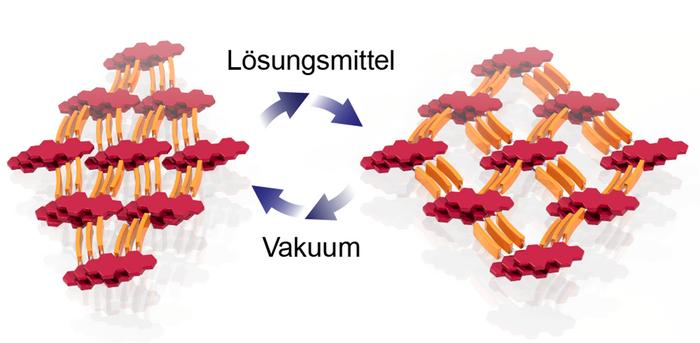
Molecular sponge
66
SHARES
598
VIEWS
Share on FacebookShare on Twitter
ADVERTISEMENT

Porous covalent organic frameworks (COFs) are a class of highly ordered, porous materials consisting of organic molecules that are linked by covalent bonds to form a network. They enable the construction of functional materials with molecular precision. Similar to metal organic frameworks (MOFs), which were discovered around 25 years ago and have already reached market maturity, COFs possess highly promising structural, optical and electronic properties for numerous applications, for example in gas and liquid storage, catalysis, sensor technology and energy applications.  

Molecular sponge

Credit: Florian Auras

Porous covalent organic frameworks (COFs) are a class of highly ordered, porous materials consisting of organic molecules that are linked by covalent bonds to form a network. They enable the construction of functional materials with molecular precision. Similar to metal organic frameworks (MOFs), which were discovered around 25 years ago and have already reached market maturity, COFs possess highly promising structural, optical and electronic properties for numerous applications, for example in gas and liquid storage, catalysis, sensor technology and energy applications.  

Previous research on COFs has generally focussed on the construction of rigid frameworks with static material properties. Dr Florian Auras and his team at the Chair of Molecular Functional Materials at TUD have now developed a design strategy for dynamic two-dimensional COFs that can open and close their pores in a controlled manner, similar to a sponge. “The main aim of the study was to equip these frameworks, which are normally very precisely ordered but rigid, with exactly the right degree of flexibility so that their structure can be switched from compact to porous. By adding solvent to the molecular sponge, we can now temporarily and reversibly change the local geometry as well as optical properties such as colour or fluorescence,” says Florian Auras, explaining his research approach.  

The ability to switch the structural and optoelectronic properties of the materials back and forth in a targeted manner makes the materials particularly interesting for future applications in electronics and information technology. “Our research results form the basis for our further research into stimuli-responsive polymers, particularly with the aim of realising switchable quantum states. When working on COFs, I am always fascinated by how precisely their properties can be manipulated by controlling the molecular structure,” adds Auras.


Journal

Nature Chemistry

DOI

10.1038/s41557-024-01527-8

Article Title

Dynamic two-dimensional covalent organic frameworks

Share26Tweet17
Previous Post

More than 1 in 10 patients at FQHCs experience major social risk factors

Next Post

Breakthrough approach enables bidirectional BCI functionality

Related Posts

Using Epigenetics to Monitor Environmental Arsenic Exposure — Chemistry
Chemistry

Using Epigenetics to Monitor Environmental Arsenic Exposure

May 1, 2026
Innovative Nanoreactor Design Enhances Catalysis by Optimizing Transport and Reaction Kinetics — Chemistry
Chemistry

Innovative Nanoreactor Design Enhances Catalysis by Optimizing Transport and Reaction Kinetics

May 1, 2026
Scientists Reveal Atomic Mechanism Behind Water-Induced Hydroxylation in CoOx Nanostructures — Chemistry
Chemistry

Scientists Reveal Atomic Mechanism Behind Water-Induced Hydroxylation in CoOx Nanostructures

May 1, 2026
Swift Creation of Conductive Organic Compounds via Mechanochemistry — Chemistry
Chemistry

Swift Creation of Conductive Organic Compounds via Mechanochemistry

May 1, 2026
Physics-Guided Network Eliminates Honeycomb Artifacts in Fiber Endoscopy — Chemistry
Chemistry

Physics-Guided Network Eliminates Honeycomb Artifacts in Fiber Endoscopy

May 1, 2026
Scientists Reveal Key to Intense Acidity in Fluorinated Aluminas — Chemistry
Chemistry

Scientists Reveal Key to Intense Acidity in Fluorinated Aluminas

May 1, 2026
Next Post
Experimental paradigm for noninvasive BCI speller

Breakthrough approach enables bidirectional BCI functionality

  • Mothers who receive childcare support from maternal grandparents show more parental warmth, finds NTU Singapore study

    Mothers who receive childcare support from maternal grandparents show more parental warmth, finds NTU Singapore study

    27639 shares
    Share 11052 Tweet 6908
  • University of Seville Breaks 120-Year-Old Mystery, Revises a Key Einstein Concept

    1042 shares
    Share 417 Tweet 261
  • Bee body mass, pathogens and local climate influence heat tolerance

    677 shares
    Share 271 Tweet 169
  • Researchers record first-ever images and data of a shark experiencing a boat strike

    540 shares
    Share 216 Tweet 135
  • Groundbreaking Clinical Trial Reveals Lubiprostone Enhances Kidney Function

    527 shares
    Share 211 Tweet 132
Science

Embark on a thrilling journey of discovery with Scienmag.com—your ultimate source for cutting-edge breakthroughs. Immerse yourself in a world where curiosity knows no limits and tomorrow’s possibilities become today’s reality!

RECENT NEWS

  • Family Health Needs of Disabled Elders Explored
  • Mcu Controls Bone Growth Through Mitochondrial Calcium
  • Physical Disorders, ADLs, Cognition, Depression in Nursing Homes
  • Precise Spatiotemporal Cardiac Repair and Regeneration

Categories

  • Agriculture
  • Anthropology
  • Archaeology
  • Athmospheric
  • Biology
  • Biotechnology
  • Blog
  • Bussines
  • Cancer
  • Chemistry
  • Climate
  • Earth Science
  • Editorial Policy
  • Marine
  • Mathematics
  • Medicine
  • Pediatry
  • Policy
  • Psychology & Psychiatry
  • Science Education
  • Social Science
  • Space
  • Technology and Engineering

Subscribe to Blog via Email

Success! An email was just sent to confirm your subscription. Please find the email now and click 'Confirm Follow' to start subscribing.

Join 5,146 other subscribers

© 2025 Scienmag - Science Magazine

Welcome Back!

Login to your account below

Forgotten Password?

Retrieve your password

Please enter your username or email address to reset your password.

Log In
No Result
View All Result
  • HOME
  • SCIENCE NEWS
  • CONTACT US

© 2025 Scienmag - Science Magazine
