


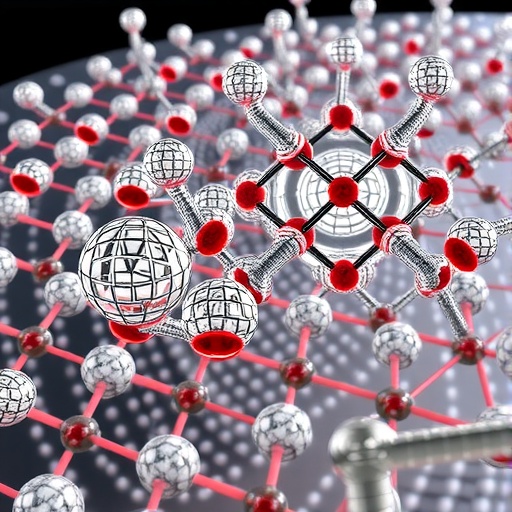
Semiconductor surfaces—especially silicon and germanium (100)—owe much of their chemistry to a seemingly simple motif: the “buckled dimer.” In this arrangement, two surface atoms form a pair with opposing electronic tendencies: a Lewis-acidic “down” atom and a Lewis-basic “up” atom. That polarization is central to how these materials behave during passivation, chemical functionalization, and device fabrication. Yet the same polarity that makes buckled dimers so influential also makes them exceptionally hard to isolate and quantify in a clean, atomically resolved way.
Now, a study in Nature Chemistry reports a clever workaround: translating the surface motif into a discrete molecular system that can be interrogated in solution. The researchers designed a dinuclear Ge(II) complex using a calix[4]pyrrolato ligand, a scaffold selected specifically to enforce geometric control rather than rely on chance molecular conformations. The key result is a forced cis-bent geometry around germanium atoms.
This constrained arrangement produces a polarized Ge–Ge unit that effectively mimics the ambiphilic character of the Ge(100) buckled dimer—one part of the pair behaves as a strong Lewis acid while the other acts as a strong Lewis base. Importantly, the team did not simply claim “surface-like” behavior qualitatively. They combined structural analysis with quantitative Lewis acidity/basicity measurements to map electronic preferences onto the molecular framework.
To validate the model’s functional relevance, solution-phase reactivity experiments were used to test how the complex engages with substrates. The reactivity patterns display pronounced features reminiscent of interface chemistry, where distinct donor and acceptor sites act in different spatial domains. In other words, the ligand constraint doesn’t just shape the molecule—it separates electronic roles, enabling site-selective behavior that resembles what happens at solid–vacuum boundaries.
Despite this impressive emulation, the authors also report clear divergence from conventional digermenes. This is a critical nuance: the complex is not a generic Ge–Ge multiple-bond species showing typical reactivity. Instead, the rigid geometry creates exceptionally strong and spatially distinct Lewis acidic and basic regions, tuning chemical response in ways that align more closely with a buckled surface dimer than with established ground-state digermene paradigms.
For materials science, the implication is viral in the best sense: it offers a recipe for “molecular surrogates” that can let chemists probe interfacial phenomena without the experimental ambiguities of working directly at semiconductor vacuum interfaces. By turning an elusive surface motif into a robust, testable unit, the work opens a path to studying how electronic polarization governs real chemical outcomes.
Beyond germanium, the strategy suggests a broader design principle: constrain main-group elements into geometries that reproduce polarization and charge-transfer tendencies normally restricted to surfaces. Such approaches could accelerate the screening and rational design of interface-reactive molecules for passivation chemistry, catalytic steps at semiconductor boundaries, and next-generation device processing.
Cite Scienmag News
Bethany Barker. (July 15, 2026). Molecular Model Explains Buckled Dimers on Ge(100) Surface. Scienmag. https://scienmag.com/molecular-model-explains-buckled-dimers-on-ge100-surface/
Bethany Barker. "Molecular Model Explains Buckled Dimers on Ge(100) Surface." Scienmag, 15 July 2026, https://scienmag.com/molecular-model-explains-buckled-dimers-on-ge100-surface/. Accessed 4 September 2026.
Bethany Barker. "Molecular Model Explains Buckled Dimers on Ge(100) Surface." Scienmag. July 15, 2026. https://scienmag.com/molecular-model-explains-buckled-dimers-on-ge100-surface/


