


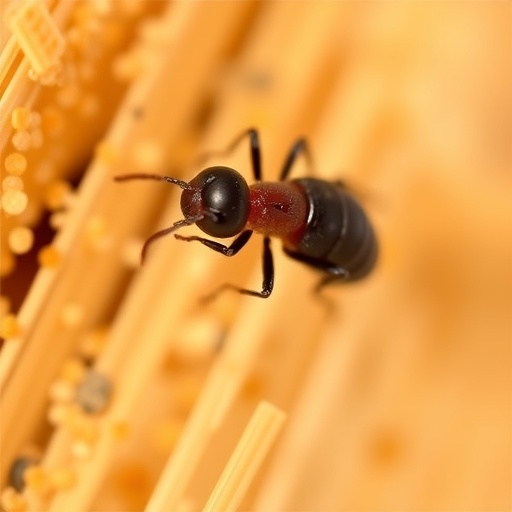
A laboratory study has identified a potentially powerful way to intensify the insecticidal activity of zinc oxide nanoparticles: exposing the particles to a low-power blue laser before applying them to termites. In experiments with workers and soldiers of the fungus-growing termite Macrotermes malaccensis, zinc oxide nanoparticles modified with 405-nanometre laser light produced complete mortality at a concentration of 1 milligram per millilitre within 36 hours. The result suggests that a brief optical treatment may alter the physical or chemical behaviour of nanoparticles enough to make them more effective against a major group of wood-damaging insects. The work, reported by researchers in Nigeria and Malaysia, remains an early laboratory demonstration rather than a ready-to-use pest-control product. Nevertheless, it brings together nanotechnology, photonic materials science and insect management in a way that could attract attention from researchers searching for alternatives to conventional chemical termiticides.
Termites are among the most economically consequential social insects. Their colonies can damage buildings, wooden structures, agricultural materials and stored products, often while remaining hidden inside soil or timber. Conventional control commonly depends on toxic chemicals that may persist in the environment, move through soil or pose risks to non-target organisms when improperly applied. Nanoparticles have been investigated as possible alternatives because their extremely small dimensions create a large surface area relative to their mass. That high surface-to-volume ratio can increase contact with an insect’s body and can change how the material interacts with moisture, biological membranes and surrounding chemicals. Zinc oxide is particularly interesting because it is already widely studied as a semiconductor, photocatalyst and antimicrobial material. At the nanoscale, its surface can participate in reactions that generate chemically reactive oxygen species, molecules capable of damaging lipids, proteins and cellular structures.
The researchers tested whether laser irradiation could further modify zinc oxide nanoparticles before they were used against M. malaccensis. Their experimental material was divided into three groups: untreated nanoparticles, particles irradiated for 15 minutes and particles irradiated for 30 minutes. A continuous-mode 405-nanometre diode laser delivered 500 milliwatts of power through a beam measuring 4 millimetres across. The samples were positioned 10 centimetres from the laser source, creating a fixed exposure geometry intended to make the treatment reproducible. After irradiation, the nanoparticle preparations were diluted serially and presented to termite workers and soldiers. The study also included physicochemical characterization using ultraviolet-visible spectroscopy, scanning electron microscopy, energy-dispersive X-ray analysis and laser-irradiation measurements. These techniques can reveal how light treatment changes optical absorption, particle morphology and elemental composition, although the available report does not establish that one specific alteration caused the insects’ deaths.
The central finding was a statistically significant difference in termite mortality among the treatment groups. The analysis produced an F statistic of 4.75 with degrees of freedom reported as 6 and 36, and a probability value below 0.05, indicating that the observed variation was unlikely to be explained by random differences alone under the study’s statistical model. The most striking result came from the 30-minute irradiated nanoparticles at 1 milligram per millilitre: every termite in that treatment was dead within 36 hours. The 15-minute irradiated particles also performed significantly better than the untreated control. However, the researchers did not detect a statistically significant difference between the 15-minute and 30-minute irradiation groups. That means the longer exposure produced the headline result at the tested concentration, but the data do not yet demonstrate that doubling irradiation time consistently doubles or otherwise improves toxicity.
Why might a blue laser make zinc oxide nanoparticles more lethal? Zinc oxide is a wide-band-gap semiconductor, with electronic properties that allow light energy to influence the movement of electrons and positively charged holes within the material. When suitable radiation interacts with the surface, these charge carriers can participate in oxidation and reduction reactions involving oxygen and water. Such reactions may generate reactive oxygen species, including highly reactive radicals and peroxides. In an insect, oxidative damage could compromise the waxy outer cuticle, disrupt cell membranes or interfere with essential metabolic processes. Nanoparticles may also adhere to the cuticle or enter through respiratory openings, although the experiment described does not determine the route of exposure. The 405-nanometre wavelength lies in the violet-blue region of the spectrum and may alter surface defects, oxygen vacancies, aggregation state or optical absorption in the particles. Those changes could affect reactivity, but they remain hypotheses until directly measured alongside biological damage.
The study’s results build on a broader body of research showing that zinc oxide nanoparticles can affect insects under laboratory conditions. Earlier experiments have examined their activity against pests such as the fall armyworm and the tomato potato psyllid, while other work has investigated zinc oxide and silica nanoparticles against insects that attack stored seeds. The new termite study adds a social, wood-feeding species to that research landscape and introduces pre-use laser treatment as a potential way to tune nanoparticle performance. The idea is not entirely unexpected from materials science: irradiation can influence the structural, morphological and optical properties of metal-oxide nanomaterials. Even modest changes in particle size distribution, surface defects or aggregation can affect how particles absorb light and interact with living tissue. The challenge is translating that controllability into a dependable pest-management system, where humidity, soil chemistry, wood surfaces and colony behaviour could all change the outcome.
M. malaccensis is not simply a collection of isolated insects. Like other termites, it operates as a colony in which workers forage and maintain the nest while soldiers defend it. A treatment that kills individuals in a laboratory container may not automatically eliminate a colony in the field. Termites can avoid contaminated areas, groom one another, dilute exposure through social interactions or rebuild damaged structures. The study focused on workers and soldiers, but it does not show whether irradiated nanoparticles can penetrate a nest, transfer between castes or affect reproductive members. Nor does it establish how long the particles remain active once deposited in soil or wood. These questions matter because a successful termiticide must do more than produce rapid mortality under controlled conditions; it must reach the insects in their ecological setting while limiting exposure to people, pets, beneficial insects, plants and soil organisms.
Safety and environmental fate will therefore be crucial if laser-modified zinc oxide nanoparticles move beyond the laboratory. Zinc is an essential element, but dose, particle size, chemical form and exposure route determine whether it is harmless or toxic. Nanoparticles can behave differently from larger particles because they disperse, aggregate and interact with biological surfaces in distinctive ways. The study reports that experimental residues, including zinc oxide suspensions and treated biological samples, were collected and handled under institutional nanomaterial safety procedures. Contaminated waste was sealed, transferred to a certified hazardous-waste facility and treated to prevent nanoparticle release. Those precautions underscore an important point: a material that is promising as an insecticide must still be evaluated for impacts on aquatic life, soil microbes, plants and non-target arthropods. The research did not provide field-scale ecological tests, residue measurements or comparisons with established termiticide products.
The practical appeal of the approach lies in its relative simplicity. A 405-nanometre diode laser is a compact and widely available light source, and the reported treatment uses a fixed power and exposure period rather than an elaborate high-energy process. If irradiation can reliably increase activity without requiring more zinc oxide, manufacturers might eventually design nanoparticle formulations that are more efficient at lower doses. Yet the laboratory protocol also highlights the variables that would need to be standardized: laser power, wavelength, beam size, distance, exposure duration, sample thickness, particle concentration and temperature. A change in any of these parameters could alter the energy delivered to the material. The researchers found no significant mortality difference between the 15- and 30-minute groups, suggesting that optimization may be more useful than simply increasing treatment time. Reproducibility studies across independent laboratories will be needed before the technique can be considered robust.
For now, the finding is best understood as a proof of concept: light-treated zinc oxide nanoparticles caused rapid, complete mortality in one termite species under defined laboratory conditions. It does not show that the particles are safe for broad environmental application, that they outperform commercial termite controls or that laser treatment would work equally well against other species and life stages. The researchers say their data support further investigation of wavelength and power as tools for engineering nanoparticle-based pest control. Future experiments could connect particle characterization with measured reactive oxygen species, cellular damage and exposure routes, then test treated materials in wood, soil and simulated colonies. If those studies confirm both efficacy and environmental safety, the technology could become part of a new generation of precision pest-management methods. Until then, the most important lesson is not that termites have met their nanotechnological match, but that a brief flash of blue light may give a familiar material an unexpectedly potent new edge.
Cite Scienmag News
Denise Maddox. (August 29, 2026). Modified Zinc Oxide Nanoparticles Show Promise for Termite Control. Scienmag. https://scienmag.com/modified-zinc-oxide-nanoparticles-show-promise-for-termite-control/
Denise Maddox. "Modified Zinc Oxide Nanoparticles Show Promise for Termite Control." Scienmag, 29 August 2026, https://scienmag.com/modified-zinc-oxide-nanoparticles-show-promise-for-termite-control/. Accessed 3 September 2026.
Denise Maddox. "Modified Zinc Oxide Nanoparticles Show Promise for Termite Control." Scienmag. August 29, 2026. https://scienmag.com/modified-zinc-oxide-nanoparticles-show-promise-for-termite-control/


