


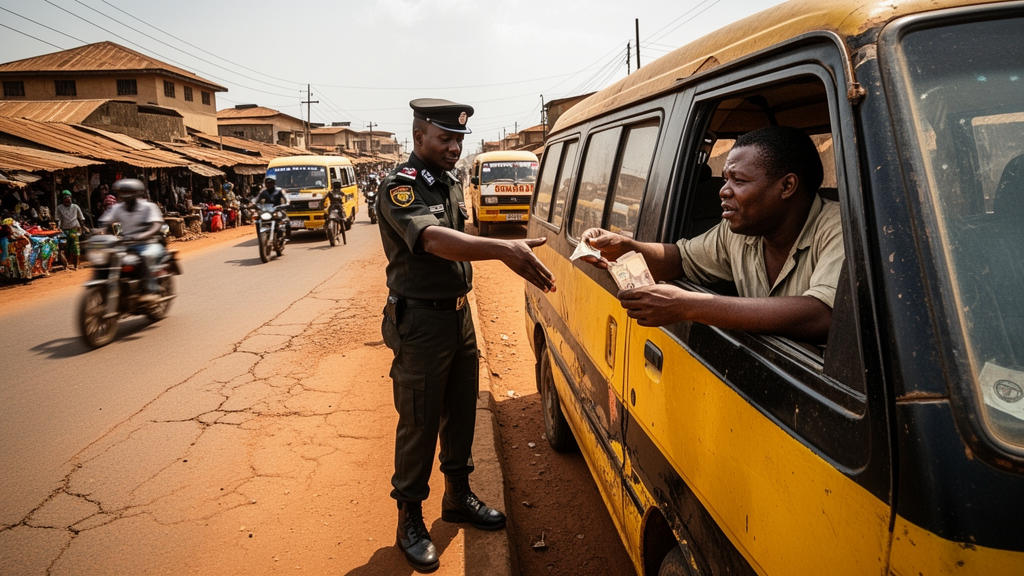
A mixed-methods study of informal transport operators in Ibadan, Nigeria, found that road-enforcement encounters frequently involved verbal degradation, demands for bribes and, in some cases, physical or sexual assault. The study, described in the published abstract, combined a survey of 122 drivers of buses, taxis, tricycles and motorcycles with a focus group of seven enforcement officers from the Nigeria Police Force, Federal Road Safety Corps and Vehicle Inspection Office.
Verbal harassment was the most frequently reported experience. A total of 69.67% of surveyed operators said enforcement personnel had made them feel less than human, while most reported being shouted at, sworn at or insulted. Physical assault was reported by 24.6% of respondents, and sexual harassment by 4.1%. Demands for bribes were also widespread, with 78.69% reporting such demands. These figures describe the experiences recorded in the operator survey; the abstract does not provide details about survey dates, recruitment, question wording or statistical uncertainty around the percentages.
The authors interpret the survey alongside the officers’ accounts as showing that roadside enforcement cannot be characterized simply as interactions between powerful officers and powerless drivers. The focus-group material indicated that harassment could run in both directions, while bribery could range from a coerced toll to a transaction chosen by the operator. The researchers also report repeated bending of enforcement through elite interference. Drawing on theories of state-produced informality, street-level discretion and political economy, they propose a “discretion in exception” model to explain how unaccountable discretion within a weakly regulated environment may contribute to these outcomes.
The study offers an empirical account of what enforcement encounters can look like for informal transport workers in one Nigerian city, while also presenting a framework for examining relationships between police authority, discretion and informality. Its stated contribution includes documenting the bidirectional and elite-influenced character of Nigerian roadside enforcement and demonstrating how complementary data can be used to study a population that the authors describe as previously unmapped. However, this report is based only on the accessible abstract rather than the full article. The limited information available prevents assessment of the instruments, analytical procedures, subgroup patterns and broader generalizability, and the reported associations do not by themselves establish the causes of harassment, bribery or assault.
Subject of Research: Mixed-methods analysis of law-enforcement encounters experienced by informal transport operators in Ibadan, Nigeria
Article Title: The dynamics of power and vulnerability: an analysis of law enforcement interactions with informal transport operators in Ibadan, Nigeria
Article References: Akogun, O., & Popoola, A. (2026). The dynamics of power and vulnerability: an analysis of law enforcement interactions with informal transport operators in Ibadan, Nigeria. SN Social Sciences, 6(9), Article 381. https://doi.org/10.1007/s43545-026-01673-5
Image Credits: AI Generated
DOI: 10.1007/s43545-026-01673-5
Keywords: informal transport, road enforcement, harassment, bribery, police, Nigeria, Ibadan, mixed methods, street-level discretion, dynamics, power, vulnerability
Cite Scienmag News
Courtney Benton. (October 20, 2026). Mixed-methods study maps abuse and bribery in Ibadan road-enforcement encounters. Scienmag. https://scienmag.com/mixed-methods-study-maps-abuse-and-bribery-in-ibadan-road-enforcement-encounters/
Courtney Benton. "Mixed-methods study maps abuse and bribery in Ibadan road-enforcement encounters." Scienmag, 20 October 2026, https://scienmag.com/mixed-methods-study-maps-abuse-and-bribery-in-ibadan-road-enforcement-encounters/. Accessed 20 October 2026.
Courtney Benton. "Mixed-methods study maps abuse and bribery in Ibadan road-enforcement encounters." Scienmag. October 20, 2026. https://scienmag.com/mixed-methods-study-maps-abuse-and-bribery-in-ibadan-road-enforcement-encounters/


