


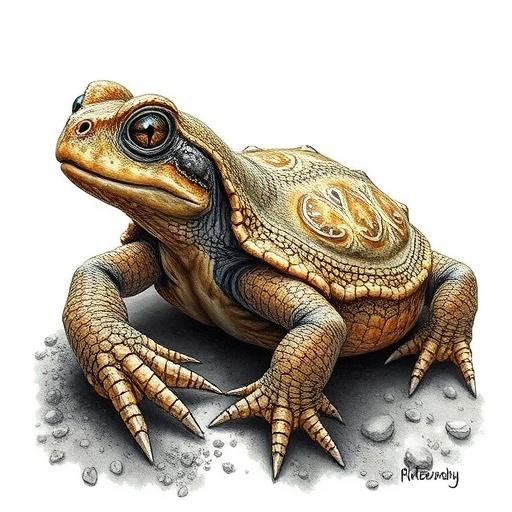
In a groundbreaking study, researchers have unveiled significant insights into the evolutionary dynamics of the Phrynocephalus guttatus species group, a fascinating assembly of reptiles found in arid regions of Central Asia. This research is particularly crucial as it delves into the mitochondrial genomic variations that inform our understanding of the species’ phylogeny and biogeography. The implications of these findings are not only important for herpetology but also for broader ecological and evolutionary discussions.
The Phrynocephalus guttatus species group, part of the Agamidae family, is known for its remarkable adaptations to harsh desert environments. The study led by D. Ualiyeva and colleagues focuses on mitochondrial DNA, which provides critical insights into the genetic variations and evolutionary relationships among these reptiles. Mitochondrial genomes are often used in phylogenetic studies due to their maternal inheritance and relatively high mutation rates, making them ideal for understanding evolutionary timelines.
Central Asia presents a unique challenge with its diverse yet extreme habitats. Researchers explored how geographical barriers and climatic changes have shaped the biogeography of the Phrynocephalus guttatus species. Previous studies suggested that geological events, such as the uplift of mountain ranges and the formation of vast desert areas, have influenced species distribution. The team’s analysis aimed to clarify whether these historical events resulted in speciation within this group.
In their methodology, the researchers collected samples from various locations across Central Asia, obtaining mitochondrial sequences that highlight significant genetic differentiation. Through advanced genomic sequencing techniques, they were able to construct detailed phylogenetic trees illustrating the relationships and divergences among the species. This data provides tangible evidence to evaluate the impact of geographical separation on evolutionary processes.
Interestingly, the study revealed unexpected degrees of genetic diversity within relatively close populations, suggesting that the historical landscape of Central Asia may have fostered distinct evolutionary pathways. The findings challenge the existing notions of a linear relationship between geographic distance and genetic divergence. Instead, they propose that local adaptation and microhabitat differences significantly contribute to the genetic diversity observed in these reptiles.
The research also emphasizes the importance of understanding evolutionary history in the context of conservation. As climate change continues to affect habitats and species distributions, knowledge about the historical and genomic frameworks of species like Phrynocephalus guttatus becomes vital for developing effective conservation strategies. The authors highlight that preserving genetic diversity is crucial for the resilience of these reptiles in the face of environmental changes.
Moreover, the study’s revelations extend beyond the specific group of Phrynocephalus guttatus. The methodologies employed can be applied to other taxa in arid environments, enriching our understanding of evolutionary processes across diverse species. The implications of this research are broad, touching on key principles in evolutionary biology and conservation efforts in biodiversity hotspots.
Furthermore, the results suggest the need for further investigations into the ecological roles of these reptiles. Understanding their interactions with other species, including their prey and predators, as well as their responses to climatic shifts, could provide deeper insights into their ecology and the functioning of desert ecosystems.
The work of Ualiyeva et al. not only contributes to the body of knowledge surrounding the Phrynocephalus guttatus species group but also serves as a model for future research endeavors in evolutionary and conservation biology. The study calls for a concerted effort within the scientific community to focus on the integration of genomic data with ecological and environmental studies.
As scientists continue to uncover the mysteries of Earth’s biodiversity, the implications of such research become increasingly apparent. The intricate web of life, shaped by millions of years of evolution, like that of Phrynocephalus guttatus, deserves attention as it holds keys to understanding resilience in changing environments. This study reinforces the notion that even in the most arid and inhospitable places, life finds a way to adapt, survive, and evolve.
In conclusion, the mitochondrial genomic variations of the Phrynocephalus guttatus species group illuminate a complex tapestry of evolutionary history. This research not only provides a roadmap for future studies in herpetology but also raises critical questions about the preservation of genetic diversity in the face of global change. The findings are a testament to the enduring importance of evolutionary research in our quest to understand, appreciate, and protect the natural world.
As we anticipate further studies building on this groundbreaking work, the scientific community remains engaged in discussions about the implications for species conservation in rapidly changing environments. The lessons learned from the Phrynocephalus guttatus species group may inform conservation policies that safeguard both reptiles and their desert habitats for generations to come.
The article encapsulates significant advancements in the field and is set to catalyze discussions among scientists and conservationists alike, urging them to consider the evolutionary history that shapes today’s biodiversity and its future.
Cite Scienmag News
Gavin Prescott. (January 15, 2026). Mitochondrial Insights into Phrynocephalus Guttatus Evolution. Scienmag. https://scienmag.com/mitochondrial-insights-into-phrynocephalus-guttatus-evolution/
Gavin Prescott. "Mitochondrial Insights into Phrynocephalus Guttatus Evolution." Scienmag, 15 January 2026, https://scienmag.com/mitochondrial-insights-into-phrynocephalus-guttatus-evolution/. Accessed 5 September 2026.
Gavin Prescott. "Mitochondrial Insights into Phrynocephalus Guttatus Evolution." Scienmag. January 15, 2026. https://scienmag.com/mitochondrial-insights-into-phrynocephalus-guttatus-evolution/


