


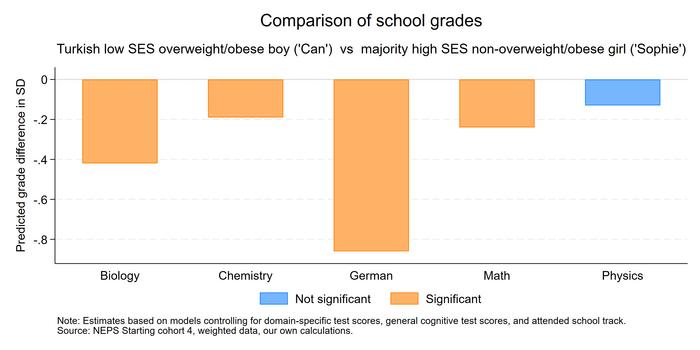
A new study done in more than 14,000 ninth graders in Germany has revealed that students experience grading bias based on their gender, body size, ethnicity and parental socio-economic status. These negative biases stack on each other, meaning that students with multiple intersectional identities get significantly lower grades than their peers regardless of their true abilities. Richard Nennstiel and Sandra Gilgen of the University of Bern and University of Zurich in Switzerland present these findings in the open-access journal PLOS ONE on July 3, 2024.

Credit: Nennstiel, Gilgen, CC-BY 4.0 (
A new study done in more than 14,000 ninth graders in Germany has revealed that students experience grading bias based on their gender, body size, ethnicity and parental socio-economic status. These negative biases stack on each other, meaning that students with multiple intersectional identities get significantly lower grades than their peers regardless of their true abilities. Richard Nennstiel and Sandra Gilgen of the University of Bern and University of Zurich in Switzerland present these findings in the open-access journal PLOS ONE on July 3, 2024.
Secondary school grades can open or close doors to careers later in life. To explore whether students are suffering from bias in their school grades, Nennstiel and Gilgen used data from the National Educational Panel Study in Germany, a study that has tracked seven cohorts of German school children since 2008. They focused on a nationally representative sample of 14,090 students who were in the ninth grade in 2010. Nennstiel and Gilgen compared grades handed by school teachers to results on standardized competence tests to find out whether some students had an advantage over others. The scientists looked at the effects of gender, body mass index (BMI), parent socio-economic status (SES), and ethnic background.
Gender bias was evident in teacher-assigned grades in all subjects except for chemistry. Girls had an advantage in German, math, and biology, while boys benefitted in physics. Higher BMIs were associated with significantly lower grades from teachers in every subject, while students with higher parental SES had higher grades. Minority students received lower grades in all subjects except biology. These disadvantages compounded, meaning that irrespective of true skill and aptitude, a boy with a high BMI from a low-SES, minority background received on average lower grades, than a German-born, low BMI girl from a higher SES.
While these results can’t determine the exact mechanisms behind this bias, they suggest that grading bias is widespread in Germany. The researchers recommend that further studies focus on why students receive biased grades, and how such biases could be tackled in the classroom.
The authors add: “Even after controlling for three different measures of ability and attended school track we find widespread additive intersectional effects of gender, social and ethnic origin as well as body weight on grading.”
#####
In your coverage please use this URL to provide access to the freely available article in PLOS ONE:
Citation: Nennstiel R, Gilgen S (2024) Does chubby can get lower grades than skinny Sophie? Using an intersectional approach to uncover grading bias in German secondary schools. PLoS ONE 19(7): e0305703.
Author Countries: Switzerland
Funding: The author(s) received no specific funding for this work.
Journal
PLoS ONE
Method of Research
Observational study
Subject of Research
People
Article Title
Does chubby can get lower grades than skinny Sophie? Using an intersectional approach to uncover grading bias in German secondary schools
Article Publication Date
3-Jul-2024
COI Statement
The authors have declared that no competing interests exist.
Cite Scienmag News
Courtney Benton. (July 3, 2024). Minority status, social origin, gender, and weight can all count against a German kid’s grades. Scienmag. https://scienmag.com/minority-status-social-origin-gender-and-weight-can-all-count-against-a-german-kids-grades/
Courtney Benton. "Minority status, social origin, gender, and weight can all count against a German kid’s grades." Scienmag, 3 July 2024, https://scienmag.com/minority-status-social-origin-gender-and-weight-can-all-count-against-a-german-kids-grades/. Accessed 6 September 2026.
Courtney Benton. "Minority status, social origin, gender, and weight can all count against a German kid’s grades." Scienmag. July 3, 2024. https://scienmag.com/minority-status-social-origin-gender-and-weight-can-all-count-against-a-german-kids-grades/

