


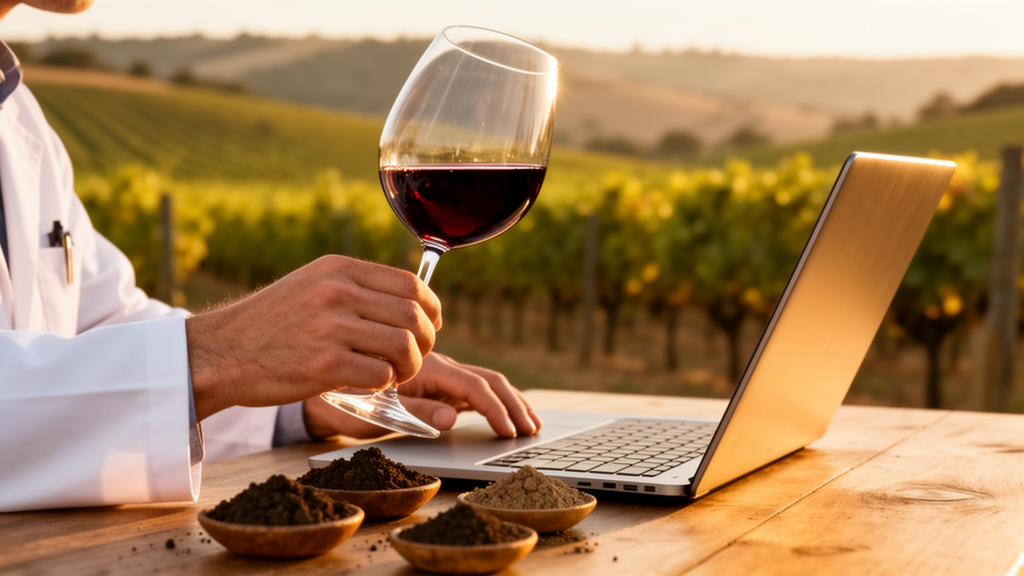
For decades, wine scientists have chased the same elusive question: what, chemically, makes a Cabernet Sauvignon taste like a Cabernet Sauvignon? Now, a team at Tarim University in China believes the answer has been hiding in plain sight — buried in the tables of thousands of published papers that nobody ever thought to stitch together.
In a study published in Food Chemistry: X, researchers Mei-Ling Yang, Wang Hui and Li-Xia Zhu systematically mined nearly three decades of wine aroma literature, building what they describe as a harmonised database of volatile compounds drawn from 103 peer-reviewed studies spanning 22 countries and 38 grape cultivars. From this trove, they distilled a panel of 31 candidate compounds that appear to distinguish grape varieties — and then tested whether those markers could actually tell two commercial Chinese red wines apart.
The approach is deceptively simple but technically ambitious. Rather than generating new experimental data under a single controlled protocol, the team harvested quantitative aroma measurements that individual laboratories had already published, then confronted the messy reality that such data were never designed to be combined. Extraction methods, instrumental platforms, quantification strategies and reporting formats all differ wildly between studies, making direct comparison notoriously unreliable.
To tame this heterogeneity, the researchers standardised compound identities using CAS numbers and PubChem records, converted concentrations to micrograms per litre where conversion bases were explicit, and retained detailed analytical metadata for every record. Odour thresholds — critical for calculating aroma activity values — were sourced with their original matrices and units rather than averaged, preserving traceability in a field where threshold values can vary by orders of magnitude depending on ethanol content and sensory methodology.
With the database assembled, the team deployed a three-pronged chemometric screening strategy. Unsupervised principal component analysis first mapped natural clustering among six major varieties. Supervised partial least squares discriminant analysis then identified compounds driving separation, with variable importance in projection scores above 1 flagging key discriminators. Finally, a random forest classifier — tuned via five-fold cross-validation and achieving 87 percent mean accuracy — ranked compounds by permutation importance. Only compounds surviving all three filters were retained, yielding the final panel of 31.
The intersection approach is what gives the result its weight. Ethyl octanoate, a fermentation-derived ester imparting pear and floral notes, topped the PLS-DA ranking with a VIP score of 1.46. Two-phenylethanol, a rose-scented higher alcohol produced via the Ehrlich pathway from phenylalanine, scored 1.40. One-hexanol, a C6 alcohol born from the lipoxygenase pathway of grape membrane lipids, carried a VIP of 1.31 — a marker the authors link to differences in grape maturity and pre-fermentation maceration.
As a proof of concept, the researchers analysed 24 commercial dry red wines — 12 Cabernet Sauvignon and 12 Marselan, all from Chinese producers and vintages 2020 to 2022 — using headspace solid-phase microextraction coupled to gas chromatography-mass spectrometry. A trained sensory panel of ten assessors evaluated the wines on a 0–5 intensity scale across six attributes, from fruity and floral to animal-like and green.
The results were striking. In the PLS-DA score plot built from the experimental measurements, the two varieties separated cleanly along the first principal component with no overlap, yielding internal fit statistics of R²Y(cum) = 0.971 and Q²(cum) = 0.947, and a ROC area under the curve of 0.840. Cabernet Sauvignon wines scored higher on green and herbaceous attributes — consistent with their blackcurrant and bell-pepper character — while Marselan showed stronger floral and red-fruit intensities, matching its reputation for violet and cherry notes.
The authors are careful to frame these as candidate indicators rather than universal fingerprints. Wine aroma is shaped by vintage, region, winemaking practice, yeast strain and analytical platform, and the team acknowledges that their marker panel is conditional on threshold availability — only 191 of the 792 catalogued compounds had usable odour thresholds, meaning the other 601 were excluded from activity-based screening regardless of their sensory relevance.
What makes the study genuinely provocative is its implication for the broader data crisis in food science. The authors argue that the fragmentation of aroma literature — inconsistent units, undefined missing values, incompatible reporting — is the single biggest obstacle preventing decades of accumulated knowledge from becoming reusable digital infrastructure. Statistical normalisation, they note, rescales numbers but does not remove systematic differences between analytical platforms.
Their prescription is a cultural shift: unified compound identification systems, complete provenance metadata, explicit definitions of what a non-detect means, and open-access databases governed by FAIR principles. Only then, they argue, can machine learning and artificial intelligence move from pattern-fitting exercises to genuine sensory prediction — the kind that could authenticate a bottle’s varietal claim, flag fraud, or even help winemakers dial in fermentation conditions before the first grape is crushed.
For an industry increasingly targeted by counterfeiters and increasingly dependent on data-driven quality control, the message is clear: the future of wine authentication may not lie in new instruments, but in teaching algorithms to read what science has already written.
Subject of Research: Wine Aroma Data Mining
Article Title: Quantitative mining of wine aroma literature data for specification reuse
Article References: Yang, M.-L., Hui, W., & Zhu, L.-X. (2026). Quantitative mining of wine aroma literature data for specification reuse. Food Chemistry: X, Article 104611. https://doi.org/10.1016/j.fochx.2026.104611
Image Credits: AI Generated
DOI: 10.1016/j.fochx.2026.104611
Keywords: wine aroma, chemometrics, machine learning, GC-MS, data harmonisation, varietal markers, food chemistry, sensory evaluation, bibliometrics, artificial intelligence, wine authentication, volatile compounds
Cite Scienmag News
Bethany Barker. (October 17, 2026). Mining decades of wine research, scientists teach AI to taste terroir. Scienmag. https://scienmag.com/mining-decades-of-wine-research-scientists-teach-ai-to-taste-terroir/
Bethany Barker. "Mining decades of wine research, scientists teach AI to taste terroir." Scienmag, 17 October 2026, https://scienmag.com/mining-decades-of-wine-research-scientists-teach-ai-to-taste-terroir/. Accessed 17 October 2026.
Bethany Barker. "Mining decades of wine research, scientists teach AI to taste terroir." Scienmag. October 17, 2026. https://scienmag.com/mining-decades-of-wine-research-scientists-teach-ai-to-taste-terroir/


