


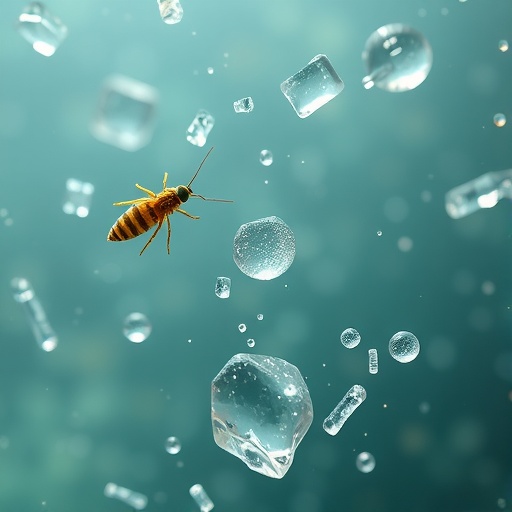
In a groundbreaking study published in Microplastics and Nanoplastics, researchers Gouin and Whelan have brought new clarity to a topic that has puzzled environmental scientists for years: the role of microplastic particles as vectors of exposure for harmful plastic additive chemicals across aquatic food webs. This investigation not only elucidates the intricate pathways through which toxic substances travel but also highlights the potential risks microplastics pose to ecosystems and human health, offering fresh perspectives that could shape future environmental policies.
Microplastics, tiny plastic fragments often smaller than five millimeters, have become ubiquitous in aquatic environments worldwide. These particles originate from a variety of sources, including the breakdown of larger plastic debris and direct release from consumer products. While their physical presence in water bodies has long raised concerns, growing attention has turned to their chemical properties—specifically, how they interact with and transport hazardous additives incorporated during plastic manufacturing.
The central focus of Gouin and Whelan’s research revolves around these additives—substances such as plasticizers, flame retardants, and stabilizers—that are embedded within plastic polymers to enhance product performance but can be toxic to living organisms. Their study utilizes an advanced food web model to simulate the bioaccumulation and transfer of these chemicals through different aquatic trophic levels, with microplastic particles serving as potential vectors facilitating exposure.
What makes this study particularly innovative is the integration of microplastic particles into a comprehensive ecological framework that accounts for the complexity of biological interactions and chemical dynamics. Prior research often examined microplastics in isolation or focused solely on direct ingestion by organisms. Here, the model captures how microplastics absorb, desorb, and ultimately transfer additive chemicals, underscoring their role as more than just physical contaminants.
The methodology involved coupling empirical data on microplastic concentrations, chemical properties of plastic additives, and feeding relationships among aquatic species. This allowed the researchers to quantify the extent to which microplastic-mediated transfer alters chemical exposure compared to baseline environmental pathways, such as direct uptake from water or sediment. The sophistication of the model reveals subtle but critical nuances that influence contaminant movement.
One of the key findings is that microplastic particles do indeed function as vectors, enhancing the bioavailability of certain hydrophobic additives to organisms at multiple trophic levels. This mechanism increases the potential for bioaccumulation and biomagnification of toxic substances, raising alarm bells about the long-term ecological and health impacts. Importantly, the degree of this effect varies depending on particle size, chemical characteristics, and environmental context.
The study highlights how smaller microplastics, due to their larger surface area-to-volume ratios, facilitate more efficient chemical exchange between plastics and surrounding media. Additionally, the interactions between microplastics and natural organic matter or biota can influence the binding and release kinetics of additives. These insights contribute to a more dynamic understanding of microplastic behavior in real-world conditions.
Ecologically, the implications are profound. Aquatic organisms ranging from plankton to fish can ingest microplastics, inadvertently introducing plastic-associated chemicals into their systems. As these creatures are consumed by predators higher up the food chain, additive chemicals transfer and potentially concentrate in top predators, including commercially important fish species consumed by humans. This trophic transfer pathway underscores a hidden risk within seafood safety assessments.
Furthermore, the model accounts for factors like feeding rates, metabolism, and elimination, which impact chemical retention and toxicity. By doing so, it provides a realistic estimation of organism-level exposure, moving beyond mere presence of contaminants to their potential biological consequences. Such detailed modelling is vital for risk assessment frameworks seeking to incorporate emerging pollutants like microplastics.
Beyond ecological and human health concerns, Gouin and Whelan’s work also offers critical guidance for environmental management. Recognizing microplastics as chemical vectors suggests that mitigation strategies should not only focus on reducing plastic debris but also consider the chemical profiles of additives in product design. Innovations toward safer, less persistent additives or materials that reduce additive leachability could be instrumental.
This research also calls for enhanced monitoring and regulatory approaches. Traditional chemical pollutant surveillance often overlooks microplastic-facilitated exposure routes, which this study demonstrates can be significant. Integrating microplastic-associated chemical transfer models into environmental policy making could help prioritize interventions and improve ecosystem protection.
The authors acknowledge that their model, while comprehensive, relies on certain assumptions and parameters that warrant further empirical validation. The interplay of environmental variables such as temperature, salinity, and microbial activity can influence additive behavior and microplastic degradation, affecting exposure dynamics. Hence, continued experimental work and field studies remain essential to refine these predictions.
Importantly, this study also opens a new research frontier by linking material science with ecology, toxicology, and environmental chemistry. Understanding how engineered materials interact with natural systems on chemical and biological levels is crucial as society grapples with the pervasive plastic pollution crisis. This interdisciplinary approach embodies the future of environmental science.
The findings by Gouin and Whelan not only deepen our comprehension of microplastic pollution but also emphasize the urgent need for systemic change in plastic production, waste management, and chemical safety. Addressing the hidden vector function of microplastics could be a game-changer in mitigating the subtle yet significant spread of toxic additives through aquatic ecosystems.
As the world grapples with the escalating consequences of plastic pollution, this study serves as a stark reminder that what we see floating on the surface is only part of the problem. The invisible chemical pathways facilitated by microplastics pose insidious risks with potential for far-reaching ecological disruption and human exposure.
Ultimately, the research shines a spotlight on the complex entanglement of modern materials and natural environments, urging scientists, policymakers, industry leaders, and the public to rethink their relationship with plastics. Only through comprehensive understanding and collaborative action can we hope to curb the mounting threats posed by these tiny plastic particles.
The full paper by Gouin and Whelan can be accessed in Microplastics and Nanoplastics, volume 4, article number 21, 2024, providing an invaluable resource for academics and regulators aiming to tackle one of the planet’s most challenging pollutants.
Cite Scienmag News
Denise Maddox. (November 25, 2025). Microplastics as Vectors of Plastic Additives Exposure. Scienmag. https://scienmag.com/microplastics-as-vectors-of-plastic-additives-exposure/
Denise Maddox. "Microplastics as Vectors of Plastic Additives Exposure." Scienmag, 25 November 2025, https://scienmag.com/microplastics-as-vectors-of-plastic-additives-exposure/. Accessed 5 September 2026.
Denise Maddox. "Microplastics as Vectors of Plastic Additives Exposure." Scienmag. November 25, 2025. https://scienmag.com/microplastics-as-vectors-of-plastic-additives-exposure/


