


Leuven (Belgium) 30/04/2024 – For the first time, researchers from VIB-KU Leuven, UZ Leuven, Janssen Pharmaceutica and multiple international collaborators have introduced quantitative methods and extensive confounder control to discover microbiome biomarkers in colorectal cancer development. While multiple microbial taxa have been put forward as potential cancer-associated biomarkers in the past, this new study uncovers obscured contributions that may have resulted in incorrect associations. The results have been published in Nature Medicine.

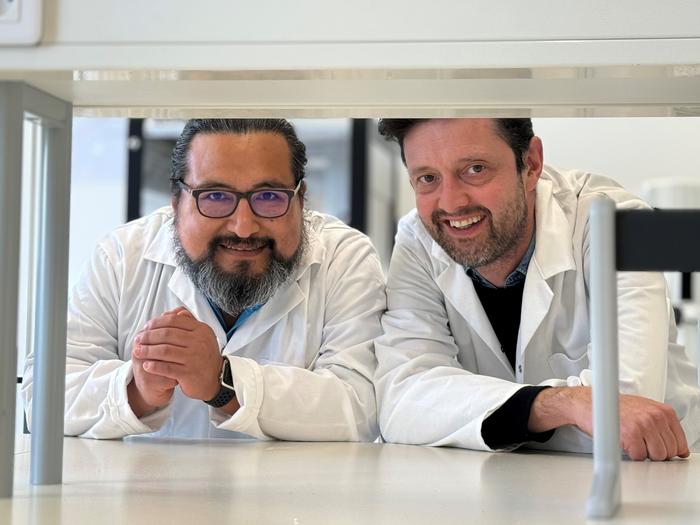
Credit: VIB
Leuven (Belgium) 30/04/2024 – For the first time, researchers from VIB-KU Leuven, UZ Leuven, Janssen Pharmaceutica and multiple international collaborators have introduced quantitative methods and extensive confounder control to discover microbiome biomarkers in colorectal cancer development. While multiple microbial taxa have been put forward as potential cancer-associated biomarkers in the past, this new study uncovers obscured contributions that may have resulted in incorrect associations. The results have been published in Nature Medicine.
Cancer microbiome research has taken significant strides over the past decade, leading to new insights into cancer-associated biomarkers. Despite numerous scientific advances, previous research has focused on non-quantitative, descriptive biomarker discovery methods. Research led by the VIB-KU Leuven Center for Microbiology, UZ Leuven, and Janssen Pharmaceutica, now shows the risks of adhering to these methods. In their latest publication, they take microbiome confounders and absolute quantification into account, with surprising results.
For this pioneering study, the researchers combined Quantitative Microbiome Profiling (QMP) with extensive patient phenotyping from a group of 589 patients at various stages of colorectal cancer. In addition, they reanalyzed the data from fifteen published studies encompassing a total of 4439 patients and controls. The study revealed that in absence of confounder control, the results are equivalent to those stated by the authors of the published cohorts. However, when confounder control and absolute quantitative methods are incorporated, some previously claimed microbial biomarker associations are revealed to be driven by other factors rather than cancer diagnosis.
This study shows we must separate the wheat from the chaff when studying cancer-associated biomarkers. By implementing confounder control and quantitative profiling, we were able to reveal potential misleading associations between microbial markers and colorectoral cancer development, for example driven by intestinal inflammation. – Professor Dr. Jeroen Raes, PI and Vice-Director at VIB-KU Leuven Center for Microbiology and Rega Institute, Faculty of Medicine, KU Leuven.
The study identifies transit time, faecal calprotectin, and BMI as primary microbial covariates, surpassing the variance explained by traditional CRC diagnostic groups. Surprisingly, well-established microbiome-CRC targets, such as Fusobacterium nucleatum, fail to significantly associate with CRC diagnostic groups when controlling for these covariates. Instead, the study underscores the robust associations of Anaerococcus vaginalis, Dialister pneumosintes, Parvimonas micra, Peptostreptococcus anaerobius, Porphyromonas asaccharolytica, and Prevotella intermedia with CRC, highlighting their potential as future targets for intervention.
This research underscores the importance of rigorous methodologies in unraveling complex disease-microbiome associations. Many of the discovered targets have been mostly ignored until now. – Raul Yhossef Tito-Tadeo, first author and postdoc at the Raes Lab.
Our results show the importance of rigorous patient phenotyping. Collecting all this extra data in a study is a tremendous amount of work, but worth the effort. – Sara Verbandt, Research Manager at the Digestive Oncology Group, KU Leuven.
The clinical implications of this study are important. There is an high need for fast, non-invasive colon cancer diagnostics. Current screening tools (e.g based on the presence of blood in stools) are not specific enough and require too many unnecessary colonoscopies, putting unnessecary burden on the heathcare system.
Fast, specific stool tests will allow a much larger number of individuals to be screened early, avoiding many unnecessary colon cancer deaths. - Professor Dr. Sabine Tejpar, Gastro-enterologist at UZ Leuven, head of the Digestive Oncology group, and professor at the Faculty of Medicine KU Leuven.
Journal
Nature Medicine
Method of Research
Meta-analysis
Subject of Research
Not applicable
Article Title
Microbiome confounders and quantitative profiling challenge predicted microbial targets in colorectal cancer development
Article Publication Date
30-Apr-2024
COI Statement
JA and JRE are employees of Janssen Pharmaceutica NV. JRA and RT are inventors on the patent application WO2017109059A1 in the name of VIB VZW, KATHOLIEKE UNIVERSITEIT LEUVEN, KU LEUVEN R&D, and UNIVERSITEIT GENT covering methods for detecting the presence or assessing the risk of development of inflammatory arthritis disease. JRA, SVS, and GF are inventors on the patent application PCT/EP2018/084920 in the name of VIB VZW, KATHOLIEKE UNIVERSITEIT LEUVEN, KU LEUVEN R&D, and VRIJE UNIVERSITEIT BRUSSEL covering microbiome features associated with inflammation described in Vieira-Silva et al. Nature Microbiology 2019. The remaining authors declare no competing interests
Cite Scienmag News
Nathaniel Bowman. (April 30, 2024). Microbiome researchers challenge the state of the art in colon cancer biomarker discovery. Scienmag. https://scienmag.com/microbiome-researchers-challenge-the-state-of-the-art-in-colon-cancer-biomarker-discovery/
Nathaniel Bowman. "Microbiome researchers challenge the state of the art in colon cancer biomarker discovery." Scienmag, 30 April 2024, https://scienmag.com/microbiome-researchers-challenge-the-state-of-the-art-in-colon-cancer-biomarker-discovery/. Accessed 3 September 2026.
Nathaniel Bowman. "Microbiome researchers challenge the state of the art in colon cancer biomarker discovery." Scienmag. April 30, 2024. https://scienmag.com/microbiome-researchers-challenge-the-state-of-the-art-in-colon-cancer-biomarker-discovery/

