


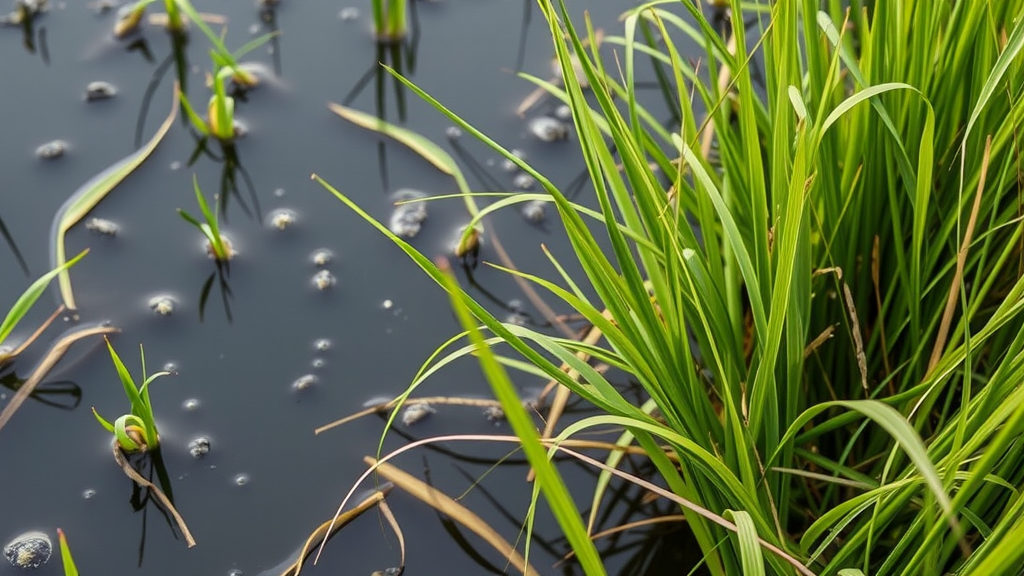
Along the tidal flats of coastal salt marshes, an unlikely arms race is unfolding beneath the mud. The invasive cordgrass Spartina anglica, a hybrid species that has colonized shorelines across Europe, Asia and beyond, is outcompeting its native relative Spartina maritima not through visible weaponry but through invisible infrastructure: the architecture of the microbial networks that surround its roots. A new study published in Microbial Ecology suggests that the secret to this plant’s extraordinary invasive success lies not in which microbes it recruits, but in how it wires them together.
The research, led by Yunshi Li and Gaosen Zhang of Shaanxi Xueqian Normal University and the Northwest Institute of Eco-Environment and Resources, together with colleagues in China and France, compared the rhizosphere microbial communities of the two Spartina species along gradients of environmental stress. Using 16S rRNA high-throughput sequencing and co-occurrence network analysis, the team mapped how bacterial and archaeal communities structured themselves around the roots of each plant at sites varying in distance from freshwater inputs. The findings point to a subtle but potentially decisive mechanism: topological reinforcement of microbial interaction networks, a process in which a plant actively reshapes the connectivity and complexity of its underground microbial society without changing who belongs to it.
Rhizosphere microbes are far more than passive hitchhikers on plant roots. They mediate nutrient cycling, buffer against salinity and heavy metals, suppress pathogens, and produce growth-promoting compounds. In salt marshes, where salinity, waterlogging and nutrient availability shift dramatically over short distances, the microbial community surrounding a plant’s roots can mean the difference between thriving and merely surviving. For decades, invasion biologists have debated whether invasive plants succeed by recruiting different microbes than natives do, by escaping their native soil enemies, or by cultivating a more favorable microbial entourage. The new study adds a crucial twist: perhaps the most important difference is not taxonomic at all, but structural.
The researchers sampled rhizosphere soils from S. anglica and the native S. maritima across locations spanning proximal sites near a freshwater stream to distal sites characterized by high abiotic stress, where salinity and other harsh conditions intensify. What they found was striking. At the level of species composition, the two plants told very different stories. S. anglica maintained remarkably stable rhizosphere microbial communities across all locations: no matter how stressful the environment, the taxonomic makeup of its root-associated microbes stayed largely consistent. S. maritima, by contrast, showed significant shifts in community composition in response to environmental variation, suggesting that its microbial partnerships were being reshuffled by the same pressures that S. anglica seemed to shrug off.
Yet the deeper surprise emerged when the team moved beyond simple taxonomic inventories and examined the topology of microbial co-occurrence networks, the mathematical webs that describe which groups of microbes tend to appear together, and how densely interconnected the resulting communities are. Despite keeping essentially the same cast of microbial characters, S. anglica adaptively rewired the relationships among them. At distal, highly stressed locations, the invasive plant’s rhizosphere networks exhibited significantly higher density, greater nodal connectivity and increased topological complexity compared with those at more benign sites. In plain terms, as conditions worsened, S. anglica did not replace its microbes; it knitted them more tightly together.
The native S. maritima moved in the opposite direction. Under identical high-stress conditions, its microbial networks suffered a substantial reduction in organizational stability and complexity, with connections thinning and the interaction architecture fraying. This divergence matters because network structure is increasingly understood to govern how microbial communities function under disturbance. Densely connected, modular networks tend to be more robust: if one link or node is perturbed, alternative pathways of interaction can compensate, maintaining ecosystem processes such as nitrogen cycling and organic matter decomposition. Sparse, fragile networks, on the other hand, can cascade into dysfunction when stress pushes them past a threshold.
The implications of this pattern are considerable. If S. anglica engineers a cooperative, resilient microbial interaction environment through topological reinforcement, it effectively builds a biological insurance policy underground, allowing the plant to maintain nutrient acquisition and stress tolerance even where the native species’ microbial support systems begin to collapse. The study’s authors are careful to frame this as a proposed mechanism: the evidence links invasive success with network rewiring, but they note that further studies across seasonal and temporal scales are needed to confirm the causal relationship. Coastal salt marshes are dynamic systems, and microbial networks may fluctuate across tides, seasons and years in ways a single spatial survey cannot fully capture.
Still, the conceptual shift the study proposes is significant. Much of invasion ecology has focused on species lists: which taxa are present, which are absent, and how communities differ. This work argues that structural organization, the pattern of interactions rather than the roster of participants, may be the true determinant of competitive superiority in dynamic coastal ecosystems. It echoes a broader movement in microbial ecology toward network-level thinking, in which the same principle has been invoked to explain everything from gut microbiome stability to the collapse of soil communities under drought. Applying that lens to plant invasion provides a new diagnostic tool: managers assessing invasion risk might one day read not just which microbes live in a soil, but how tightly woven the microbial fabric is.
Spartina anglica itself is a fitting subject for such a study. The species originated as a hybrid between the North American S. alterniflora and the European native S. maritima, and its hybrid vigor, combined with vigorous clonal growth and high salinity tolerance, has made it one of the world’s most successful salt marsh invaders. In many regions it has transformed mudflats into dense meadows, altering sediment dynamics, displacing native vegetation and reshaping habitat for birds and invertebrates. Understanding why it dominates so thoroughly has practical stakes: restoration programs seeking to reestablish native marsh communities must contend with an invader whose advantage may be rooted, literally, in the microbial world it cultivates.
The study also raises intriguing evolutionary questions. How does a plant manipulate the topology of a microbial network it cannot directly see or control? Root exudates, the chemical cocktail of sugars, organic acids and secondary metabolites that plants release into the soil, are one plausible lever, shaping which microbes flourish and how they interact. The team’s finding that S. anglica’s taxonomic community remained stable even as its network architecture changed suggests a finely tuned feedback system, one in which the plant maintains a consistent microbial partner pool while flexibly adjusting the interaction structure to match prevailing stress levels. Disentangling the chemical and genetic mechanisms behind that flexibility will be a natural next step for the field.
For now, the study stands as a vivid demonstration that ecological competition plays out in dimensions invisible to the naked eye. On the surface, two cordgrasses may appear to be simply vying for space and light in the same marsh. Below ground, one is rewiring a vast microbial web into a denser, more resilient configuration while the other’s web slackens under stress. If future work confirms that this topological reinforcement drives invasion, it could reshape how scientists think about plant dominance, how conservationists approach restoration in invaded marshes, and how microbial ecology is integrated into invasion biology. The roots of an invasion, it turns out, may be best understood not as a list of species but as a map of connections.
Subject of Research: Rhizosphere microbial network topology underlying the invasive success of Spartina anglica in coastal salt marshes
Article Title: Topological Reinforcement of Rhizosphere Microbial Networks Facilitates the Invasive Superiority of Spartina anglica
Article References: Li, Y., Michalet, R., Chen, Y., Yue, M., Da, L., Xie, H., Jiang, J., & Zhang, G. (2026). Topological Reinforcement of Rhizosphere Microbial Networks Facilitates the Invasive Superiority of Spartina anglica. Microbial Ecology. https://doi.org/10.1007/s00248-026-02883-3
Image Credits: AI Generated
DOI: 10.1007/s00248-026-02883-3
Keywords: Spartina anglica, plant invasion, rhizosphere microbiome, microbial networks, network topology, salt marshes, coastal ecosystems, microbial ecology, co-occurrence analysis, 16S rRNA sequencing, ecological resilience, invasive species
Cite Scienmag News
Morgan Morrow. (September 20, 2026). Microbial Network Rewiring Gives Invasive Marsh Grass Its Edge. Scienmag. https://scienmag.com/microbial-network-rewiring-gives-invasive-marsh-grass-its-edge/
Morgan Morrow. "Microbial Network Rewiring Gives Invasive Marsh Grass Its Edge." Scienmag, 20 September 2026, https://scienmag.com/microbial-network-rewiring-gives-invasive-marsh-grass-its-edge/. Accessed 4 October 2026.
Morgan Morrow. "Microbial Network Rewiring Gives Invasive Marsh Grass Its Edge." Scienmag. September 20, 2026. https://scienmag.com/microbial-network-rewiring-gives-invasive-marsh-grass-its-edge/


