


Space is one of the most hostile environments humanity has ever asked its machines to survive. Beyond the protective embrace of Earth’s atmosphere and magnetic field, high-energy particles stream continuously from the sun and from deep cosmic sources, and when those particles strike a semiconductor device, they can flip bits, degrade circuits or destroy them outright. As missions venture farther from Earth, beyond the relative safety of low Earth orbit, the electronics that spacecraft depend on for navigation, communication and scientific measurement become increasingly vulnerable. That vulnerability is now the target of a major new investment: Michigan State University has received a $20 million grant from the U.S. National Science Foundation to establish a shared-use research facility designed to accelerate the development and testing of semiconductor technologies built specifically for extreme environments.
The initiative, known as the Integrated Diamond and Carbon Research in Space Applications, or IDiCaRS, represents an unusual approach to a stubborn problem. Today, the development, manufacturing and severe-environment testing of radiation-hardened electronics typically occur at separate facilities, often in separate locations, forcing researchers to shuttle prototypes between sites and stretching development timelines considerably. IDiCaRS aims to collapse that fragmented pipeline by bringing an end-to-end research infrastructure under one roof: the growth and processing of diamond and related carbon materials, the fabrication of electronic devices from those materials, and radiation-effects testing using high-energy heavy-ion beams at the Facility for Rare Isotope Beams, or FRIB, located on the MSU campus.
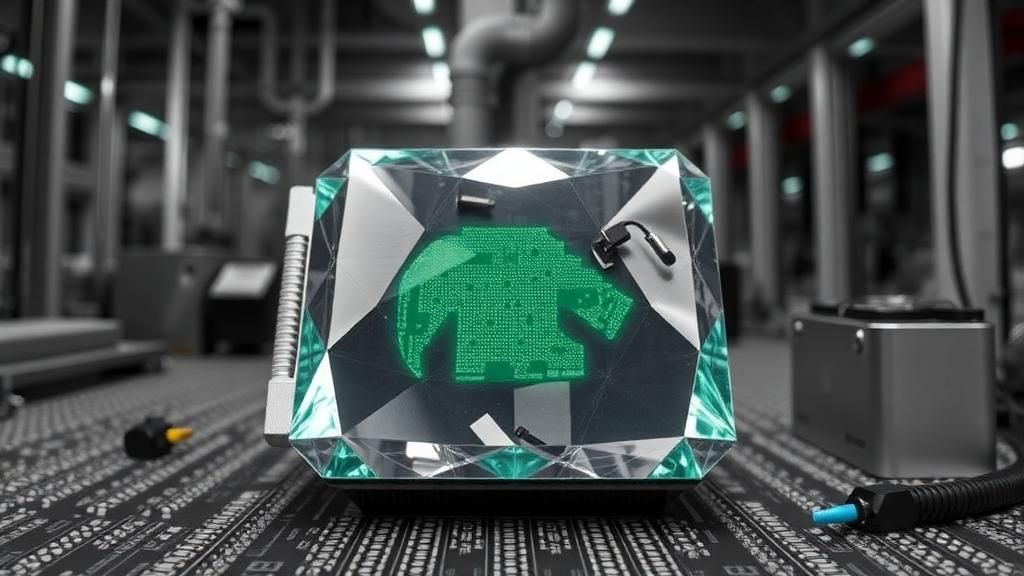
The choice of diamond as the flagship material is not accidental. Diamond possesses a unique combination of physical properties that make it exceptionally promising for space electronics. It conducts heat better than nearly any other material, which allows devices to dissipate the thermal loads that accumulate during operation. It resists high temperatures, tolerates intense radiation and withstands significant electrical stress, all qualities that conventional silicon struggles to match in harsh conditions. By establishing what project leaders describe as a first-of-its-kind diamond foundry, the facility will allow researchers to investigate these materials and devices in depth and generate systematic data about how they respond to extreme radiation and temperature regimes, data that is currently difficult and slow to obtain.
Wen Li, an MSU Research Foundation Distinguished Professor in the College of Engineering and executive director of Fraunhofer USA Center Midwest, is leading the effort. According to Li, the goal is to give researchers in space and automotive electronics a place to move more quickly from developing a material or device to testing how it performs under the harsh environmental conditions that can damage electronics in space. That speed matters. In the current landscape, a promising new radiation-tolerant material may take years to progress from laboratory synthesis to qualified flight hardware, in part because each stage of validation happens at a different institution with different equipment and protocols. By co-locating the full workflow, IDiCaRS intends to shorten development cycles and establish shared testing methodologies and qualification approaches for electronics intended for extreme environments.
The facility will not be built from scratch. It leverages existing MSU capabilities and partnerships, most notably FRIB, a DOE Office of Science user facility that accelerates heavy ions to energies capable of simulating decades of space radiation exposure in a matter of hours. It also draws on the MSU Space Electronics Initiative and the Fraunhofer USA Center Midwest, which has collaborated with the university on advanced diamond and carbon materials science for decades. Thomas Glasmacher, director of the FRIB Laboratory, said the laboratory is excited to bring its heavy-ion beam infrastructure to the IDiCaRS initiative to help expand MSU’s reach of cutting-edge research for extreme environments, adding that joining forces in advanced material science positions the partners to make a lasting impact on space exploration and semiconductor innovation while preparing the next generation of STEM leaders.
Industry and government leaders have framed the project as strategically significant well beyond the university. Thomas Schuelke, president of Fraunhofer USA and a professor in the College of Engineering, described the grant as the culmination of decades of collaborative research between MSU and Fraunhofer USA in advanced diamond and carbon materials science. What began as fundamental research partnerships, he noted, has evolved into a shared-use facility intended to accelerate the translation of next-generation semiconductor materials from the laboratory to the marketplace, strengthening America’s position in critical materials innovation. John Papapolymerou, dean of the College of Engineering and director of the MSU Space Electronics Initiative, emphasized that IDiCaRS will strengthen the university’s ability to bring together researchers, industry partners and advanced research capabilities to tackle some of the most important challenges facing space electronics and semiconductors.
The technical payoff could be transformative for spacecraft design. More radiation-resistant and thermally capable semiconductor technologies could reduce the need for the heavy shielding and redundant systems that current spacecraft must carry to protect conventional silicon electronics. Every kilogram of shielding is a kilogram that cannot be devoted to scientific instruments, fuel or payload capacity, so electronics that survive radiation natively could enable future missions to fly smaller, lighter and more efficient systems with advanced capabilities. The implications extend beyond space exploration as well. Research conducted at IDiCaRS could contribute to high-power electronics and next-generation communications technologies used on Earth and in orbit, from electric-vehicle power systems that already demand extreme-environment semiconductors to the growing constellation of satellites that form the backbone of global connectivity.
The project also carries an explicit workforce mission, one that Michigan’s elected officials have highlighted as central to the state’s economic future. IDiCaRS will create hands-on education and training opportunities for students, including access to advanced research facilities and specialized equipment used in semiconductor manufacturing and radiation testing. Plans include updated undergraduate and graduate coursework, a graduate certificate and an undergraduate minor related to the facility’s research areas, along with space electronics programs for middle and high school students and opportunities for community college students. U.S. Sen. Gary Peters noted that semiconductors power many of the products Michigan excels at making and that the federal investment will help MSU bring key university, government and industry partners together to accelerate deployment of cutting-edge semiconductor technologies. U.S. Rep. Haley Stevens added that Michigan students will have opportunities to learn and work with technologies pushing the boundaries of space exploration, quantum technologies and semiconductor manufacturing.
The broader context is a national push to shore up the domestic semiconductor ecosystem at a moment when chips have become as strategically important as energy or food. Advanced wide-bandgap materials such as diamond sit at the frontier of that effort, promising devices that operate at higher voltages, higher temperatures and higher frequencies than silicon allows. By pairing materials discovery with device fabrication and world-class radiation testing in a single shared facility, IDiCaRS is designed to serve researchers from academia, industry and government, creating a common resource for advancing technologies built to operate where ordinary electronics fail. Ultimately, the initiative is intended to accelerate the development and testing of electronics that can withstand extreme environments while strengthening the infrastructure, technologies and workforce needed for the future of space exploration and advanced manufacturing, a bet that the next generation of machines, whether bound for the outer planets or the factory floor, will be built on carbon.
Subject of Research: A $20 million NSF-funded shared-use facility at Michigan State University for developing and radiation-testing diamond and carbon-based semiconductor electronics for space applications
Article Title: Building for the future of space and semiconductors
Article References: Building for the future of space and semiconductors. (n.d.). Original publication
Image Credits: AI Generated
DOI: Not provided
Keywords: space electronics, semiconductors, diamond materials, radiation testing, Michigan State University, National Science Foundation, Facility for Rare Isotope Beams, Fraunhofer USA, extreme environments, workforce development, advanced manufacturing, spacecraft technology
Cite Scienmag News
Denise Maddox. (October 4, 2026). Michigan State Wins $20 Million NSF Grant to Build Diamond Foundry for Space-Ready Electronics. Scienmag. https://scienmag.com/michigan-state-wins-20-million-nsf-grant-to-build-diamond-foundry-for-space-ready-electronics/
Denise Maddox. "Michigan State Wins $20 Million NSF Grant to Build Diamond Foundry for Space-Ready Electronics." Scienmag, 4 October 2026, https://scienmag.com/michigan-state-wins-20-million-nsf-grant-to-build-diamond-foundry-for-space-ready-electronics/. Accessed 4 October 2026.
Denise Maddox. "Michigan State Wins $20 Million NSF Grant to Build Diamond Foundry for Space-Ready Electronics." Scienmag. October 4, 2026. https://scienmag.com/michigan-state-wins-20-million-nsf-grant-to-build-diamond-foundry-for-space-ready-electronics/


