


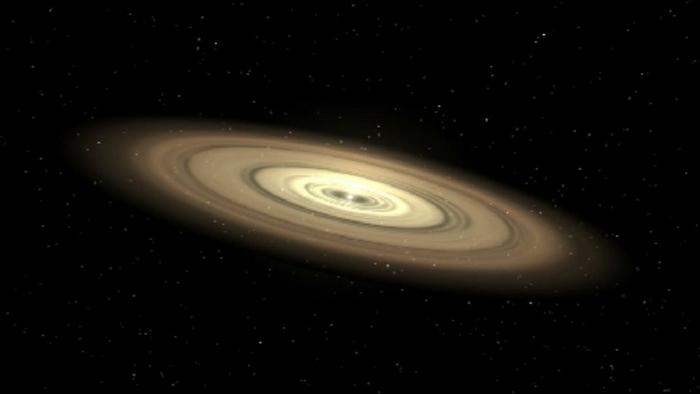
An international team of 45 researchers studying meteor showers has found that not all comets crumble the same way when they approach the Sun. In a paper published in the journal Icarus this week, they ascribe the differences to the conditions in the protoplanetary disk where comets formed 4.5 billion years ago.

Credit: NASA/JPL-Caltech
An international team of 45 researchers studying meteor showers has found that not all comets crumble the same way when they approach the Sun. In a paper published in the journal Icarus this week, they ascribe the differences to the conditions in the protoplanetary disk where comets formed 4.5 billion years ago.
“The meteoroids we see as meteors in the night sky are the size of small pebbles,” said lead author and SETI Institute and NASA Ames meteor astronomer Peter Jenniskens. “They are, in fact, the same size as the pebbles that collapsed into comets during the formation of our solar system.”
As our solar system formed, tiny particles in the disk around the young Sun gradually grew larger until they became the size of small pebbles.
“Once pebbles grow large enough to no longer travel along with the gas, they are destroyed by mutual collisions before they can grow much bigger,” said NASA Ames planetary scientist and co-author Paul Estrada. “Comets and primitive asteroids instead were formed when clouds of these pebbles locally collapsed into kilometer-sized and larger bodies.” /p>
Fast forward 4.5 billion years: when comets approach the Sun today, they crumble into smaller pieces called meteoroids. Those meteoroids co-orbit with the comet for a while and can later create meteor showers when they hit Earth’s atmosphere.
“We hypothesized that comets crumble into the sizes of the pebbles they are made of,” said Jenniskens. “In that case, the size distribution and the physical and chemical properties of young meteoroid streams still contain information about the conditions in the protoplanetary disk during this collapse.”
Jenniskens and his team of professional and amateur astronomers use special low-light video cameras in networks all over the world to track meteors in a NASA-sponsored project called “CAMS” – or Cameras for Allsky Meteor Surveillance (http://cams.seti.org).
“These cameras measure the meteoroids’ paths, how high they are when they first light up, and how they slow down in Earth’s atmosphere,” said Jenniskens. “Specialized cameras measured the composition of some of these meteoroids.”
The team studied 47 young meteor showers. Most are the crumbs of two types of comets: Jupiter-family comets from the Scattered Disk of the Kuiper Belt beyond Neptune and long-period comets from the Oort Cloud surrounding our solar system. Long-period comets move on much wider orbits than the Jupiter-family comets and are much more loosely held by the Sun’s gravity.
“We found that long-period (Oort Cloud) comets often crumble into sizes indicative of gentle accretion conditions,” said Jenniskens. “Their meteoroids have a low density. The meteoroid streams contain a fairly constant 4% of a type of solid meteoroids that were heated in the past and now only brighten deeper in Earth’s atmosphere and typically are poor in the element sodium.”
On the other hand, Jupiter-family comets usually crumble into smaller, denser meteoroids. They also have a higher 8% of solid materials on average and show more diversity in that content.
“We concluded that these Jupiter-family comets are composed of pebbles that had reached the point where fragmentation became important in their size evolution,” said Estrada. “The higher admixture of materials that were heated in the past are expected closer to the Sun.”
Primitive asteroids formed even closer to the Sun, although still outside the orbit of Jupiter. These asteroids produce meteor showers with even smaller particles, showing their pebble building blocks experienced even more aggressive fragmentation.
“While there are exceptions in both groups, the implication is that most long-period comets formed under more gentle particle growth conditions, possibly near the 30 AU edge of the Trans Neptunian Disk,” said Estrada. “Most Jupiter family comets formed closer to the Sun where pebbles reached or passed the fragmentation barrier, while primitive asteroids formed in the region where the cores of the giant planets formed.”
How is this possible? While the giant planets were growing, Neptune moved outward and scattered comets and asteroids out of the remaining protoplanetary disk. This outward movement likely created both the Scattered Disk of the Kuiper Belt and the Oort Cloud. That would predict that both long period and Jupiter-family comets have the same properties, but the team found otherwise.
“It is possible that stars and molecular clouds in the birth region of the Sun perturbed the wide orbits of Oort Cloud comets early on, and the long-period comets we see today were scattered into such orbits only at a time when the Sun had moved out of this region,” said Jenniskens. “In contrast, Jupiter-family comets have always been on shorter orbits and sample all objects scattered by Neptune on its way out.”
About the SETI Institute
Founded in 1984, the SETI Institute is a non-profit, multi-disciplinary research and education organization whose mission is to lead humanity’s quest to understand the origins and prevalence of life and intelligence in the Universe and to share that knowledge with the world. Our research encompasses the physical and biological sciences and leverages expertise in data analytics, machine learning and advanced signal detection technologies. The SETI Institute is a distinguished research partner for industry, academia and government agencies, including NASA and NSF.
Contact information
Rebecca McDonald
Director of Communications
SETI Institute
rmcdonald@seti.org
Journal
Icarus
Cite Scienmag News
Grant Pearson. (August 22, 2024). Meteor showers shed light on where comets formed in the early solar system. Scienmag. https://scienmag.com/meteor-showers-shed-light-on-where-comets-formed-in-the-early-solar-system/
Grant Pearson. "Meteor showers shed light on where comets formed in the early solar system." Scienmag, 22 August 2024, https://scienmag.com/meteor-showers-shed-light-on-where-comets-formed-in-the-early-solar-system/. Accessed 5 September 2026.
Grant Pearson. "Meteor showers shed light on where comets formed in the early solar system." Scienmag. August 22, 2024. https://scienmag.com/meteor-showers-shed-light-on-where-comets-formed-in-the-early-solar-system/

