


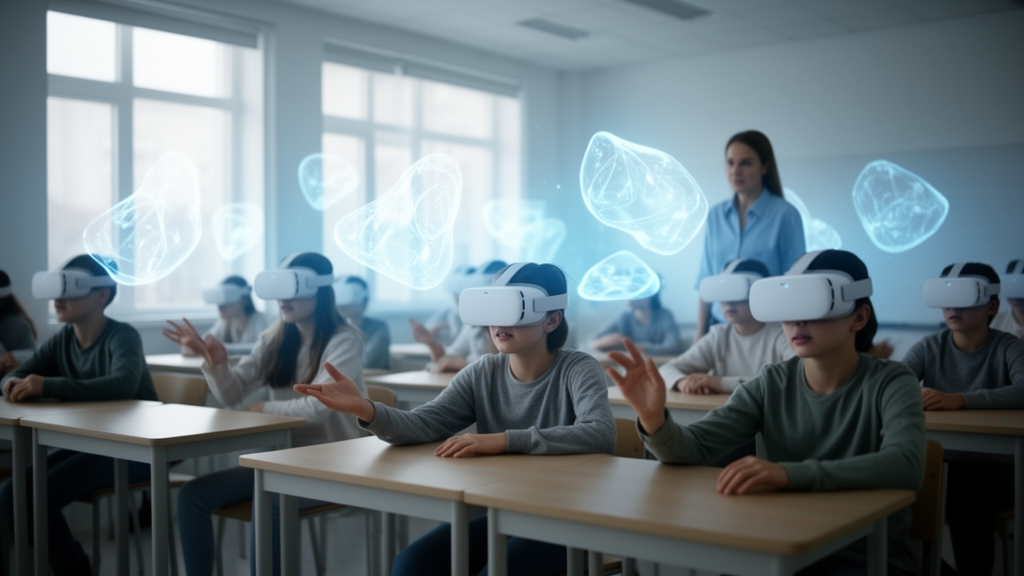
Immersive digital education is advancing at remarkable speed, but according to a new scoping review, the technology is running well ahead of the evidence needed to prove it actually works. The study, published in Frontiers in Blockchain, systematically maps how researchers around the world have combined Metaverse technologies with generative artificial intelligence (GenAI) to build the classrooms, laboratories, and training environments of the near future. The result is both a celebration of rapid innovation and a sober warning that educational science has not kept pace with engineering ambition.
The research team followed the PRISMA Extension for Scoping Reviews, a rigorous reporting framework designed to make literature syntheses transparent and reproducible. Searching five major databases—ACM Digital Library, IEEE Xplore, Scopus, ScienceDirect, and SpringerLink—the authors identified 114 primary studies published or indexed between January 2022 and the database search dates in 2026. That window captures the explosive period following the public debut of large language models, when generative AI moved from research curiosity to everyday tool, and when affordable virtual reality headsets brought immersive environments within reach of ordinary schools and universities.
To make sense of such a fast-moving field, the researchers constructed a comprehensive taxonomy that classifies every study along multiple dimensions: application domains, Metaverse technologies, categories of generative AI, target user groups, degrees of freedom in the virtual environments, pedagogical foundations, evaluation practices, technical limitations, and future research directions. Taxonomies of this kind serve a practical purpose. They allow researchers to see at a glance which corners of the field are crowded with activity and which remain nearly empty, and they give designers a shared vocabulary for comparing systems that would otherwise be difficult to compare at all.
The headline numbers reveal a field with clear centers of gravity. Virtual reality dominates the immersive modality landscape, appearing in 61 percent of the reviewed studies, while augmented and mixed reality approaches play supporting roles. On the AI side, OpenAI-based models power 60 percent of the systems, making that single ecosystem the backbone of most GenAI-enabled educational prototypes. Applications cluster heavily in STEM education, higher education, and healthcare training, domains where complex, three-dimensional, and risk-laden subject matter naturally rewards simulation. Anatomy students can walk through a beating heart; engineering students can disassemble a virtual turbine; nursing students can practice emergency procedures without real-world consequences.
Within these immersive environments, generative AI increasingly plays the role of an intelligent collaborator. The review documents a consistent pattern of intelligent tutoring systems that converse with learners, adaptive feedback mechanisms that adjust difficulty in real time, virtual agents that role-play patients or historical figures, and automated content generation that builds scenarios on demand. The combination is conceptually powerful: the Metaverse supplies the embodied, spatial context in which learning happens, while generative models supply the linguistic and creative flexibility that static simulations have always lacked. A virtual patient can now answer unexpected questions; a virtual laboratory can generate new experiments on request.
Yet the evaluation picture tells a more troubling story. A full 68 percent of the studies—77 of the 114 articles—reported some form of user perceptual evaluation, typically measuring usability, presence, engagement, or user satisfaction over short sessions. These are useful metrics, but they capture only the shallowest layer of educational value. Comparatively few studies examined longitudinal learning effectiveness, knowledge retention over weeks or months, deeper cognitive outcomes, the trustworthiness of the AI components, accessibility for learners with disabilities, inclusivity across diverse populations, or performance in real-world deployment outside the laboratory. In other words, researchers know a great deal about whether students enjoy these systems and little about whether students actually learn from them durably.
The authors describe this imbalance as a central maturity gap: technological sophistication is advancing faster than the educational evidence needed to establish sustained learning effectiveness and real-world readiness. The gap matters because immersive AI-driven education carries real risks. Generative models can produce plausible but incorrect explanations, and a learner immersed in a convincing virtual environment may have fewer external cues to detect errors. Systems that measure engagement may inadvertently optimize for entertainment rather than understanding. Without longitudinal and pedagogically grounded evaluation, the field risks building ever more impressive scaffolding on untested foundations.
The review also catalogs the practical challenges that recur across the literature. Limited empirical validation tops the list, followed by system maturity, scalability, and interoperability—the persistent difficulty of getting virtual environments, AI services, and institutional infrastructure to work together across platforms. Immersive performance remains a constraint, since rendering rich 3D worlds while running large language models in real time strains both hardware and networks. Accessibility and ethical governance round out the concerns, encompassing questions of data privacy, algorithmic bias, equitable access to expensive hardware, and the psychological effects of prolonged immersion.
From this synthesis, the researchers distill a set of priorities for the field’s next phase. They call for longitudinal and pedagogically grounded evaluation that tracks learning outcomes over semesters rather than sessions, and for scalable, interoperable system architectures that do not lock educators into proprietary ecosystems. Trustworthy AI emerges as a core requirement, encompassing transparency, reliability, and appropriate oversight of generative components. The authors further urge inclusive and ecologically valid validation—testing systems with diverse learners in authentic educational settings rather than homogeneous volunteer samples—and stronger integration of pedagogical theory and governance considerations from the earliest design stages rather than as afterthoughts.
The proposed taxonomy itself may prove to be the study’s most durable contribution. By providing an evidence-based framework for classifying Metaverse and GenAI-enabled educational systems, it gives future researchers a map of what has been done, a measure of what has been neglected, and a common structure for comparative analysis. As schools and universities continue to experiment with virtual campuses and AI tutors, the review’s central message stands out: the tools are arriving faster than the proof, and closing that gap will require the same rigor and patience that education has always demanded.
Subject of Research: A scoping review of Metaverse and generative AI applications in education
Article Title: Metaverse and generative AI in education: a scoping review of technologies, applications, evaluation, challenges, and future directions
Article References: Tukur, M., Elsharif, W., Bello, A. S., Salami, B. A., Ibrahim, I. A., Househ, M., Schneider, J., Mikros, G., & Agus, M. (2026). Metaverse and generative AI in education: a scoping review of technologies, applications, evaluation, challenges, and future directions. Frontiers in Blockchain, 9, Article 1860582. https://doi.org/10.3389/fbloc.2026.1860582
Image Credits: AI Generated
DOI: 10.3389/fbloc.2026.1860582
Keywords: Metaverse, generative AI, education, virtual reality, scoping review, intelligent tutoring, learning outcomes, evaluation, accessibility, interoperability, STEM education, healthcare training
Cite Scienmag News
Courtney Benton. (October 16, 2026). Metaverse Classrooms Meet Generative AI, but the Evidence Lags Behind the Hype. Scienmag. https://scienmag.com/metaverse-classrooms-meet-generative-ai-but-the-evidence-lags-behind-the-hype/
Courtney Benton. "Metaverse Classrooms Meet Generative AI, but the Evidence Lags Behind the Hype." Scienmag, 16 October 2026, https://scienmag.com/metaverse-classrooms-meet-generative-ai-but-the-evidence-lags-behind-the-hype/. Accessed 16 October 2026.
Courtney Benton. "Metaverse Classrooms Meet Generative AI, but the Evidence Lags Behind the Hype." Scienmag. October 16, 2026. https://scienmag.com/metaverse-classrooms-meet-generative-ai-but-the-evidence-lags-behind-the-hype/


