


The energy density of supercapacitors – battery-like devices that can charge in seconds or a few minutes – can be improved by increasing the ‘messiness’ of their internal structure.

Credit: Nathan Pitt
The energy density of supercapacitors – battery-like devices that can charge in seconds or a few minutes – can be improved by increasing the ‘messiness’ of their internal structure.
Researchers led by the University of Cambridge used experimental and computer modelling techniques to study the porous carbon electrodes used in supercapacitors. They found that electrodes with a more disordered chemical structure stored far more energy than electrodes with a highly ordered structure.
Supercapacitors are a key technology for the energy transition and could be useful for certain forms of public transport, as well as for managing intermittent solar and wind energy generation, but their adoption has been limited by poor energy density.
The researchers say their results, reported in the journal Science, represent a breakthrough in the field and could reinvigorate the development of this important net-zero technology.
Like batteries, supercapacitors store energy, but supercapacitors can charge in seconds or a few minutes, while batteries take much longer. Supercapacitors are far more durable than batteries, and can last for millions of charge cycles. However, the low energy density of supercapacitors makes them unsuitable for delivering long-term energy storage or continuous power.
“Supercapacitors are a complementary technology to batteries, rather than a replacement,” said Dr Alex Forse from Cambridge’s Yusuf Hamied Department of Chemistry, who led the research. “Their durability and extremely fast charging capabilities make them useful for a wide range of applications.”
A bus, train or metro powered by supercapacitors, for example, could fully charge in the time it takes to let passengers off and on, providing it with enough power to reach the next stop. This would eliminate the need to install any charging infrastructure along the line. However, before supercapacitors are put into widespread use, their energy storage capacity needs to be improved.
While a battery uses chemical reactions to store and release charge, a supercapacitor relies on the movement of charged molecules between porous carbon electrodes, which have a highly disordered structure. “Think of a sheet of graphene, which has a highly ordered chemical structure,” said Forse. “If you scrunch up that sheet of graphene into a ball, you have a disordered mess, which is sort of like the electrode in a supercapacitor.”
Because of the inherent messiness of the electrodes, it’s been difficult for scientists to study them and determine which parameters are the most important when attempting to improve performance. This lack of clear consensus has led to the field getting a bit stuck.
Many scientists have thought that the size of the tiny holes, or nanopores, in the carbon electrodes was the key to improved energy capacity. However, the Cambridge team analysed a series of commercially available nanoporous carbon electrodes and found there was no link between pore size and storage capacity.
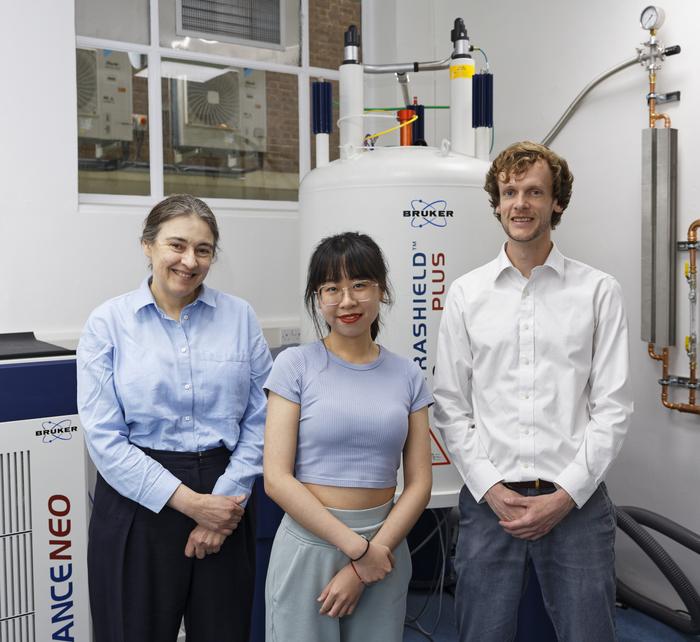
Forse and his colleagues took a new approach and used nuclear magnetic resonance (NMR) spectroscopy – a sort of ‘MRI’ for batteries – to study the electrode materials. They found that the messiness of the materials – long thought to be a hindrance – was in fact the key to their success.
“Using NMR spectroscopy, we found that energy storage capacity correlates with how disordered the materials are – the more disordered materials are able to store more energy,” said first author Xinyu Liu, a PhD candidate co-supervised by Forse and Professor Dame Clare Grey. “Messiness is something that’s hard to measure – it’s only possible thanks to new NMR and simulation techniques, which is why messiness is a characteristic that’s been overlooked in this field.”
When analysing the electrode materials with NMR spectroscopy, a spectrum with different peaks and valleys is produced. The position of the peak indicates how ordered or disordered the carbon is. “It wasn’t our plan to look for this, it was a big surprise,” said Forse. “When we plotted the position of the peak against energy capacity, a striking correlation came through – the most disordered materials had a capacity almost double that of the most ordered materials.”
So why is mess good? Forse says that’s the next thing the team is working on. More disordered carbons store ions more efficiently in their nanopores, and the team are hoping to use these results to design better supercapacitors. The messiness of the materials is determined at the point they are synthesised.
“We want to look at new ways of making these materials, to see how far messiness can take you in terms of improving energy storage,” said Forse. “It could be a turning point for a field that’s been stuck for a little while. Clare and I started working on this topic over a decade ago, and it’s exciting to see a lot of our previous fundamental work now having a clear application.”
The research was supported in part by the Cambridge Trusts, the European Research Council, and UK Research and Innovation (UKRI).
Journal
Science
Article Title
Structural disorder determines capacitance in nanoporous carbons
Article Publication Date
19-Apr-2024
Cite Scienmag News
Faith Mcneil. (April 18, 2024). Mess is best: disordered structure of battery-like devices improves performance. Scienmag. https://scienmag.com/mess-is-best-disordered-structure-of-battery-like-devices-improves-performance/
Faith Mcneil. "Mess is best: disordered structure of battery-like devices improves performance." Scienmag, 18 April 2024, https://scienmag.com/mess-is-best-disordered-structure-of-battery-like-devices-improves-performance/. Accessed 7 September 2026.
Faith Mcneil. "Mess is best: disordered structure of battery-like devices improves performance." Scienmag. April 18, 2024. https://scienmag.com/mess-is-best-disordered-structure-of-battery-like-devices-improves-performance/

