


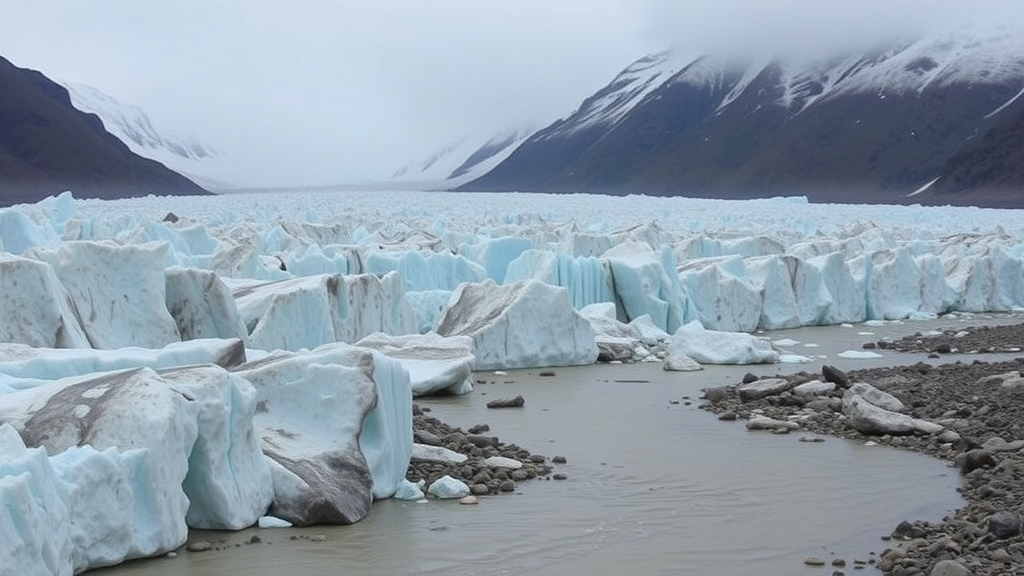
High in the western Himalayas, a quiet transformation is underway that scientists say could shape the region’s disaster risk for decades to come. A new satellite-based study has documented dozens of glacial lakes forming across northern India over the past three decades, while lakes that already existed have expanded at a striking pace. The findings, published in the international journal Open Geosciences, arrive at a sobering moment: as recovery operations continue in Nepal following catastrophic flooding that struck the country on 26 August 2026, researchers warn that the same high-mountain dynamics that make sudden floods so destructive are intensifying across the Himalayan arc as glacier ice melts.
The research, titled ‘Alarming trends: rapidly growing and recently formed glacial lakes in the Alaknanda Basin, northern Indian Himalayas,’ was conducted by Dr Aayushi Pandey of Charles University in Prague, Czech Republic. It focused on the Alaknanda Basin, a heavily glaciated catchment in the western Himalayas of India whose waters ultimately feed some of the most densely populated river systems on Earth. Using space-based observations from the Landsat and Sentinel-2 satellite missions, the study mapped changes in 74 glacial lakes across the basin between 1994 and 2023, producing one of the most detailed long-term pictures yet of how this high-altitude landscape is being reshaped by a warming climate.
The numbers reveal how quickly the transformation is unfolding. The combined area of 24 glacial lakes larger than 0.01 square kilometres – a low cut-off threshold used in the methodology to exclude small seasonal water bodies – grew from 0.97 square kilometres in 1994 to 1.62 square kilometres in 2023. That represents an increase of 67 percent in just 30 years, a remarkable rate of change for landscape features that were once considered permanent fixtures of the high mountains. Each additional hectare of lake surface represents water pooled behind natural barriers of ice, rock or sediment, sometimes in precarious positions on steep slopes.
Equally significant is the discovery that the phenomenon is not limited to existing lakes simply getting bigger. The study identified 57 new glacial lakes that formed during the three-decade study period, bringing the total number of lakes in the basin to 131. Of these newly formed water bodies, 18 exceeded the 0.01 square kilometre threshold, meaning they are large enough to pose meaningful hazards if they were to fail. The emergence of so many new lakes in a single basin illustrates how rapidly retreating glaciers are leaving behind depressions that fill with meltwater, effectively creating new reservoirs in some of the most inaccessible terrain on the planet.
Some individual lakes have grown at rates that demand particular attention. Vasundhara Lake expanded by 261 percent between 1994 and 2023, nearly quadrupling in surface area over the study period, while Balbala Lake grew by 119 percent. The research also flagged 27 glacial lakes showing notable growth, including one situated upstream of Badrinath, one of the most important pilgrimage sites in the Indian Himalayas, which draws enormous seasonal crowds of visitors. The author singles out the very rapid expansion of Vasundhara Lake as requiring close attention, noting that these lakes warrant continued monitoring and further assessment because changes in their size and stability could have serious consequences for communities and infrastructure downstream.
The hazard in question is known as a Glacial Lake Outburst Flood, or GLOF. These events occur when water held back by ice, rock or sediment is suddenly released, sending a torrent of water, mud and debris down narrow mountain valleys with potentially devastating force. Because glacial lakes often sit at high elevations above villages, roads, bridges and hydropower installations, even a modest volume of released water can gain destructive momentum as it descends. The mechanisms of failure can include avalanches of ice or rock plunging into a lake, the collapse of moraine dams, or the sudden drainage of ice-dammed water bodies, and in many cases there is little or no warning for people living downstream.
While the recent disaster in Nepal was not itself a conventional GLOF, it demonstrates the extraordinary consequences that sudden high-mountain flood events can inflict on communities and infrastructure. Nepal’s government reports that the August floods caused widespread damage to houses, roads, bridges and hydropower facilities, and recovery efforts are still ongoing. The episode serves as a stark illustration of how vulnerable Himalayan societies remain to water-related hazards originating in remote high-altitude terrain, and why scientists argue that understanding the evolving glacial lake landscape is a matter of urgent practical importance rather than purely academic interest.
‘The recent flooding is a reminder of how important it is to continuously monitor high-mountain environments where multiple hazards including extreme rainfall, glacial lake expansion, slope instability and seismic activity can interact and potentially amplify downstream impacts,’ says study author Dr Aayushi Pandey. Her point underscores a growing recognition among hazard researchers that mountain disasters rarely stem from a single cause. Instead, compound and cascading hazards – a heavy rainfall event striking a slope already destabilised by melting permafrost, for example, or an avalanche dumping into an expanded glacial lake – can multiply the risks faced by downstream populations in ways that individual hazard assessments may miss.
Satellite data, Pandey notes, are extremely valuable for screening such a large and inaccessible region. ‘They allow us to identify newly formed lakes, measure changes in lake area, identify rapidly expanding lakes and shortlist those that need detailed investigation,’ she says. ‘But that’s not the complete solution. Field measurements are essential to determine lake depth and volume, assess slope stability, understand drainage pathways and glacier–lake interactions, and improve flood modelling.’ In other words, remote sensing can tell researchers where to look, but only ground-based work can reveal how much water a lake actually holds, how stable its dam is, and what would happen if it failed – the information needed to build reliable early warning systems and flood models.
That fieldwork, however, comes at a cost. Pandey emphasises that it requires substantial logistical and financial support, including stronger transboundary scientific cooperation and data sharing, because glacial-lake and flood hazards do not follow political boundaries and should be addressed as a shared regional concern. The Himalayas span multiple countries, and rivers fed by these mountains sustain hundreds of millions of people across South Asia. As the new study of the Alaknanda Basin makes clear, the pace of change on the ground – and on the ice – is outstripping the pace of monitoring. Whether the region’s growing inventory of glacial lakes becomes a catalogue of near misses or a series of future disasters may depend on how quickly that gap is closed.
Subject of Research: Satellite-based monitoring of newly formed and rapidly expanding glacial lakes in the Alaknanda Basin of the northern Indian Himalayas and their associated outburst flood risk.
Article Title: Himalayan glacial lakes are growing – and so is the downstream flood risk
Article References: Himalayan glacial lakes are growing – and so is the downstream flood risk. (n.d.). Original publication
Image Credits: AI Generated
DOI: Not provided
Keywords: glacial lakes, Himalayas, glacial lake outburst floods, climate change, Alaknanda Basin, satellite monitoring, Landsat, Sentinel-2, glacier retreat, flood risk, Open Geosciences, northern India
Cite Scienmag News
Violet Maxwell. (September 12, 2026). Melting Himalayan Glaciers Are Quietly Building a Flood Threat Downstream. Scienmag. https://scienmag.com/melting-himalayan-glaciers-are-quietly-building-a-flood-threat-downstream/
Violet Maxwell. "Melting Himalayan Glaciers Are Quietly Building a Flood Threat Downstream." Scienmag, 12 September 2026, https://scienmag.com/melting-himalayan-glaciers-are-quietly-building-a-flood-threat-downstream/. Accessed 5 October 2026.
Violet Maxwell. "Melting Himalayan Glaciers Are Quietly Building a Flood Threat Downstream." Scienmag. September 12, 2026. https://scienmag.com/melting-himalayan-glaciers-are-quietly-building-a-flood-threat-downstream/


